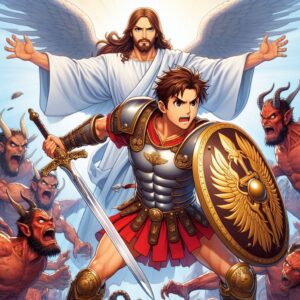

It seemed like it happened overnight. One day, in early 2023, I got a weird Facebook ad that showed this face made of 1s and 0s saying “I can bring your weirdest ideas to life” followed by a display of someone writing a prompt “Mario charged with war crimes”, and after the prompt was written, it displayed several images of, well, Mario from the Super Mario franchise in a federal court, set to a musical track from Bleach. I thought it was utter poppycock! There’s no way you can make full-blown images just by typing a description into a text box and clicking a button. Turns out, it wasn’t a scam. Overnight, AI seemed to become a thing. It was not here in 2022, and in 2023 it exploded. And over the past couple of years, it has been evolving at an incredibly rapid pace. I was excited about it at first. Sure, I saw the potential for abuse, but we humans have used everything we’ve ever invented for both good and evil. But now I’m beginning to wonder if it will be net positive for mankind.
Since AI is likely not going anywhere anytime soon, and since I’ve obviously been using AI to make thumbnails, I have decided to be up front with my readers about precisely how I will and will not be using AI to make content going forward.
I Will NOT –
1: Use a Chat Bot to generate an entire blog post for me.
Nevermind the fact that essays that are entirely, 100% AI generated are incredibly easy to spot just by reading it yourself, if you can’t tell, you can run it through a checker to test to see whether it was AI generated. Now, I’m not completely confident in these AI Essay detectors as there have been a lot of false positives. But there are certainly tell tale signs of AI. But if that wasn’t reason enough for me to resist the temptation to make fast and easy content, it would completely render all the reading and research I do in order to be informed enough to write on the topics that I do completely irrelevant. And if I tell the AI to write an essay on something I haven’t studied enough on, then I won’t be learned enough to respond to follow-up questions about it. Finally, I LIKE writing! I actually enjoy opening up my computer, pulling up WordPress, and typing my thoughts out. There is something oddly therapudic about the sound of the clicking and clacking of the keyboard, the feel of the keys under my fingers, and the battle to keep my cat off of my keyboard to keep me from fjdifjdigjgokeie2eu9233. I love having Logos Bible Software open and going through my notes, commentaries, and the biblical text, and copy/pasting scholarly quotes and biblical quotes into the WordPress editor. Sometimes I put Lofi music on to help me focus. And I feel so satisfied when I am done with the rough draft, and I am ready to just read over what I have written to see my thoughts flow seamlessly, catching any spelling or grammatical errors I might have made before publishing it. Yes, I do proofread my stuff. I’m just bad at it! I would NEVER, EVER have AI write an entire piece for me. Doing so would rob me of the very joy that writing brings me. When you read articles here at Cerebral Faith, you can rest assured that they’re either mine or a guest blogger’s thoughts.
2: I Will Never Make A Fake Podcast
If or when I ever do another podcast, I will record my own voice talking into the mic. And there will be real conversations with me and other real people. I will never use AI voice generating software (e.g Eleven Lab, Murf AI, Fish AI, et. al.) to manufacture a fake conversation, fake interviews. You can rest assured that if I return to podcasting some day, they will be as real and as authentic as the 170 episodes of The Cerebral Faith Podcast are.
I Will
1: Use AI Images For Thumbnails
You’ve probably already figured that out by now. Some people hate AI-produced things in all of its forms no matter how its used. They’re just anti-AI, plain and simple. But for me, I am not opposed to writing prompts and making AI images for thumbnails of blog posts or podcast episodes. Even if I did have artistic talent, I would really only use these images for just the articles I upload them to. In the old days, I had to search through Pixabay, Pexels, and other Public Domain Images to find non-copyrighted images to use as my blog thumbnails. And if you’ve written as copiously as I have, it can get hard after a while to find images that you either haven’t already used, or look too similar to images you’ve already used. Not only are AI images copyright-free, but based on my knowledge of the law, they cannot be copyrighted even if I wanted to claim ownership of them since a human didn’t make them. And I get to be really clever, such as in my blog post “‘He Appeared’ – The Problem Of Vagueness With Minimal Facts”, I had Bing’s AI image generator make an image of the disciples looking at Jesus on a faraway hill, for example.
2: Use AI Voices For Audio Versions Of The Articles
While I won’t use AI voices to manufacture a podcast, audio versions of my written content are different. At the time of writing this, I’m currently in the process of making audio versions of every single blog post I’ve ever written. It took a lot of brainstorming and troubleshooting, and I eventually found a Freeware program called Balabolka, and a wonderful TTS voice named Microsoft Andrew (US) to work on the backlog. Because all AI TTS programs to date (e.g Eleven Labs) have a credit based limit even on the paid tiers. And that just won’t work for over 600 articles! My recent series on the Trinity was voiced by an Eleven Labs voice, but most of the MP3 versions of the articles will be voiced by Microsoft Andrew and produced by the Balabolka program. So, it’s technically not AI, but Microsoft Andrew (US) reads the text so well that if I didn’t tell you it wasn’t a real human, you might assume I hired a professional audiobook reader to read these articles for me. For future articles though, I may use a voice clone of myself, or the voice I affectionately call “Pastor Bradley” who read the articles “Defending The Trinity From Matthew Alone”, “Defending The Trinity From Mark Alone”, and “Defending The Trinity From Luke Alone”. And I call him that because his tone, cadence, and inflexions remind me very much of Pastor Brandon Robbins who talks about The Bible and The Chosen on his YouTube channel. Whether I use Balabolka (with Andrew’s voice) or Eleven Labs with Pastor Bradley or a clone of my voice, this will be a time saver. It takes less time to make a human sounding TTS file than to record my own voice reading, especially if the article is an in-depth hour long essay.
3: Use AI Chat Bots As An Editorial Tool
While I maintain a strict policy against using generative AI to draft full-length essays, I find it an invaluable tool for refining prose and managing complex biblical references. It is particularly effective for verifying the specific provenance of theological citations. For prolific authors such as C.S. Lewis or G.K. Chesterton, locating a precise page number for a familiar quote can be an exhaustive manual process. By utilizing Gemini to identify the exact source of a passage—such as Lewis’s famous remark on the ‘infinite importance’ of Christianity—I can ensure academic accuracy and provide readers with full, reliable footnotes without the inefficiency of manual searching.
One example of adding biblical references;
What I wrote: The temple had three compartments: the outer court, the holy place, the most holy place, and the holy of holies. Only the high priest could enter the holy of holies, and even then only once a year in order to present a sacrifice to atone for the sins of the people. This is where God chose to manifest His special presence to the people of Israel. It is this special place that Jesus is claiming to be greater than. Jesus greater than the temple? What does that say about what Jesus thinks of himself. If He’s greater than the temple, is He as great as the one who dwells there?”
The AI Added the references: “The temple had three compartments: the outer court, the holy place (Exodus 26:33; 1 Kings 6:17), the most holy place, and the holy of holies (Exodus 26:34; 1 Kings 6:16). Only the high priest could enter the holy of holies (Leviticus 16:2) and even then only once a year in order to present a sacrifice to atone for the sins of the people (Leviticus 16:34). This is where God chose to manifest His special presence to the people of Israel (Exodus 25:22; 1 Kings 8:10-11). It is this special place that Jesus is claiming to be greater than (Matthew 12:6). Jesus greater than the temple? What does that say about what Jesus thinks of himself? If He’s greater than the temple, is He as great as the one who dwells there?”
The example is taken from my recent essay “Defending The Trinity From Matthew Alone”.
I know Gemini can make mistakes, so I double check the references in Logos before proceeding. Also, just purely for illustrative purposes, I ran the first paragraph in this sub-subsection in Gemini and told it to rephrase it to sound more professional and less conversational. The original paragraph said;
“As I said, I will never have a ChatBot write a whole essay for me. But that doesn’t mean I’m opposed to using it to help me polish up paragraphs, or add a bunch of biblical references in a paragraph in which I rapid-fire the attributes of God or events in the historical books of The Bible. I especially find it helpful to copy/paste quotes and have Gemini give me the exact place the theologian or pastor said it. C.S Lewis is an extremely quotable person, and I have read many of his books, and quoted him in many places on this website. But I can’t always remember where Lewis said this or that quote. I may remember the book, but not the page. In the past, I have gotten some of Lewis’ books off of my shelf and have flipped through them until I found the exact page he said, say, “Christianity, if false. Is of no importance. And if true, it is of infinite importance. The only thing it cannot be is moderately important.” I do this because I need to properly cite my sources. I can cite an elusive C.S Lewis or G.K Chesterton quote, and Gemini will provide me with a full citation I can copy/paste into a footnote.”
Although I would have been perfectly fine with how I originally worded it, I did this for the sake of illustrating how a chatbot can be an assistant rather than someone who does all of the work for me. It also gave me two other options for how that paragraph might be worded. Again, I don’t really obsess over my tone. As long as what I’m saying is spelled correctly, is grammatically correct, and I’ve cited all of my sources, I’m fine. And if it is intended to be a more scholarly essay, I think I’ve read enough scholarly material to know how to maintain a professional tone. With a blog post like this, it doesn’t matter much, so I don’t care. I can sound scholarly when I need to, and conversational when I don’t. And if I fail, well, it’s not like I’m writing for a biblical journal or anything, and it’s the merits of the content that really matter.
Additionally, if I ask a ChatBot (like Gemini) a question, and it gives me an answer without citing its source, I will always ask me to tell me where it got its information from so I can check to see if it’s reputable. Although I will rarely do that. Should I need to ask a question, I’ll ask the Logos Bible Software AI, as it will pull from either my library of books and commentaries, or it will pull from the larger Logos database at large, meaning it’s getting its answers from sources I trust. And, the Logos AI will always cite precisely which book it’s pulling a certain claim from, and I can see for myself with just a simple click.
Conclusion
I’ve been up front with how I will and will not use AI. Some people may be angered that I use AI AT ALL, because they just hate the technology and think it’s creepy. I mean, 2025 was the year humanity coined a racial slur for robots, for Pete’s Sake! So even with what I consider to be ethical use of it might still make people hot under the collar. I see it as more like me being Tony Stark using J.A.R.V.I.S. J.A.R.V.I.S didn’t fight villains on Tony’s behalf (well, not until Vision became a thing). He just did things like help run diagnostics on his suit, locate villains’ weak points, and so on. Stark still built his own Iron Man suits and he still fought bad guys wearing those suits. His use of AI was mild and it didn’t make him less of a hero. I use AI to make thumbnails, track down citations for elusive quotes, sometimes make charts and tables, and sometimes add biblical references to a paragraph that I, a human, wrote. But nothing more.
I believe we should use AI minimally. One of my fears is that AI will make creating things so easy that we will head toward a singularity that I’ve grimly termed “The death of art”. What prompted me to write this article was my dismay at finding that a new Christian Rock band I discovered, Native Raven, doesn’t actually exist. I was listening to every song on their newest album and I was like “Every track on this album is an absolute masterpiece! At this rate, they’ll be second only to Skillet!” Alas, “they” don’t exist. This is the second time this has happened. The first with was a “band” called Deus Metallicus. And the sad thing is that the music sounds really really good. The only thing that made me investigate whether Native Raven was AI wasn’t due to anything in the songs. I had no audible reason to think these tracks were produced by anything other than a group of humans. Rather, it was driven by a hermeneutic of suspicion I am subconsiously cultivating whenever I see anything online.
Before you leave, be sure to scroll down to the bottom of the page and sign up for our newsletter. That way, you won’t miss a single article. Every new blog post will be sent directly to your e-mail. Also considering downloading the Jetpack App to follow this and other blogs you like. Why should you be at the mercy of social media algorithems to show you my content? So go ahead and subscribe! Peace out, God bless, and keep using the brains that God gave you.
Discover more from Cerebral Faith
Subscribe to get the latest posts sent to your email.