I’ve been listening to The Divine Council Worldview Podcast, and by listening, I mean “binging” it. I had gone nearly a year without listening to a single episode and I’ve gotten very far behind. I just made it to “EP054: John 1:29-51: How Did Jesus ‘Take Away The Sin Of The World”. I am reminded of a comment that I got on this blog where someone asked me a question on a prior blog post I wrote responding to Ronn Johnson on Genesis 18-19 whether these passages were presenting us with a Godhead (A Yahweh on Earth and a Yahweh in Heaven”. [1]That blog post was titled “Yahweh or Yahweh’s Agent: A Response To Ronn Johnson”, August 12th 2025. He asked me what I thought about the Soteriology that Johnson was talking about in the series, and I said that I hadn’t listened to that series yet so I wasn’t able to give an opinion. I just said that I was an Arminian if that helped.
Before I continue, I want to make it known that I love this podcast and I appreciate the thoughts of Dr. Ronn Johnson and Dr. Mike Chu. I appreciate that both of them make me think and intellectually engage with the text even if I don’t always agree with them. I won’t tell you not to listen to the podcast, or that Johnson is a heretic, or anything like that. I respect him, but I just disagree with him on several issues. Also, Logos has recently made me an ambassador, if you click the link right here, you’ll get an extended free trial. The Logos Ambassador program extends a free extended trial to those in my community and allows me to earn additional revenue for those who utilize my link for a trial or any purchases.
Johnson’s Argument Steel Manned and Summarized.
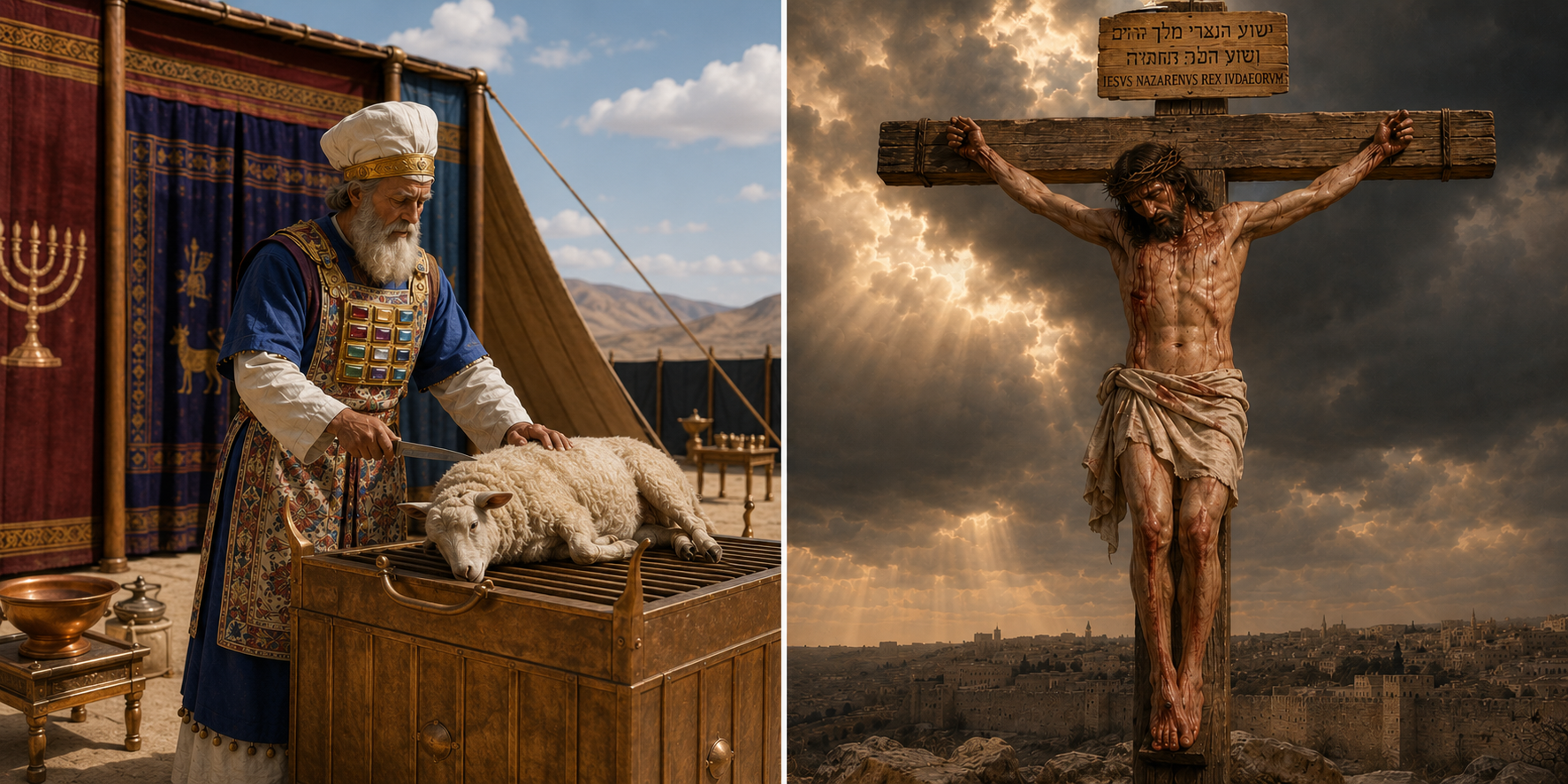
The topic of the episode is discussing the meaning in which Jesus, as “The Lamb Of God” takes away the sin of the world. Dr. Ronn Johnson and Mike Chu are going through the gospel of John on The Divine Council Worldview Podcast, and John 1:29 is the text they are studying in episode 54. His goal is to show that since the Torah offered no sacrificial “fix” for intentional moral crimes (like murder or adultery), the Cross should not be viewed as a “payment” for those specific categories of sin.
I’m going to quote the podcast episode at length because I want to make sure his full theological reasoning is fleshed out. One thing you will find is that I don’t technically disagree with all of Dr. Johnson’s conclusions that he draws from the data he presents. I merely think that he makes a non-sequitur move from the data to infer that penal substitutionary atonement is false.
Moving on with what Johnson said;
\\”Ronn Johnson: So, Solomon’s temple—we all know that it had a Holy of Holies on one end, and then the entrance on the other. And priests could go in the front end, and only the High Priest into the back end. Well, that idea of an increasingly sacred space is not uncommon to the ancient world. This is a schematic of a temple found in Syria—ancient Syria. And it’s the same—this is not a biblical temple, but notice it’s the same idea where the farther you go in, you have an inner room, and that’s where the altar was.
And so, the idea of moving from less pure—shall we say, less clean—to a more clean, ‘Most Holy Place’ is just part of culture. And so, when this—this is a reconstruction of Herod’s temple in the days of Jesus that’s in the Jewish Museum, the Hebrew Museum today—notice that little wall that’s outside. This is reconstructed again in the model because we have found evidence both in Josephus’s writings and an actual inscription found that—here’s quoting Josephus: ‘When you go through this first cloister into the second court of the temple, there was…’ — He’s telling his Roman audience about the Jewish temple — ‘There was a partition made of stone all around whose height was three cubits. Its construction was very elegant; upon it stood pillars at equal distances from one another, declaring the law of purity, some in Greek, some in Roman letters, that no foreigner should go into that sanctuary.‘
In fact, we have found a ‘warning stone,’ shall we say, that’s at the base of all the rubble in the Second Temple. And it said this: ‘No outsider shall enter the protective enclosure around the sanctuary. Whoever is caught will only have to blame himself for his ensuing death.’ … I often hear my audience say ‘There’s no way that this is important enough information for God to have Jesus take away the sin of the world on this level.’ In other words, ‘You’re talking impurity. That can’t be important enough.’ Well, wait a second. Read, Acts 21, where Paul takes a Greek into the temple. And what do they do now? The Jews were trying to kill him. Paul was getting killed by his fellow Jews for bringing a Gentile simply past that cloister. And so, if we don’t think it’s important to the story of atonement in the New Testament, you’re not reading the same New Testament that they were because they thought it was a matter of life and death that you would not cross that boundary if you were unclean. It’s that important to them, and thus, I think it should be to us as we read. ‘Jesus takes away the sin of the world’—that phrase is found in that kind of culture.
… Sin. Here’s where the problem starts. ‘Sin’ is a thoroughly English word with no clear Hebrew or Greek equivalent. Khata is the Hebrew word that we often translate as sin. And it has a very broad meaning in Hebrew, from missing a physical target—you know, slinging a stone and khata-ing, missing—to committing murder. It generally meant ‘to fail’—a very general word—and it often has the idea of the result of an action. So, to go through a stop sign is not the khata; it’s the accident that happens because I go through the stop sign that the text would call khata. It’s the evil that ensues from wrong decision-making.
…
When it comes to khata, you have to think in terms of: well, is it moral or amoral? Is it having a bodily fluid problem? That would be amoral, but that’s khata. If I touch a carcass, that’s khata, but it’s not moral. So, you have to go into the Old Testament world of sacrifice, remembering that there’s a huge difference between the moral sins I commit and the amoral failings I have as a dirty, dusty human. That’s where sacrifice fits, okay? And again, you knew that, I know. The audience needs to catch this. Sacrifice did not deal with moral offenses. Sacrifice deals with amoral failings of the dirty, dusty nature that humans have. It’s not a sin to touch a carcass. It was a khata to touch a carcass, and that’s why sacrifice was part of the story.
So, Numbers 15 is one of my favorite passages to just clarify this. I’m not going to read the whole thing, but take a look at Numbers 15:28-29 sometime, and you’ll see where, you know, “the priest shall make atonement for the person who sins unintentionally”—however you take that word, unintentional or whatever, non-rebelliously, okay? So, there’s all sorts of laws for how to do atonement for unintentional—I would call it non-moral, or specifically non-rebellious—sins.
The next verse, though, starts this way: Numbers 15:30. “But the person who does anything,” literally, hand-fist to God’s face. If you, you know, put a hand up to God, a fist up to God—that’s how the word actually works in Hebrew. He’s cut off; there’s no sacrifice for him. So, the point being: don’t think you can kill someone and then bring a bigger lamb to sacrifice next week. That’s not how this is going to work. Sacrifice is for non-moral or amoral issues of purity. That’s—and it’s so hard to catch in the English model, but that’s where you’ve got to go.
So, how do you handle moral offenses? I would say David tells you in Psalm 32; he tells you in Psalm 51. You pray to God for grace, for mercy. You say, ‘God, oh God, oh God, I can’t pay you enough for what I’ve done.’ And God says, ‘I know. That’s not how we do this. You have to ask for forgiveness.’
So now, bring it into the New Testament. What does it mean, then, that ‘Christ died for our sins according to the scriptures’? Well, there’s the answer: ‘according to the scriptures.’ Paul is telling his Corinthian Gentile audience, ‘He died for our sins,’ but go back to the Old Testament to know what that means. He doesn’t die for your murder, rape, and adultery. He’s dying for that amoral stuff that you go through every day. That’s why he died.
And so, I—again, I think when I tell people this—well, no, this is what I often hear back is: ‘No, he couldn’t have died for that. That’s not big enough. He’s got to die for my murder. He’s got to die for my rebellion.’ All I’m saying is, well, give me the text that says that, because there is no text that has that. And if I make that up and I put that in my hymn, then people in the audience will believe it. But the problem is the text never got there. And so, I just say to be careful, and that’s rule number one of a DCW: think biblically. And I think that’s what Paul was trying to say in 1 Corinthians 15:3, for example. ‘He died for our sins,’ but remember what I mean by that. You’ve got to go back to the Old Testament to figure out how that works.” [2]Ronn Johnson, Mike Chu, “The Divine Council Worldview Podcast, “EP054: John 1:19-51: How Did Jesus Take Away The Sin Of The World?” April 13th, August 25. — … Continue reading
My Response: I Agree…..Kind Of.
The funny thing is, I don’t necessarily agree with his data points and all of his conclusions. I just think that at a point, he pivots and makes a logical inference that the data doesn’t support. Namely that Jesus didn’t die for the sin of idolatry or murder. We can say Jesus died for ritual impurities, being “the lamb of God” (John 1:29) prefigured in Leviticus (Leviticus 4). Yes, purity was indeed a big deal to the Ancient Jews both in Old Testament times and in New Testament times—as in Acts 21:27-28, where Jews try to stone Paul for bringing a Gentile into the temple. Yes, there were indeed no sacrifices for moral offenses, especially ones as egregious as idolatry, murder, and adultery (Numbers 15:30-31). You couldn’t just kill someone in cold blood, have the high priest slaughter a lamb, and you were good. The Levitical sacrifices only dealt with amoral offenses like the uncleanliness that came from touching a carcass (Leviticus 11:24-28) or having one’s monthly flow of blood (Leviticus 15:19-30). And he’s absolutely right that the Hebrew word khata, which we translate as “sin” in our English Bibles, can mean anything from “missing a mark” (Judges 20:16) to heinous moral crimes (Exodus 32:31, Psalm 51:4). However, what does all this mean? It means that Jesus would have died for all our amoral offenses. Jesus would have died to remove all ritual impurities, including those that come from being a Gentile. As Paul would say, Christ tore down the dividing wall between Jew and Gentile (Ephesians 2:14-15). But that’s as far as the data takes us. Dr. Johnson goes a step further and concludes that Jesus could not, therefore, have died for our moral offenses as well. This is where I stop tracking with him and accuse him of the non-sequitur fallacy. All of his premises are true, but his conclusion doesn’t follow.
Examining The Penal Language Of Isaiah 53
For one thing, there are good biblical grounds to affirm that Jesus died for our moral crimes. Isaiah 53 is a prophetic passage about the Messiah’s death and resurrection. This is a controversial take, of course, but I think it is quite justified. For one thing, the New Testament authors link Jesus’ death to the suffering of “The Suffering Servant” in Isaiah 53, such as Acts 8:26-38, where Phillip explains to the Ethiopian Eunich who was reading Isaiah 53 aloud, that the passage he was reading about was fulfilled in Jesus, and 1 Peter 2:24-25 says “He himself bore our sins in his body on the tree, that we might die to sin and live to righteousness. By his wounds you have been healed. For you were straying like sheep, but have now returned to the Shepherd and Overseer of your souls.” (ESV) Here, we see 2:24 explicitly quotes Isaiah 53:5 and 2:25 alludes to Isaiah 53:6, which says “All we like sheep have gone astray; we have turned—every one—to his own way;” (ESV) If all scripture is God-breathed (2 Timothy 3:16) and The New Testament documents are scripture (cf. 2 Peter 3:16), then it follows that The New Testament is God-breathed. If God breathed out the contents of The New Testament, and God doesn’t lie (Numbers 23:19, Titus 1:2), then whatever The New Testament teaches must be true. If what The New Testament teaches is true, then if The New Testament says that Jesus’ death fulfilled the prophecy of Isaiah 53, then it is true that Isaiah 53 was about Jesus. You cannot say that Isaiah 53 is not about Jesus without saying that The New Testament authors, under the inspiration of The Holy Spirit, erred.
But aside from The New Testament’s teaching, when one compares the contents of the Suffering Servant passage with the details of Jesus’ death and resurrection, it becomes clear that Jesus’ death is what the prophet was talking about. The touch points are so numerous as to become uncanny.
Isaiah describes the Servant of the Lord as one who was “despised and rejected by men,” “a man of sorrows, and acquainted with grief” (Isaiah 53:3, ESV). The prophet emphasizes that the Servant would suffer, not for His own sins, but for the sins of others: “he was pierced for our transgressions; he was crushed for our iniquities” and “the LORD has laid on him the iniquity of us all” (Isaiah 53:5-6, ESV). These themes closely parallel the Gospel accounts of Jesus’ suffering and crucifixion. Though Pilate repeatedly declared that he could find no guilt in Jesus (John 18:38; 19:4), Christ was scourged, mocked, and condemned to death. Isaiah’s statement that the Servant would be “like a lamb that is led to the slaughter” and would remain silent before His accusers (Isaiah 53:7, ESV) also finds a parallel in Jesus’ silence before Caiaphas and Pilate during His trials (Matthew 26:63; 27:12-14).
The parallels continue beyond Jesus’ death and extend even to His burial and resurrection. Isaiah says that the Servant would be “cut off out of the land of the living” and that “they made his grave with the wicked and with a rich man in his death” (Isaiah 53:8-9, ESV). This corresponds to Jesus being crucified between criminals and then being buried in the tomb of the wealthy Joseph of Arimathea (Matthew 27:38, 57-60). Yet Isaiah 53 has a happy ending. After declaring that the Servant would make “his soul an offering for guilt,” the prophet says, “he shall see his offspring; he shall prolong his days” (Isaiah 53:10, ESV). After all the talk about being “pierced”, “crushed”, and being “cut off from the land of the living” (a way of saying he would die), his days would be prolonged? How could that be? Only if he was “cut off from the land of the living” and then brought back to the land of the living (i.e be resurrected). And by the way, if you want a thorough, in-depth historical case for the death and resurrection of Jesus, please consider getting a copy of my book “Eyewitnesses Of His Majesty: Why The Gospels Can Be Trusted – and the Case For The Resurrection Of Jesus”. Isaiah further declares that “out of the anguish of his soul he shall see and be satisfied” and that the righteous Servant would “make many to be accounted righteous” because “he shall bear their iniquities” (Isaiah 53:11, ESV).
It is difficult for me to get around Isaiah 53 being about the death of Jesus. And more parallels could be adduced. Isaiah 53 is pivotal to this discussion because of how Isaiah describes the death of the servant.
Isaiah 53:4-6 says, “Surely he has borne our griefs and carried our sorrows; yet we esteemed him stricken, smitten by God, and afflicted. But he was pierced for our transgressions; he was crushed for our iniquities; upon him was the chastisement that brought us peace, and with his wounds we are healed. All we like sheep have gone astray; we have turned—every one—to his own way; and the LORD has laid on him the iniquity of us all.” (ESV, emphasis mine in bold)
Isaiah says the servant was“pierced for our transgressions”. Unlike the Hebrew word katah, the Hebrew word here is pěʹ·šǎ (pesha). This word is much less broad than katah and means specifically a moral crime. The word is used in Genesis 50:17 in which we read Jacob saying to his sons “‘Say to Joseph, ‘Please forgive the transgression of your brothers and their sin, because they did evil to you.’ And now, please forgive the transgression of the servants of the God of your father.’ Joseph wept when they spoke to him.” (ESV). The word translated as “trangression” is pesha, and if you know the story of Joseph from Genesis 37-50, you would be hard pressed to think that what Joseph’s brothers did to him was an amoral offense. They sold him into slavery, lied about it to their father, and kept their father Jacob under the impression that Joseph was dead all of those years. This was a moral wrong, a transgression, not a mere missing of the mark or an amoral impurity. Michah 1:5-7 says “All this is for the transgression of Jacob and for the sins of the house of Israel. What is the transgression of Jacob? Is it not Samaria? And what is the high place of Judah? Is it not Jerusalem? Therefore, I will make Samaria a heap in the open country, a place for planting vineyards, and I will pour down her stones into the valley and uncover her foundations. All her carved images shall be beaten to pieces, all her wages shall be burned with fire, and all her idols I will lay waste, for from the fee of a prostitute she gathered them, and to the fee of a prostitute they shall return.” (ESV) Yahweh through the Prophet Micah says that punishment is coming upon Israel for their “transgression”, pesha. What is the transgression? We keep reading and we see that it is the idolatry of the land, the “carved idols”. It’s the sin of idolatry. It’s the capital sin that drove Israel into Babylonian captivity. Proverbs 28:4 says“Whoever robs his father or his mother and says, ‘That is no transgression,’ is a companion to a man who destroys.” (ESV) In other words, anyone who says that breaking the eighth commandment is not a transgression is looked down upon, they are “a companion to a man who destroys”. I could go on with examples, but pesha is consistently translated by the ESV as “transgressions” and is consistently used in moral contexts. This implies that when we read that Christ was “pierced for our pesha.” we ought to take that as Christ being pierced for our moral wrong doings. Psalm 51:3-4, the famous repentant prayer of David after he had Uriah murdered to cover up his adultery with Bathsheba says “For I know my transgressions, and my sin is ever before me. Against you, you only, have I sinned and done what is evil in your sight,” (ESV). David’s transgression was a breaking of the sixth and seventh commandments (Exodus 20:14-15, cf. 2 Samuel 11-12), not an amoral offense like touching a corpse or having a nocturnal emission.
Isaiah also says that Christ or The Suffering Servant was“crushed for our iniquities”. Again, the Hebrew word that is translated as “iniquities” is much more specific than katah that gets translated as “sin”. ā·wōn means “iniquity, guilt or punishment of iniquity;” [3]Francis Brown, Samuel Rolles Driver, and Charles Augustus Briggs, Enhanced Brown-Driver-Briggs Hebrew and English Lexicon (Oxford: Clarendon Press, 1977), 730. In 2 Kings 7:9, we read, “Then they said to one another, “We are not doing right. This day is a day of good news. If we are silent and wait until the morning light, punishment will overtake us. Now therefore come; let us go and tell the king’s household.” (ESV). This is in the context of Israelites contemplating going to the camp of the Assyrians lest they die, and Yahweh making the Assyrian army flee in terror for making it sound as if the army was larger than it really was. The words of this man seem to imply that it would be immoral not to take the news to the king. Psalm 51, again, uses the word “iniquities” “ā·wōn'”, in the moral context of his sin against Bathsheba and Uriah (verse 9).
Isaiah says, “The Lord laid on him the iniquity of us all.” It is hard for me to read Isaiah 53 and not see the death of this person as being a penal substitutionary atonement.
The “Cup” Of God’s Wrath
In Matthew 26:39, the context of which is Jesus’ prayer in the Garden Of Gethsemane, we read this; “And going a little farther he fell on his face and prayed, saying, ‘My Father, if it be possible, let this cup pass from me; nevertheless, not as I will, but as you will.'” (ESV, emphasis mine in bold). A cup? What is Jesus talking about? The context clearly indicates that Jesus is experiencing heightened anxiety because of the crucifixion that is to occur the following day. So the “cup” that Jesus wants to pass from him must be metaphorically tied to the crucifixion somehow. The cup was also mentioned in Matthew 20:22 in the context of John and James having their mother ask Jesus if they could sit at His right and left sides in His kingdom, but what the “cup” that Jesus will drink isn’t explained in that passage either.
It is widely known among scholars that Matthew’s primary audience is Jewish. This is evident from his systematic use of ‘fulfillment formulas.’ Repeatedly, Matthew reports an event and notes, ‘All this took place to fulfill what the Lord had spoken by the prophet’ (e.g., Matthew 1:22; 2:15; 2:23; 21:4). He assumes his readers already value and understand the authority of the Hebrew Scriptures.
Moreover, Matthew assumes significant background knowledge regarding Jewish customs. For example, in Matthew 15:1-2, he discusses the tradition of the elders regarding hand-washing without explanation. In contrast, Mark 7:3-4, writing to a primarily Gentile audience, goes out of his way to explain the specific ritual washing practices of ‘all the Jews.’ Similarly, while Mark translates Aramaic terms for his readers (as in Mark 5:41 or 15:34), Matthew frequently leaves Jewish concepts and titles to stand on their own. Both of these are strong indicators that Matthew’s primary audience was Jews whom he hoped to convince that Jesus of Nazareth really is the Christ.
With this in mind, I think there is a good possibility that Jesus is alluding to the cup of God’s wrath mentioned in Psalm 75:8. The entirety of Psalm 75 is about a future worldwide judgment from Yahweh and the Psalmist is praising Yahweh for his justice. In verse 8, he says “For in the hand of the LORD there is a cup with foaming wine, well mixed, and he pours out from it, and all the wicked of the earth shall drain it down to the dregs.“ (ESV, emphasis mine in bold). Could it be that Jesus is referring to the cup of God’s wrath in Psalm 75:8 and that the Jewish readers of Matthew’s gospel, who undoubtedly would have been extremely familiar with this psalm as they would have sung it in various contexts, would have made the connection between Jesus’ death and God’s pouring out of wrath? I think it’s a good possibility. Especially since the cup metaphor referring to God’s wrath doesn’t have a lone referent in Psalm 75. We also find this metaphor in Isaiah 51:17, which says “Wake yourself, wake yourself, stand up, O Jerusalem, you who have drunk from the hand of the LORD the cup of his wrath, who have drunk to the dregs, the bowl, the cup of staggering.” (ESV, emphasis in bold added) In Jeremiah 25:15-26, we read “Thus the LORD, the God of Israel, said to me:“Take from my hand this cup of the wine of wrath, and make all the nations to whom I send you drink it. They shall drink and stagger and be crazed because of the sword that I am sending among them.’ So I took the cup from the LORD’s hand, and made all the nations to whom the LORD sent me drink it: Jerusalem and the cities of Judah, its kings and officials, to make them a desolation and a waste, a hissing and a curse, as at this day; Pharaoh king of Egypt, his servants, his officials, all his people, and all the mixed tribes among them; all the kings of the land of Uz and all the kings of the land of the Philistines (Ashkelon, Gaza, Ekron, and the remnant of Ashdod); Edom, Moab, and the sons of Ammon; all the kings of Tyre, all the kings of Sidon, and the kings of the coastland across the sea; Dedan, Tema, Buz, and all who cut the corners of their hair; all the kings of Arabia and all the kings of the mixed tribes who dwell in the desert; all the kings of Zimri, all the kings of Elam, and all the kings of Media; all the kings of the north, far and near, one after another, and all the kingdoms of the world that are on the face of the earth. And after them the king of Babylon shall drink.” (ESV)
So if the minds of Matthew’s Jewish readers didn’t go to Psalm 75:8, they probably would have gone to one of these other places where God’s wrath is likened to a cup of wine. It was a well-known Old Testament metaphor for God’s wrath. This strongly supports The Penal Substitution Theory of atonement (i.e that God The Father punished Jesus in our place so that if we give Him our allegiance, He won’t have to punish us). Jesus praying “Father, let this cup pass from me” in Matthew 26:39 makes the most sense. Jesus doesn’t want to suffer the divine wrath. He doesn’t want to drink this cup down to the dregs. But, Jesus prays, essentially, that if there is no other way to save humanity, that He’s willing to do it. “Yet not my will, but yours be done.” When Jesus was being tortured and when he eventually died, He was drinking the cup of The Father’s wrath “down to the dregs”. Because God poured it out on Jesus, He doesn’t have to pour it out on you or I. God treated Jesus as if he were me, so he could treat me as if I were Jesus. That is, instead of a wicked rebel deserving of death, a beloved son (John 1:12, Luke 15:11-31). Because Jesus swapped places with me, God can say of me, “This is my beloved son in whom I am well pleased”. (Matthew 3:17). You can be a child of God too, if you give your allegience to Jesus as your King. As John 3:16 says“For God so loved the world that he gave his one and only son, that whosoever believes in him will not perish, but have eternal life.” As Ephesians 2:8-9 says “For by grace you have been saved through faith. And this is not your own doing; it is the gift of God, not a result of works, so that no one may boast.” (ESV). [4]See my articles “Evangelism: Non-Violent Conquest Warfare” and “How Gospel Allegiance Solves Two Of The Church’s Biggest Problems” for a discussion on saving faith being … Continue reading
What Did Paul Mean That Christ “Died For Our Sins In Accordance With The Scriptures”?
Dr. Ronn Johnson said \\“So now, bring it into the New Testament. What does it mean, then, that ‘Christ died for our sins according to the scriptures’? Well, there’s the answer: ‘according to the scriptures.’ Paul is telling his Corinthian Gentile audience, ‘He died for our sins,’ but go back to the Old Testament to know what that means. He doesn’t die for your murder, rape, and adultery. He’s dying for that amoral stuff that you go through every day. That’s why he died.”\\ –
What Doctor Johnson is arguing here is that given what we know about the Levitical sacrifices, when John 1:29 says that Jesus is the “Lamb Of God”, he must be taking away the sins of the world in the same ways the Levitical sacrifices did, and only in the way the Levitical sacrifices did (i.e he’s taking away our a-moral offenses only, not our moral offenses). In the section directly above, he quotes 1 Corinthians 15:3 and says that this is the sense Paul means when he says that Christ died “in accordance with the scriptures”. He’s taking Paul to mean “In accordance with the way sacrifices were handled in Torah”. However, (1) We’ve already seen ample positive evidence that Jesus died on the cross to atone for our moral crimes, and (2) There is another way to take “in accordance with the scriptures”.
If passages like Isaiah 53 and Psalm 22 really did predict the suffering and death of the Messiah as they seem to [5]And, by the way, I have a whole section in Chapter 10 of my book “Eyewitnesses Of His Majesty: Why The Gospels Can Be Trusted – and the Case For The Resurrection Of Jesus” comparing … Continue reading, then Christ dying in accordance with the scriptures could plausibly be taken to mean in fulfillment of the scriptures. In other words, to paraphrase, Paul is saying, “Christ died for our sins according to Psalm 22 and Isaiah 53”. So yes, “He died for our sins,’ but go back to the Old Testament to know what that means.” Indeed, Dr. Johnson, indeed! You go back to the Old Testament and you learn that Christ was “pierced for our transgressions”, “crushed for our iniquities” (Isaiah 53:5-6), and that he drank the cup of the Father’s wrath (Psalm 75:8, Isaiah 51:17, Jeremiah 25:15-16).
How Moral Sins Were Forgiven In The Old Testament
Dr. Johnson says \\“So, you know, we have to ask… if there’s no sacrifice for the high-handed sin, how does anyone get forgiven? I mean, think about David. This is the classic example I always go to. David… he’s an adulterer, he’s a murderer. I mean, he’s checked the boxes for the most high-handed things you can do. And he doesn’t go to the Tabernacle. He doesn’t go find the best bull in the land and say, ‘Give me the priest, we gotta kill this thing so I can be right with God.’ He knows better. He says in Psalm 51—and this should be the verse we put on the front of our Bibles—he says, ‘You do not delight in sacrifice, or I would bring it.’
Think about the weight of that. He’s saying, ‘God, if a sacrifice would fix this murder I committed, I’d have a line of animals a mile long.’ But he knows that for moral rebellion, the sacrificial system has nothing to offer. So what does he do? He offers his heart. He offers his loyalty. He says, ‘A broken and contrite heart, O God, you will not despise.‘”\\ –
To this, I say AMEN! In fact, I smiled during this part of the podcast episode and said “That’s exactly how we get forgiven today. It’s almost as if God is the same yesterday, today, and forever.” (Malachi 3:6, Hebrews 13:8). However, does that mean that no blood sacrifice is needed for our moral sins? There wasn’t a sacrifice for sins like murder and adultery in The Torah. But does that mean that there would never be one or that God can just let us off the hook without justice being served? Johnson interprets “You do not delight in sacrifice” as an ontological statement about thelimits of sacrifice, whereas a PSA proponent would argue that David is highlighting the insufficiency of animal blood compared to the “once for all” sacrifice of Christ (Hebrews 10). If, as Isaiah 53 and Matthew 26:39 coupled with Psalm 75:8 strongly imply, that Jesus was pierced for our transgressions, our iniquity, that he drank God’s wrath, then it follows that such a sacrifice was needed to avert said crushing and drinking of the wrath cup from us. This then raises the question of how people in The Old Testament got saved? Well, I certainly don’t think that every last person went to Hell until Jesus breathed his last on the cross. The Bible itself gives us ample reason to reject such a notion (not the least of which is Jesus’ Parable Of The Rich Man and Lazarus in Luke 16 where Abraham is depicted in being on the good side of Sheol prior to the resurrection, in contrast to the rich man). Johnson and Chu would argue, and I would wholeheartedly agree, that it is our Allegience to Yahweh that is credited to us as righteousness (Genesis 15:6, cf. Romans 4:3). On PSA, we would say that God is not limited to time. Those who were loyal before the cross were beneficiaries of the cross even though Jesus hadn’t even been born yet, let alone died. As Pastor Chad Lawson of Powdersville First Baptist Church likes to say “They were looking forward in time to the cross while we look back at the cross”. The fact that all a person had to do in Old Testament times was ask God to forgive them does not show that a sacrifice for moral offenses was not needed. If we interpret scripture in light of scripture (keeping the penal language of Isaiah 53 in mind, for example), those who were loyal Yahwhists are beneficiaries of the cross, whether we are living before or afterwards. I believe Yahweh retroactively covers those before the time of Jesus in His blood.
The Argument From Hebrews – Jesus Is The Better Sacrifice
Hebrews 9 is arguing that Jesus’ sacrifice is a greater sacrifice than what we had in The Old Testament system.
Hebrews 9:13-18 says “For if the blood of goats and bulls, and the sprinkling of defiled persons with the ashes of a heifer, sanctify for the purification of the flesh, how much more will the blood of Christ, who through the eternal Spirit offered himself without blemish to God, purify our conscience from dead works to serve the living God. Therefore he is the mediator of a new covenant, so that those who are called may receive the promised eternal inheritance, since a death has occurred that redeems them from the transgressions committed under the first covenant. For where a will is involved, the death of the one who made it must be established. For a will takes effect only at death, since it is not in force as long as the one who made it is alive. Therefore not even the first covenant was inaugurated without blood. For when every commandment of the law had been declared by Moses to all the people, he took the blood of calves and goats, with water and scarlet wool and hyssop, and sprinkled both the book itself and all the people, saying, ‘This is the blood of the covenant that God commanded for you.’ And in the same way he sprinkled with the blood both the tent and all the vessels used in worship. Indeed, under the law almost everything is purified with blood, and without the shedding of blood there is no forgiveness of sins. Thus it was necessary for the copies of the heavenly things to be purified with these rites, but the heavenly things themselves with better sacrifices than these. For Christ has entered, not into holy places made with hands, which are copies of the true things, but into heaven itself, now to appear in the presence of God on our behalf. Nor was it to offer himself repeatedly, as the high priest enters the holy places every year with blood not his own, for then he would have had to suffer repeatedly since the foundation of the world. But as it is, he has appeared once for all at the end of the ages to put away sin by the sacrifice of himself. And just as it is appointed for man to die once, and after that comes judgment, so Christ, having been offered once to bear the sins of many, will appear a second time, not to deal with sin but to save those who are eagerly waiting for him.” (ESV)
In this lengthy passage, and throughout the book of Hebrews, the author is writing to a largely Jewish audience under religious persecution. [6]Got Questions Ministries, Got Questions? Bible Questions Answered (Bellingham, WA: Logos Bible Software, 2002–2013 [See here.] Tony Evans, The Tony Evans Bible Commentary (Nashville, TN: Holman … Continue reading They were tempted to turn away from the Messiah and back to a unitarian messiah-less brand of Judaism. The author of Hebrews is making his case as to why they shouldn’t do that. And it boils down to “You’re sacrificing what’s superior for what’s inferior. All those things in the Torah were but shadows. Christ is the fulfillment.” If Christ’s sacrifice did nothing but take away ritual impurity, in what way would Jesus’ sacrifice be better than the Old Testament sacrifices? I would argue that it’s a greater sacrifice precisely because it does what the blood of bulls and goats could never do. There was no sacrifice for murder, there was no sacrifice for idolatry or adultery. Jesus’ sacrifice deals with those things. So, if you give up Jesus and go back to the old sacrificial system, you’re exchanging something that deals withALL of your offenses; both moral and a-moral, with those that only deal with some of your offenses (i.e ritual uncleaness).
Hebrews 9:28 says “So Christ, having been offered once to bear the sins of many…” (ESV). In an old episode of The Naked Bible Podcast, the late biblical scholar Dr. Michael S. Heiser commented on this verse saying “The atonement means many different things, one of which is substitution. The other views of the atonement do contribute something—they’re different aspects, different ways of thinking about what the atonement means and what the sacrifice of Christ means. Unfortunately, the propensity has been (both in scholarship and those who imbibe on scholarship, or imbibe on how something is preached)… The propensity has been, ‘Let’s pick another view of atonement so we don’t have to have this substitution idea, because that just sounds awful. We don’t want to hear about violence. We don’t want to hear about an innocent dying for the sins of somebody else. That’s just icky. Our culture just doesn’t tolerate that.’ Well, too bad. That’s a legitimate part of what the atonement means, and you do have passages like this one and others that use pretty clear substitution language. That’s not the only thing that atonement means—not the only thing— but it’s part of what the atonement means. So my advice would be to not try to jettison or excise out of our atonement talk an idea that is clearly there in certain texts, but to include other ideas that can derive from other texts.” [7]Dr. Michael S. Heiser, Naked Bible Podcast, “Episode 194: Hebrews 9”, –> https://nakedbiblepodcast.com/podcast/naked-bible-194-hebrews-9/
I have also noticed the trend among biblical scholars to essentially shy away from Penal Substitution en masse. I think that’s a shame. However, at the same time, pastors and theologians have so hyped up Penal Substitution that one is under the impression that suffering God’s wrath is ALL Jesus’ death accomplished. As I said in the Introduction of “Eyewitnesses Of His Majesty”, if tthat’s all that Jesus’ death did, he could have stayed dead. There would have been no need of a resurrection. However, Romans 4:25 doesn’t leave room for that because Paul says that Jesus “was delivered up for our trespasses and raised for our justification.” (ESV). He was deliver up AND raised. Thus, I’m thankful to biblical scholars like N.T Wright for bringing the Christus Victor model of the atonement back in vogue. I think Jesus’ death did more than one thing. On the one hand, He suffered the wrath of God on our behalf. But on the other hand, he was putting himself under the power of the lord of death (Satan) [8]See Dr. Michael S. Heiser, “Why Is The Serpent In Genesis Later Called Satan?” YouTube.com, November 12th 2024, – https://www.youtube.com/watch?v=2lmdhF_72fE&t=3s in order to break free from the power of death in His resurrection. And hence, anyone who united to Him in faith will participate in The Christ’s own victory over death (1 Thessalonians 4:13-19, John 3:16, John 11:25-26). By all means defend Christus Victor, but let’s not push Christus Victor at the expense of PSA! PSA is biblical, and is not mutually exclusive with Christus Victor.
Regarding verses 12-14, Dr. Heiser said “Now look at the difference. Back in the Leviticus series, we talked about how so much of the sacrificial language was about purging sacred space— decontaminating it—or decontaminating people so that they wouldn’t defile sacred space. And what defiled sacred space? What made a person a threat to sacred space back in Leviticus? Some physical deficiency, some deformity, loss of blood, loss of semen, the menstrual cycles… All these things are associated with the flesh. None of it was associated with the inner life, the inner mind, the heart, the conscience. And so the writer of Hebrews… This is easy pickings for him. Now we’re talking about being renewed from the inside out. It is by definition inherently superior, because it addresses the heart. It addresses the soul—what Christ did, not just the outer body (the outer flesh).” [9]See Dr. Michael S. Heiser, Naked Bible Podcast, “Episode 194: Hebrews 9”, –> https://nakedbiblepodcast.com/podcast/naked-bible-194-hebrews-9/
Dr. Heiser points out here that the blood of Christ sacrificed purifies our “Concience”. The Greek word translated as “conscience” is “syneidēsis”. This clearly has moral connotations, for as the Lexham Theological Workbook says, “συνείδησις (syneidēsis). n. fem. conscience, self-awareness. Refers to a person’s internal witness to their own behavior, the guilt over wrongdoing and the satisfaction of choosing right over wrong. The noun συνείδησις (syneidēsis) occurs 31 times in the NT (some manuscripts omit the phrase with the word in John 8:9). The word most frequently refers to the self-consciousness that evaluates one’s own behavior as good or bad and encourages choosing what is good.” [10]Douglas Mangum, “Conscience,” in Lexham Theological Wordbook, ed. Douglas Mangum et al., Lexham Bible Reference Series (Bellingham, WA: Lexham Press, 2014). I don’t think any woman was having a guilty concience over having her monthly period!
And so, as Dr. Heiser said in his Leviticus series, “For us, for them, there’s no restriction in forgiveness to just unintentional sins and not only that but the New Testament is focused on moral absolution, even for deliberate rebellion. It’s not just decontamination. It’s being made right with God. It’s being put in Christ so that when God looks at you he sees the perfection of Jesus the Messiah. These concepts are so far beyond what you would’ve had in the Old Testament, and so the writer of the book of Hebrews is like, you people who are lapsing back into unbelief, you’re insane. Don’t you realize how much better Jesus is> He goes through the book of Hebrews, goes through this whole litany of how Jesus is better. One of those is the sacrifice. The blood of bulls and goats could not take away sin. Think about that statement. The blood of bulls and goats is applied to the sanctuary.
It’s about decontaminating the place. It’s not about taking away your guilt. It’s not about moral absolution. The blood of bulls and goats could not do this but the blood of Christ can.” [11]Dr. Michael S. Heiser, The Naked Bible Podcast, “Episode 66: Leviticus 4”, September 12th 2015 –> https://nakedbiblepodcast.com/podcast/naked-bible-66-leviticus-4/
Summary and Conclusion
Dr. Ronn Johnson misses the mark on the atonement. And yes, the pun was very much intended!
While there is much to agree with, his “Therefore…” doesn’t follow. I can concede that Dr. Johnson is correct that kippur (atonement) in Leviticus primarily deals with “purgation” or cleansing the sanctuary from ritual impurity. He is right that the Hebrew Bible distinguishes between “unintentional sins/impurities” and “high-handed” moral rebellion. But from here, Dr. Johnson makes a Logical Leap that is unwarranted. Johnson’s leap is assuming that because Jesus fulfills the Levitical type, He is limited by it. My counter response was that in Isaiah 53, which is a prophecy of Jesus’ death, is full of penal substitutionary language (e.g “He was pierced for our transgressions”, “crushed for our iniquities”, “The Lord laid on him the iniquity of us all”. Moreover, the “cup” of God’s wrath (Psalm 75:8, Isaiah 51:1, Jeremiah 25:15-26 seems to be what Jesus is alluding to in his Gethsemane prayer in Matthew 26:39, “Father, if it be possible, let this cup pass from me.” This suggests that Jesus’ work is an expansion and a merging of multiple categories. He isn’t just the “decontaminating lamb”; He is also the “Suffering Servant” who bears the punishment (mûsār) that brings us peace.
If I may put Johnson’s reasoning into the form of a logical syllogism, it would look something like this;
1: Levitical sacrifice only dealt with ritual/amoral impurity.
2: Jesus is the fulfillment of Levitical sacrifice.
3: Therefore, Jesus’ sacrifice only deals with ritual/amoral impurity.
My response was that this ignores the Multimodal nature of the Cross. Jesus isn’t just the Lamb; He’s the Scapegoat (bearing guilt), the Suffering Servant (bearing punishment), and the one drinking a cup from God that he doesn’t want to drink, but does so in order that we won’t have to. When we think of Jesus dying for or taking away our “sins”, katah in Hebrew, we ought to therefore think of “sins” in all of its dimensions, amoral and moral.
One final word, if you’re an adherent to Penal Substitutionary Atonement like I am, please do not let this deter you from listening to The Divine Council Worldview Podcast. I do not consider Dr. Ronn Johnson a heretic. Johnson would be a heretic only if he denied that Jesus’ death saves us, but he doesn’t. We both agree that Jesus’ death is needed to save us, we just disagree on the mechanics of how it saves us. Just as Christians disagree on how old the Earth is, and how to interpret Genesis 1, while still affirming that Yahweh is the creator of all things. I disagree with Johnson’s takes frequently. Not always, but he says at least one or two things in every episode that make me pause my TV and argue with the screen. That’s fine. I appreciate different takes and perspectives. If nothing else, he makes me think. I’ve learned a lot from The Divine Council Worldview Podcast, and if you haven’t listened to it, I highly recommend you do so. For me, the best ways to listen are on YouTube or on the Michael Heiser Foundation mobile app.
References
| ↑1 | That blog post was titled “Yahweh or Yahweh’s Agent: A Response To Ronn Johnson”, August 12th 2025. |
|---|---|
| ↑2 | Ronn Johnson, Mike Chu, “The Divine Council Worldview Podcast, “EP054: John 1:19-51: How Did Jesus Take Away The Sin Of The World?” April 13th, August 25. — https://miqlat.subspla.sh/ysz2q5r time stamp is around 44-48 minutes. |
| ↑3 | Francis Brown, Samuel Rolles Driver, and Charles Augustus Briggs, Enhanced Brown-Driver-Briggs Hebrew and English Lexicon (Oxford: Clarendon Press, 1977), 730. |
| ↑4 | See my articles “Evangelism: Non-Violent Conquest Warfare” and “How Gospel Allegiance Solves Two Of The Church’s Biggest Problems” for a discussion on saving faith being allegiance or “believing loyalty” rather than mere mental assent. See also “Salvation By Allegiance Alone: Rethinking Faith, Works, and The Gospel Of Jesus The King” by Matthew Bates. |
| ↑5 | And, by the way, I have a whole section in Chapter 10 of my book “Eyewitnesses Of His Majesty: Why The Gospels Can Be Trusted – and the Case For The Resurrection Of Jesus” comparing Jesus’ death in the gospels to the contents of Psalm 22 and Isaiah 53, and I even explain why Second Temple Jews, even Jesus’ own disciples, did not understand that Jesus had to die in rise to fulfill these scriptures. |
| ↑6 | Got Questions Ministries, Got Questions? Bible Questions Answered (Bellingham, WA: Logos Bible Software, 2002–2013 [See here.] Tony Evans, The Tony Evans Bible Commentary (Nashville, TN: Holman Bible Publishers, 2019), 1310–1311. |
| ↑7 | Dr. Michael S. Heiser, Naked Bible Podcast, “Episode 194: Hebrews 9”, –> https://nakedbiblepodcast.com/podcast/naked-bible-194-hebrews-9/ |
| ↑8 | See Dr. Michael S. Heiser, “Why Is The Serpent In Genesis Later Called Satan?” YouTube.com, November 12th 2024, – https://www.youtube.com/watch?v=2lmdhF_72fE&t=3s |
| ↑9 | See Dr. Michael S. Heiser, Naked Bible Podcast, “Episode 194: Hebrews 9”, –> https://nakedbiblepodcast.com/podcast/naked-bible-194-hebrews-9/ |
| ↑10 | Douglas Mangum, “Conscience,” in Lexham Theological Wordbook, ed. Douglas Mangum et al., Lexham Bible Reference Series (Bellingham, WA: Lexham Press, 2014). |
| ↑11 | Dr. Michael S. Heiser, The Naked Bible Podcast, “Episode 66: Leviticus 4”, September 12th 2015 –> https://nakedbiblepodcast.com/podcast/naked-bible-66-leviticus-4/ |
Discover more from Cerebral Faith
Subscribe to get the latest posts sent to your email.