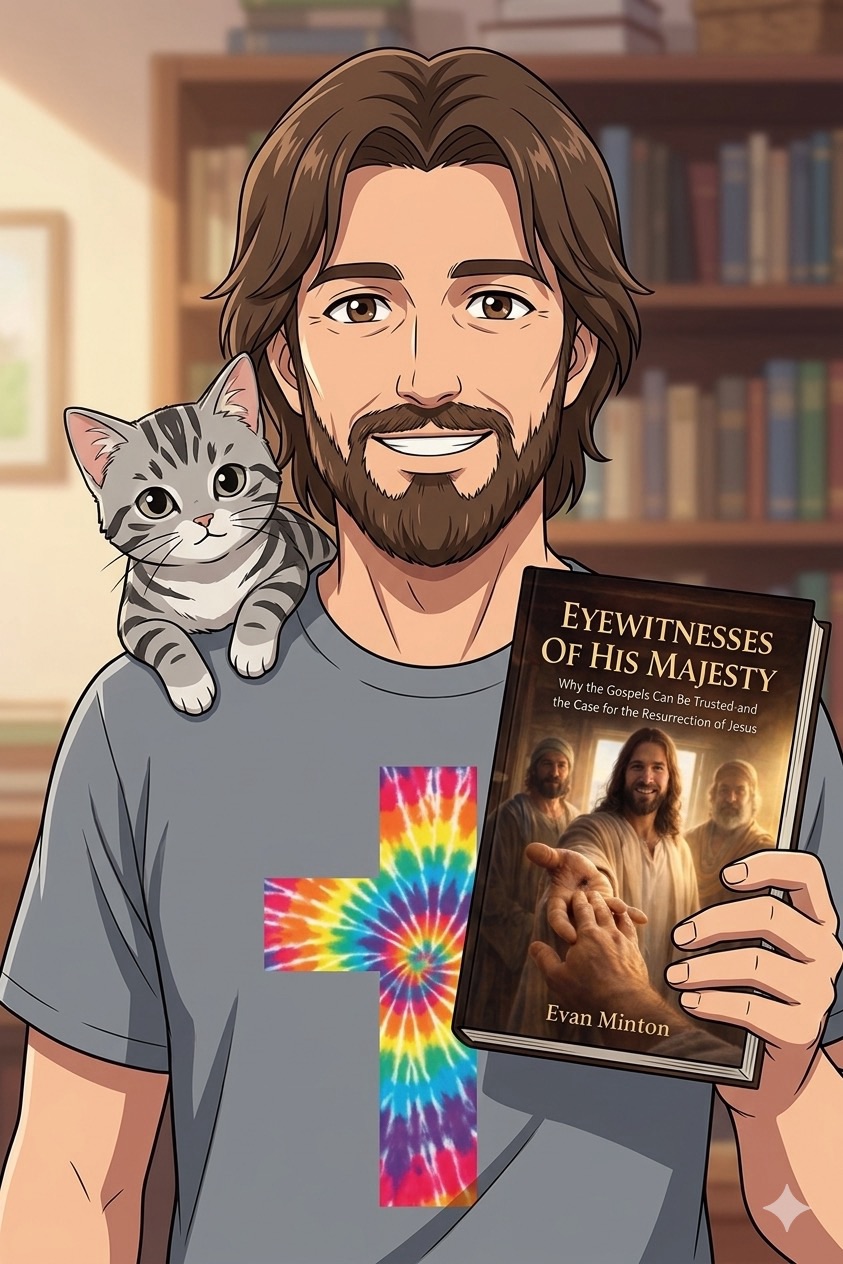
I’ve been hard at work generating the next installment of my “Blog Book” series. I actually decided to not make this book simply a compilation of articles, unlike the previous editions in the series. This book, “Eyewitnesses Of His Majesty: Why You Can Trust The Gospels – and the Case For The Resurrection Of Jesus” has a lot of fresh content that you won’t find on this blog. The first half of the book does contain blog essays I have written, such as “Jesus Christ is A.L.I.V.E” and “Defending The Resurrection Of Jesus From Matthew Alone”, “Defending The Resurrection Of Jesus From Luke Alone”, and “Defending The Resurrection Of Jesus From John Alone”, which are actually very lengthy, in depth, and heavily footnoted which is why I’m loathe to call them “blog posts”. However? The second half of the book has unique content that adds and builds upon the aforementioned essays, dealing with objections to Jesus’ resurrection and questions about it that even those gargantuan essays didn’t allow me space to deal with.
I have tried to leave no stone unturned.
The Structure Of The Book
In Chapter 1, this will be my blog post “5 Reasons Why I Prefer Maximal Data Over Minimal Facts”. In this chapter/article, I’ll give various reasons why this method is now my preferred method to defend the resurrection of Jesus over The Minimal Facts Approach. It will also address the objection that a Maximal Data Approach “takes too long”, that we need a Minimal Facts Approach to avoid info dumping on our interlocutors.
Chapter 2: “‘He Appeared’ The Problem Of Vagueness With The Minimal Facts”. This article explains why I’m beginning to doubt whether a Minimal Facts Approach is even workable as a valid way of establishing the resurrection. I argue that without the specific details that we find in the gospels, and if all we’re really leaning on are the appearances cited in 1 Corinthians 15, we’re on shaky grounds at best. How do we know the disciples were rational in affirming that Jesus rose from the dead? “He Appeared” can mean anything from the highly detailed, multi-sensory close-up appearances that we read about in the gospels to some Jewish rabbi on a hillside far away that kind of resembles Jesus.
Chapter 3: “Jesus Christ Is A.L.I.V.E”
This chapter lays the foundational historical case for the Resurrection using the A.L.I.V.E. acronym to organize data points. By examining the Appearances of Jesus, the Low status of the women witnesses, the Immediate proclamation in Jerusalem, the Voluntary suffering of the disciples, and the Empty Tomb, this chapter demonstrates that the Resurrection is the only hypothesis with enough explanatory scope and power to account for the birth of the Christian movement. Other theories like The Hallucination Hypothesis, The Swoon Theory, et. al. fail either in explanatory power, explanatory scope, or both.
Chapter 4: Defending the Resurrection of Jesus from Matthew Alone
In this essay, I take the daring approach to establish the resurrection of Jesus using the gospel of Matthew alone. In this way, I have tongue-in-cheek called it a “Maximal-Minimal Facts Approach”, because while I am arguing for the reliability of the gospel of Matthew, and making my case on the basis of its content, I do not allow Mark, Luke, John, or Paul to enter into the discussion. So, like a Minimal Facts Approach, this essay’s aim is restrictive, yet not to the extent that we are left with a weak case that leaves us uncertain, as Licona’s and Habermas’ actual Minimal Facts Approach does. In this essay, I run an 8-step syllogism that was formulated by my fellow Christian Apologetics content creator, David Pallmann. Most of the essay will be spent dealing with the premise that the gospel is a credible historical source. I will make the case from external evidence, logic, and internal clues that the tax collector Matthew really was the person who wrote the gospel that bears his name. I’ll also examine extra-biblical writings and archeology that confirm Matthew’s testimony at various points (both in broad strokes and in minute, hard-to-guess-right details), and I’ll make a case for his credibility internally from using the criteria of authenticity in a cumulative case. When the positive case for the reliability of Matthew’s gospel is finished, I will go on to address claims of historical errors that Matthew is alleged to have made, including his infamous account of various saints coming out of their tombs at the time of Jesus’ crucifixion. When Matthew’s specific testimony is plugged into Pallmann’s 8-step syllogism, it becomes clear that even this single account provides a sufficient and logically airtight case for the Resurrection, standing firm against alternative naturalistic theories like the “Stolen Body” hypothesis or “The Hallucination Theory”.
Chapter 5: Defending the Resurrection of Jesus from Luke Alone
Luke’s Gospel is the work of a meticulous historian whose narrative emphasizes the physical reality of the risen Christ. While not an eyewitness himself, I make the case that not only did Luke write the account, but moreover, that internal evidence strongly suggests that he truly did consult eyewitnesses for his report as he says in the opening of his gospel. This chapter, like the previous one, makes a case for traditional authorship, confirmation from external sources, confirmation from internal evidence (a cumulative case from the criteria of authenticity), refuting claims of historical blunders on Luke’s part, like his infamous census, and more. In the end, we conclude that Luke is an extremely reliable account, definitely a credible source, and thus, the explanation of his account of the resurrection can be boiled down to his eyewitness sources either lying, being mistaken about what happened after Jesus’ death, or that they were telling the truth. And I will show that it is not plausible that they were lying nor could they have been mistaken about what they thought they saw.
Chapter 6: Defending the Resurrection of Jesus from John Alone
While often viewed through a purely theological lens, the Fourth Gospel offers high-resolution historical data that is essential to a Maximal Data defense. This chapter explores the unique Johannine appearances and the “doubting Thomas” narrative to highlight the empirical nature of the witnesses’ claims. John presents a unique challenge, as even conservative evangelical scholars such as Michael Licona and Craig Evans have asserted that John is less concerned with historical reporting and is more theological craftsmanship. And so, in addition to defending traditional authorship, external confirmations from extrabiblical writings, internal evidences from the criteria of authenticity, etc. I take a specific section to show that John is just as interested in reporting events as he remembered them as the other three gospels are. By showcasing how John’s testimony fulfills the criteria of David Pallmann’s 8-step syllogism, we prove that the Johannine tradition provides an independent and historically robust foundation for the Resurrection.
Chapter 7: “Are Miracles Even Possible?: Refuting David Hume.”
This is where my blog-to-book adaptation ends and my content-created-specifically-for-this-book begins. The 17th century philosopher David Hume has made an argument against both the possibility of miracles and their believability that has held sway for centuries. Since the resurrection of Jesus is a miracle, if Hume were right, then Jesus’ resurrection either could not have occurred, or at the very least, we could never be justified in affirming it. Hume’s argument suffers primarily from circular reasoning, but there are some other issues with it as well.
Chapter 8: “Responding To Bart Ehrman’s Arguments Abou Historical Methodology and Miracles.”
In this chapter, I will respond to Bart Ehrman’s claim that the historical method prohibits the historian from ever saying a miracle occurred. In addition to this, I will respond to a philosophical argument against miracles that he mounts that is very similar to David Hume’s but is different enough to warrant it’s own response.
Chapter 9: What About Contradictions?
Given that the argument from alleged contradictions between the gospels continues to be a favorite among skeptics to this day, I will take some time to explain why contradictions aren’t an issue. I will argue in the fashion of “Even If, but in fact”. Even if there are contradictions among the gospels, it doesn’t matter. But in fact, I can find none that can’t be harmonized if the accounts are given enough thought. Since this is just a blurb preview of the chapter, I do not wish to explain myself here. You’ll just have to read the chapter to see my reasoning.
Chapter 10: Questions and Answers About Jesus’ Resurrection
This chapter will involve various frequent questions about Jesus’ resurrection, some of which may cast doubt on the resurrection if not given a satisfying answer, and others (like Jesus’ holes remaining, or Mary not recognizing him) are just interesting curiosities. I also respond to theological questions about Jesus’ resurrection. Because while this work primarily aims to be a historical-critical work, I am a Christian and I believe the resurrection has some profound theological implications. Among such questions to be answered are; “Why didn’t Jesus show himself to Pilate and the Sanhedrin so that they’d believe?”, “Don’t The Gospels Depict Evolving Legendary Embellishments given the number of appearances in each?”, “Why didn’t Mary recognize Jesus when he was standing right there?”, “Why did Jesus still have visible crucifixion wounds in his hands and side? Aren’t our resurrection bodies supposed to be perfect?”, “Why didn’t Jesus stay on Earth after his resurrection?” Some of these will be historical-critical in nature, others will be theological.
I’ve also responded to the question of why, if Jesus is death and resurrection were prophesied in the Old Testament, why the Jews of his dead did not realize it. I give a New Testament based answer to this and then examine the contents of Psalm 22 and Isaiah 53.
Another question I responded to regarded how we can prove that Jesus was resurrected in the full theological sense, i.e. into an immortal and glorified body rather than just being returned to life in a general sense, like Lazarus or Jairus’ daughter. There were about 15 questions in this chapter each divided into different subheaders, and some of these sections were quite extensive. Like I said, I intended this book to be the most rigorous defense of the resurrection I’ve ever written. I did not shy away from dealing with even the toughest of questions.  with regards to how we can establish Jesus was raised to immortality, I’m not even sure I addressed that anywhere on this website. There were other questions I did address on this website, but I am far more satisfied with how I answered them in this book then how I answered them in those older blog posts. Such as how we can know Jesus wasn’t raised by Yahweh instead of a demonic power.
Chapter 11: “Making The Maximal Data Approach Attractive: A Much Needed Pitch For Minimal Facts Fans”.
This chapter will be a transcription of a talk I gave at the 2024 “Defend” conference at New Orleans Baptist Seminary. In that conference lecture, I explain why Minimal Facts users are wrong to think The Maximal Data Approach is not a conversation-friendly way to give an apologetic case for Jesus’ resurrection. I explain what a Maximal Data Approach does and does not require out of you. No, you don’t have to give an exhaustive case for the reliability of all the gospels. No, you don’t have to go down the rabbit trail of every last alleged contradiction a skeptic thinks he’s found in the text. Yes, you can give a “TikTok Version” of the argument. It is my hope that this chapter, in addition to the first, will reach Christians to aim higher.
Formats You Can Read It In
Currently, there is a paperback and a Kindle edition of this book, but I soon hope to have an audio version of the book available on Audible soon. With the advent of AI, it is very easy to have a non-fiction book like this sound like it is being read by a real human being. This is not mere text to speech. It doesn’t sound like a robot reading it to you. I’ve listened to the Audible versions of some of my own books and I am just blown away by how GOOD they sound. So if you aren’t a big reader, but like to listen to my content, that should be available to you before too long.
Unfortunately, this is the most expensive book that I’ve ever put out because it is also the longest book I’ve ever put out. The paperback version is around 360 pages. I was surprised how thick it was when my author copy came in the mail. It’s $25.00 in paperback, and the only reason I priced it that way is because the printing cost was about $15. I’m only getting $7.45 in royalties from every purchase. If that is too steep, the Kindle version is $9.99, which seems pretty typical for e-books in my experience as a reader. 
Conclusion
I can definitely say this is the most powerful defense of the resurrection that I, Evan Minton, have given in my entire time of being a Christian apologist. Every single bit of research that I have ever done on this topic has gone into this book. I have tried to leave no stone unturned. If there was an objection to any argument I gave that I anticipated, I responded to it. I tried to make this the most thorough and powerful defense of Jesus’ resurrection possible.
If you’re interested in reading this book I wrote, click here to go to the Amazon page.
Discover more from Cerebral Faith
Subscribe to get the latest posts sent to your email.