A while back, I wrote a lengthy essay titled “An In-Depth Look At The Temptations Of Christ” where I exegeted the account of Satan’s three temptations of Jesus in the wilderness in Matthew 4. Even while compiling my notes and typing up the article, I learned some things about the temptation of Christ I hadn’t known when I first started writing it; about Satan’s connection to Baal (i.e he was the spiritual being behind the Ugaritic idol), the temptation to worship Satan being connected to Israel’s temptation worship the Golden Calf at Sinai, Baal’s connection to Bull imagery, and that the angels who “ministered” to Jesus most likely gave him food, and the profound callbacks that has to the first and second temptations. However, recently it dawned on me that Satan’s third temptation had a layer to it that I had completely missed! I was working the aisles at my job quietly singing The Psalm’s Project’s version of Psalm 2 to myself when it hit.
Psalm 2 is and has always been considered to be a Messianic prophecy. While the messianic status of passages like Psalm 22 and Isaiah 53 are debated [1]But see my essay “Psalm 22: A Look At The Darkest Psalm In The Bible“, and chapter 10 of my newest book “Eyewitnesses Of His Majesty: Why The Gospels Can Be Trusted – and the … Continue reading, Psalm 2 was always seen to be a prediction of the future Messiah by Jews, the ultimate king of the Davidic line. The New Testament authors frequently appeal back to this Psalm and apply it to Jesus. For example, Acts 4:25–28 quotes the opening verses of Psalm 2, applying them to the opposition Jesus faced from Herod, Pontius Pilate, and the peoples of Israel. In Acts 13:33, Paul explicitly cites Psalm 2:7 (“You are my Son, today I have begotten you”) during his sermon at Pisidian Antioch to demonstrate that Jesus fulfills the promise of God’s anointed being His Son.
The epistle to the Hebrews employs this same verse from Psalm 2:7 in both Hebrews 1:5 and 5:5 to establish Christ’s superiority over angels and His appointment as high priest (Hebrews 5:5). Revelation draws on Psalm 2:9 (“You will break them with a rod of iron; you will dash them to pieces like pottery”) in Revelation 12:5 and again in Revelation 19:15, where Jesus appears as a warrior figure who “will rule them with an iron sceptre,” referencing Christ’s second coming and final victory.
In Psalm 2:8, Yahweh says to the Davidic King, “Ask of me, and I will make the nations your heritage, and the ends of the earth your possession.” (ESV) The Davidic King is to ask Yahweh. Yahweh says “All the nations I’ll give to you. You need only ask.” Yahweh says “The ends of the Earth will be your posession.” And in a section in Chapter 10 of my book “Eyewitnesses Of His Majesty: Why The Gospels Can Be Trusted – and the Case For The Resurrection Of Jesus”, in the chapter titled “Chapter 10: Frequently Asked Questions About Jesus’ Resurrection”, I talk about how this came to pass in the spread of the gospel all over the world.
But back to Satan’s temptation of Jesus in the wilderness. What does Satan ask Jesus to do? And why? Well let’s read the passage.
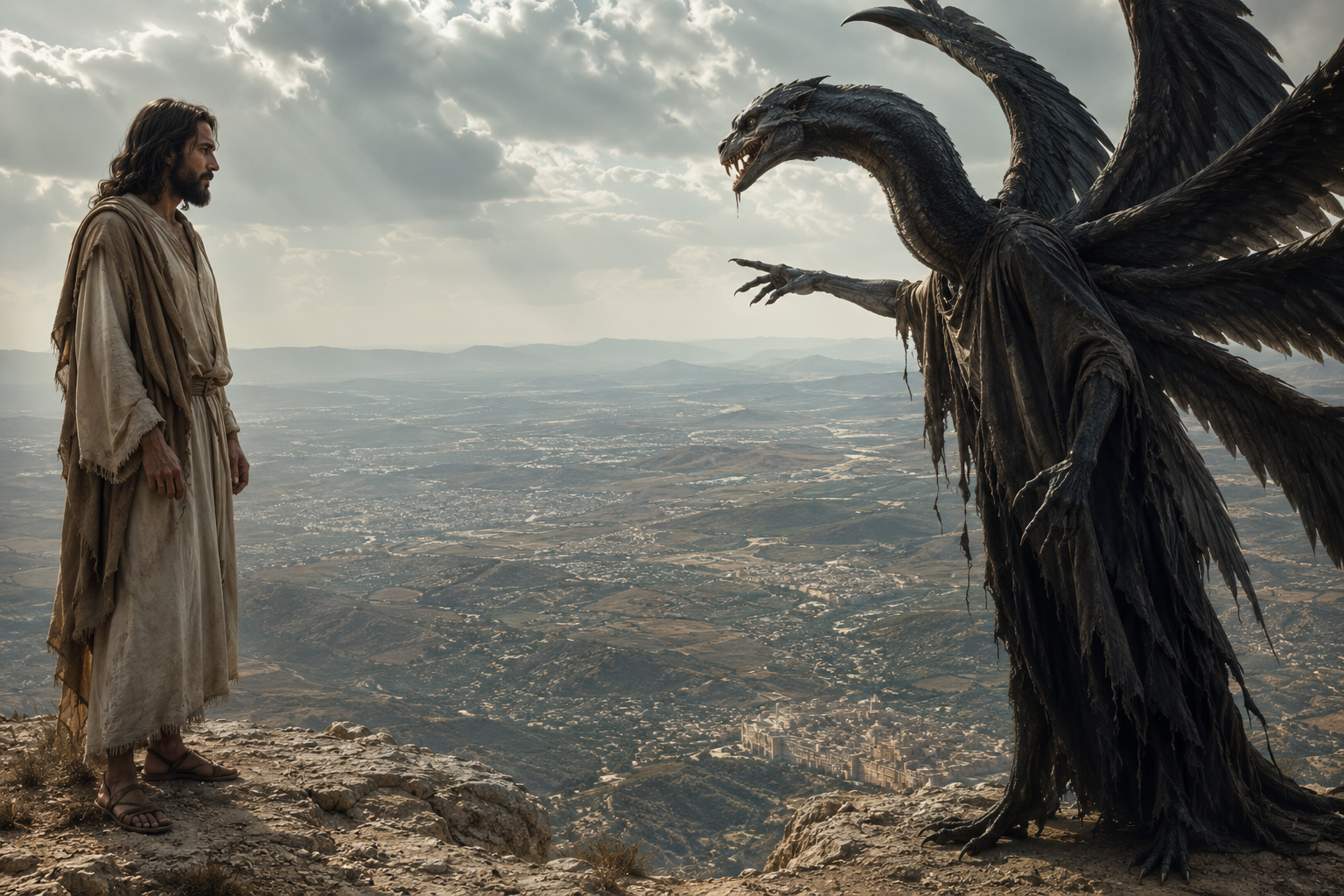
“Again, the devil took him to an exceedingly high mountain, and showed him all the kingdoms of the world and their glory. He said to him, ‘I will give you all of these things, if you will fall down and worship me.’ Then Jesus said to him, ‘Get behind me, Satan! For it is written, ‘You shall worship the Lord your God, and you shall serve him only.’ Then the devil left him, and behold, angels came and served him.” (Matthew 4:8–11, WEB, emphasis mine in bold).
Hopefully putting the words in bold helped you catch that. Satan basically inverts what Yahweh says in Psalm 2:8. “Ask of ME and I will give you all the nations of the world. This is what you came to do, right, Jesus? You came to reclaim the nations from the fallen sons of God. Well, I’ve become the sun god Apollyon, the head of the Roman pantheon. The head of the Roman pantheon. I’m the head god a Rome and Rome has conquered the entire known world. That means technically the entire world belongs to me. So I can give you all of this if you just ask me. The only thing I ask for an exchange is a little bit of worship. Don’t ask Yahweh for the nations of the world. Ask me, because all of this is kind and I can give it to whoever I choose” (cf. Deuteronomy 4:19-20, Deuteronomy 32:8-9, Psalm 82).
And given the Deuteronomy 32 Worldview, which, — if that’s new to you, I just recommend that you read some of my other blog posts and essays under the tag “Divine Council” because I can’t afford to keep re-explaining the foundations of it every time. — but given the Deuteronomy 32 Worldview, Satan was technically right that he owned the world at that time. The apostle Paul refers to Satan as “the god of this world” who has “blinded the minds of unbelievers.” (2 Corinthians 4:4).
I will never cease to be amazed that I am still discovering dots to be connected between biblical passages. St. Jerome continues to be vindicated in my eyes when he said that the scriptures are shallow enough for a baby to come and drink without fear of drowning and deep enough for a theologian to swim in without ever reaching the bottom. 
Well, apart from this being another cool Bible nerd moment where I get to think about Divine Council Worldview, I thought about how this can be preached in an application way. Satan’s main goal in life is to keep many people away from Yahweh as he can. He hates Yahweh with every fiber of his being, and he hates those who are made in his image, and he especially hates those who are loyal to him. He often tries to sell what my pastor likes to label “silly substitutes”. Pagan worship and pagan religion is a farce and is an imitation of worship of the one true God. The created gods, those spiritual entities behind the idols, are simply playing God. The gods are real (Psalm 82), and as Dr. Ronn Johnson pointed out in “EPO55: John 2:1-12: Exploring Jesus’ Miracles“, on The Divine Council Worldview Podcast, we have every biblical reason to think that they have some powers to affect the natural world. People who don’t get what they want out of Yahweh and who believe the gods are real and potent can be tempted to turn to them to get what they want if Yahweh isn’t giving affirmative answers to their prayers. This is why idolatry was so tempting in the Ancient Near East. They operated under what John Walton called “The Great Symbiosis” In his book “Ancient Near Eastern Thought and The Old Testament”.
Someone I know has been tempted to turn to witchcraft a few times because he knows that there are demonic powers behind witchcraft and he is living in an abusive situation that he can’t easily remove himself from, and Yahweh is not exacting vengeance on his adversary as he would like. He has successfully resisted that temptation with the help of the Lord and the armor of God, (Ephesians 6:12-20), particularly being protected by the shield of allegiance shielding him from those firey darts of the wicked one. But he now knows why idolatry was so tempting to the Israelites. The late Dr. Michael S. Heiser consistently emphasized that the Old Testament prohibitions against divination, sorcery, and necromancy (most famously found in Deuteronomy 18:9–14) were instituted because those practices actually tap into real spiritual power, not because they are empty, superstitious nonsense. In his view, magic works because human practitioners are soliciting real, hostile cosmic entities (demonic powers or rebellious elohim) who act on their behalf, which amounts to cosmic treason against Yahweh. [2]Michael S. Heiser, “Episode 325: Q&A 38,” The Naked Bible Podcast, audio podcast, June 2020, transcript available at https://nakedbiblepodcast.com. That’s why I said it was the shield of faith that protected my friend. In line with Matthew Bates, I take “faith” in the armor to be faith in its fullest sense; mental assent, trust, and allegience. [3]Matthew Bates, “Salvation By Allegience Alone: Rethinking Faith, Works, and The Gospel Of Jesus The King”, On pages 196-198 of his book. See also my essay “Evangelism: Non-Violent … Continue reading
But Satan and those spiritual beings who follow him do this kind of thing. They want to subvert Yahweh’s intentions. So when the heat is on and magic seems appealing, or you’re in Jesus’ position and you have the devil telling you that he’s just going to hand the nations over to you if you just become a Satanist for 15 seconds, all the while knowing that the real way to get back the nations is to go to the cross [4]Of course, Satan himself doesn’t know that, as we read in 1 Corinthians 2:7-8, if the rulers of this age understood the mystery of the gospel, they would not have crucified the Lord of glory.. When Baal seems like he might bless your crops because you can manipulate him, but you can’t manipulate Yahweh. Baal needs your grain offerings, burnt offerings, animal sacrifices, but Yahweh does not need any sacrifices and explicitly says as much in several passages (Psalm 50:10–12; Isaiah 1:11; Amos 5:21–22). Always remember where your loyalty lies, your allegiance, your faith. Remember that Satan is a liar and as Jesus said, when he lies, he speaks his native tongue because he is the father of lies (John 8:44). Satan tempted Eve in the Garden of Eden by casting doubt on God’s character and authority (Genesis 3:1–5). If she had stood on her allegiance to Yahweh, and relied on the truthfulness of his word, obeying what he said, the fall wouldn’t have happened. [5]I realize that it is somewhat controversial to say that the serpent in Genesis 3 is the devil. But I have made a cumulative biblical case for this in my essay “The Serpent In Eden: The Case For … Continue reading
The gods can be manipulated, but the gods are also capricious and unreliable. They might do something supernatural for your benefit or they might not. They might help you or they might not. They might hear you or they might not even know you exist. You know, that’s why the prophets of Baal had to spend all day dancing around, screaming, shouting, cutting themselves. They had to get Baal’s attention. All day long, and Baal didn’t respond. Baal, as a created elohim (Psalm 82:1; 86:8), either wasn’t in the area or had no idea what was going on or else Yahweh was actively keeping him from doing anything. In either case, Baal was either unreliable or impotent. But when Elijah spoke to Yahweh once, fire came down from heaven and consumed his altar (1 Kings 18:26–39).
I believe this is why Jesus says in His Sermon On The Mount, “And when you pray, do not heap up empty phrases as the Gentiles do, for they think that they will be heard for their many words. Do not be like them, for your Father knows what you need before you ask him.” (Matthew 6:7–8, ESV). Yahweh is faithful, unfailingly faithful (Deuteronomy 7:9; Lamentations 3:22–23). Yahweh is omnipotent, omniscient, omnipresent, morally perfect, and the Creator of all things (Job 42:2; 1 John 3:20; Psalm 139:7–10; Matthew 5:48; Genesis 1:1). He loves you more than you can imagine (Romans 8:38–39; Ephesians 3:18–19). He is what philosophers refer to as a “Maximally Great Being”.
That is why He and He alone is deserving of worship (Exodus 20:3-5; Revelation 4:11). That is why He and He alone is worthy of our praise! That is why He and He alone is to be the focal point of our lives. Yahweh doesn’t demand worship because he’s a narcissist and an egotist. He demands worship because a proper perspective is devotion to the Highest Good (The Summum Bonum), and He happens to be the Ultimate or Highest Good. God is not an insecure human demanding praise, but a loving Father redirecting our focus to the Ultimate. Idolatry is treating that which is not Ultimate as though it were (Romans 1:23-25). It’s to treat finite things as though they were infinite. It is a perversion. Jesus realized that worship of a being other than God was perverted, and though getting all the nations of the world is what he came for, he would not take Satan’s suggested shortcut. He responded “Get behind me, Satan! For it is written, ‘You shall worship the Lord your God, and you shall serve him only.’” (WEB). Jesus cited Deuteronomy 6:13. But He didn’t just quote a Bible verse from his own moody board back at his house in Nazareth. He had hidden the Word of God in His heart that He might not sin against The Father (Psalm 119:11), and he applied it! He obeyed it! He raised the shield of faithfulness and swung the sword of the Spirit (Ephesians 6:17) and dealt the final blow to the devil, causing him to flee with his forked tail between his legs. Will you imitate Jesus? Will you imitate God The Son? Will you give your allegiance to the God above all Gods? Will you trust Yahweh God with every single one of your wants and needs? Will you look to no other deity but Him?
As 1 Corinthians 8:4-6 says; “Therefore concerning the eating of things sacrificed to idols, we know that no idol is anything in the world, and that there is no other God but one. For though there are things that are called ‘gods’, whether in the heavens or on earth—as there are many ‘gods’ and many ‘lords’— yet to us there is one God, the Father, of whom are all things, and we for him; and one Lord, Jesus Christ, through whom are all things, and we live through him.” (WEB)
Now, Paul isn’t contradicting what he would later go on to say in 1 Corinthians 10:20, or the Old Testament’s affirmation of gods being real spiritual beings. Look at what he says. The WEB and other English translations add quotation marks as if Paul is just being sarcastic, but there were no quotation marks in the original Greek. Paul says “There are many gods and many lords – yet to us, there is one God.” There are many, Paul admits. But for us, for us who are Yahwhists, those of us who are Christians, there might as well be only one in all of existence. We don’t care about these other entities! They might as well not exist for all we care! We’re only going to worship one. Paul then goes on to describe God The Father and Jesus Christ in nearly identical terms to emphasize the divinity of both without conflating their personhood. [6]In my blog essay “Why You Should Believe In The Trinity: Responding To The WatchTower (Part 3)”, I wrote “Paul says there is one God. Who is this one God? The Father. It is the … Continue reading
In conclusion, if there’s anything we should take away from this it’s that the devil is subtle and crafty. He wants to take God’s place. Don’t let him. Also, as deeply as I’ve studied the account of the temptations of Jesus in Matthew 4, I still learned something new. While Satan deliberately twisted verses from Psalm 91 in his second temptation of Jesus, here I think we have a subtle allusion to Psalm 8:2, with Satan putting himself in Yahweh’s place, telling the Davidic King “Ask of me and I will give you all the nations of the world”. You might think you know all there is to a scripture passage, but you don’t, and neither do I. This is what makes Bible study so exciting! May we never cease desiring to go deeper and deeper in our study of God’s word.
By the way, if you would like a very powerful and helpful tool in helping you go deeper in your study of God’s word, consider getting Logos’s Bible software. Logos has recently made me an ambassador, if you click the link right here, you’ll get an extended free trial. The Logos Ambassador program extends a free extended trial to those in my community and allows me to earn additional revenue for those who utilize my link for a trial or any purchases.
References
| ↑1 | But see my essay “Psalm 22: A Look At The Darkest Psalm In The Bible“, and chapter 10 of my newest book “Eyewitnesses Of His Majesty: Why The Gospels Can Be Trusted – and the Case For The Resurrection Of Jesus” to see why I think both of these passages were genuine predictions of the death and resurrection of Jesus. |
|---|---|
| ↑2 | Michael S. Heiser, “Episode 325: Q&A 38,” The Naked Bible Podcast, audio podcast, June 2020, transcript available at https://nakedbiblepodcast.com. |
| ↑3 | Matthew Bates, “Salvation By Allegience Alone: Rethinking Faith, Works, and The Gospel Of Jesus The King”, On pages 196-198 of his book. See also my essay “Evangelism: Non-Violent Conquest Warfare” for a discussion of The Armor Of God in the context of spreading the Kingdom of Jesus across the world. |
| ↑4 | Of course, Satan himself doesn’t know that, as we read in 1 Corinthians 2:7-8, if the rulers of this age understood the mystery of the gospel, they would not have crucified the Lord of glory. |
| ↑5 | I realize that it is somewhat controversial to say that the serpent in Genesis 3 is the devil. But I have made a cumulative biblical case for this in my essay “The Serpent In Eden: The Case For A Seraph Named Satan” here on the Cerebral Faith blog. I draw heavily on the scholarly work of the late Dr. Michael S. Heiser from “The Unseen Realm: Recovering The Supernatural Worldview Of The Bible” and Ben Stanhope from his book “(Mis)Interpreting Genesis: How The Creation Museum Misunderstands The Ancient Near Eastern Context Of The Bible”. |
| ↑6 | In my blog essay “Why You Should Believe In The Trinity: Responding To The WatchTower (Part 3)”, I wrote “Paul says there is one God. Who is this one God? The Father. It is the Father from which all things came into being. Now, does Paul identifying ‘The Father’ as the one God negates Jesus being the one God? It can’t be. For if that were so, then Jesus being identified as the “One Lord” would mean that God The Father is no longer The Lord! It would mean that God was stripped of his title as ‘Lord’! So, if Jesus being the “one Lord” does not negate The Father also being the “One Lord”, then The Father being identified as the “One God” should not disqualify Jesus from being God. Moreover, The Father and Jesus are also spoken of as being responsible for creating all things. “One God, The Father, from whom all things came and for whom we live;’ is paralleled with ‘One Lord, Jesus Christ, through whom all things came and through whom we live.’ Remember from Part 1 in this series that passages like Job 9:8 and Isaiah 44:24 assert that God alone is responsible for the creation of the universe. Job 9:8 and Isaiah 44:24 preclude Yahweh from having any helping hands in creation. So if Jesus is the one through whom all things came, and this is also true of The Father, then either The Bible contradicts itself, modalism is true, or Trinitarianism is true. Given that The Bible is God’s word (2 Timothy 3:16) including The New Testament (2 Peter 3:16), and given the repeated distinctions between Jesus and His Father throughout The New Testament, the best explanation is that the doctrine of The Trinity is true.
Reread this section of scripture again! It’s almost as if Paul is trying to assert that there is only one God, that The Father is God, that Jesus is God, but that The Father and the Son are not the same person. It’s almost as if Paul is trying to assert monotheism and the deity of Jesus without accidentally making a statement that sounds like Modalism! It almost sounds like Paul is a good Trinitarian!” |
Discover more from Cerebral Faith
Subscribe to get the latest posts sent to your email.