Pastor Miles Bridges has been preaching through a sermon series on Genesis 1-11 at Powdersville First Baptist Church. I’ve been going to this church for a while, but haven’t been able to attend mid-week services due to my seemingly random work schedule. For weeks, Miles has been encouraging people to come on Wednesday nights to meet in the Choir Room, where we would be “going deeper” into the sermon Miles had preached that Sunday morning. I learned from the worship leader that this was a discussion-oriented period. Going deeper into The Bible? Having a discussion as a group? If you know me, you know that’s my jam. I asked my manager if I could consistently have Wednesdays off so I could attend, especially since Genesis is one of my favorite books of The Bible and one I’ve done the largest amount of research on. In the second week, we discussed the imago dei, the dominion mandate, some of the ways God’s creation is “very good”, and so on (Genesis 1:26-31). The first discussion question was “Do you see The Trinity in Genesis 1:26?” My answer to that was “no” and I explained my answer. However, given time constraints and wanting everyone in the room to be able to participate, my answer was much briefer than it ordinarily would have been. In this blog post, I want to explain my answer a bit more fully;
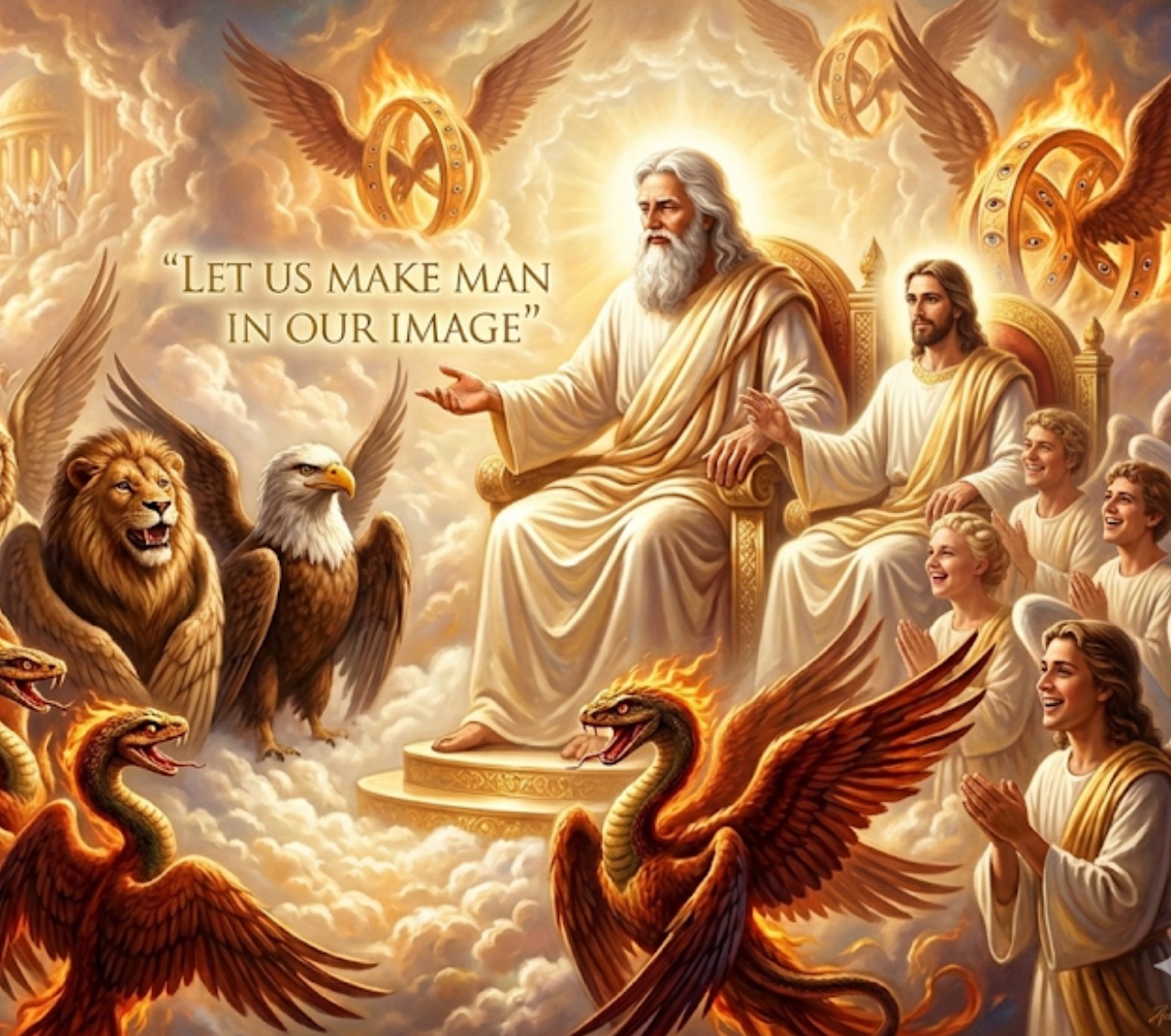
Genesis 1:26-27 says “Then God said, ‘Let us make man in our image, after our likeness. And let them have dominion over the fish of the sea and over the birds of the heavens and over the livestock and over all the earth and over every creeping thing that creeps on the earth.’ So God created man in his own image, in the image of God he created him; male and female he created them.” (ESV)
My View Stated
God The Father is not addressing other members of The Trinity, but members of The Divine Council, his angels if you will. He proposes that He make man in their image and likeness. Evidently, the divine council gave their approval, and so verse 27 describes God making man in His image. One of the most common objections to this reading is that if Yahweh says to a council of gods “Let us make man in our image”, then you have angelic beings participating in the creaton of human beings. But The Bible is clear that Yahweh Elohim made everything by Himself, He had no helpers (see Isaiah 44:24, Job 9:8). And so, it would seem to follow that Yahweh couldn’t be addressing a council here. This objection doesn’t work because it fails to understand that while the text presents the divine council as partaking in the decision, it also depicts Yahweh alone as being the sole Creator to bring it about. As the late biblical scholar Dr. Michael S. Heiser says “Genesis 1:27 tells us clearly that only God himself does the creating. In the Hebrew, all the verbs of creation in the passage are singular in form: ‘So God created humankind in his image, in the likeness of God he created him.’ The other members of the council do not participate in the creation of humankind. They watch, just as they did when God laid the foundations of the earth (Job 38:7).” [1]Dr. Michael S. Heiser, “The Unseen Realm: Recovering The Supernatural Worldview Of The Bible”, Lexham Press BA, Expanded Edition, page 46. Dr. Heiser also gives a helpful analogy; “If I am the one paying for the pizza, making the plan happen after announcing it, then I retain both the inspiration and the initiative for the entire project. That’s how Genesis 1:26 works.” [2]See, Dr. Michael S. Heiser, “The Unseen Realm: Recovering The Supernatural Worldview Of The Bible”, Lexham Press BA, Expanded Edition, page 46. Heiser’s point is spot on; if I say “Let’s get pizza”, and you all go “That’s a great idea! Let’s do it!” but then I get in the car, drive to the pizza place, pay for it, and then bring it back to the house, I’m still the one doing all the work.
Now that I’ve stated the view and refuted the most common objection to it; what are some positive reasons for thinking Yahweh is speaking to his divine council rather than other members of The Trinity? There are 2 reasons;
Reason 1: Ancient Near Eastern Creation Myths Consistently Have The High God Address A Council Before Creating Humans
If we really want to understand Genesis 1 (or the entire Old Testament for that matter), we need to get into the minds of the original author and audience as best we can. Often we can surmize what an author meant by looking at similar writings of the era in the same or similar genre. Based on my research, I’ve concluded that Genesis 1-11 belongs to a unique genre called “Mytho-History”. [3]For an in-depth defense of this, see William Lane Craig’s book “In Quest Of The Historical Adam: A Biblical and Scientific Exploration”, Eerdman’s September 28th 2021. In a nutshell, mytho-history is neither full-blown mythology (untrue stories with fantastically wild details) but neither is it straightforward literal historical reportage, such as 1 and 2 Samuel, 1 Kings, or the four gospels. Rather, they are historical narratives dressed up in mythological motifs. These are real events in a real past, but they are not recorded in a literal, sober straightforward way. [4]As arguments like The Kalam Cosmological Argument for God’s Existence and The Fine-Tuning Argument show, it is indeed a historical fact that God created and designed the universe. As such, I am not surprised to find Genesis 1 being a theologically true “creation myth” which interacts with the creation myths of Israel’s neighbors.
When exploring how ancient peoples understood the origins of humanity, comparing the Hebrew Bible with Ancient Near Eastern (ANE) literature reveals a fascinating mix of shared cultural language and radically different worldviews.
The motif of a high god announcing the creation of humanity to a divine council appears prominently in these traditions, but the purpose assigned to humanity in Genesis stands in sharp contrast to its neighbors.
- Genesis 1:26 – The Sovereign Announcement
In Genesis 1, the creation of the cosmos proceeds via effortless divine commands (“Let there be…”). However, when it comes to humanity, the language shifts to a collaborative, deliberative announcement to the heavenly host (the divine council):
“Then God said, ‘Let us make mankind in our image, in our likeness, so that they may rule over the fish in the sea and the birds in the sky…'” (Genesis 1:26)
The Council Context: The plural “Let us” reflects the high God (Elohim) speaking to His celestial court.
The Purpose: Humans are not created as an afterthought or as menial laborers. Instead, they are made in the “image and likeness” of the Creator, an ANE term usually reserved strictly for kings, to act as royal vice-regents or caretakers who exercise benevolent dominion over the earth.
- Enuma Elish – Creation for Divine Servitude
The Babylonian epic Enuma Elish (specifically Tablet VI) provides the closest structural parallel to this type of announcement, but with a completely inverted purpose. After defeating the chaos monster Tiamat, the champion god Marduk addresses the assembly of gods with a proposal:
“My blood will I take and bone will I fashion. I will create man who shall inhabit the earth, that the service of the gods may be established, and that they may be at ease.”
The Council Context: Marduk announces his master plan to his father Ea and the gathered pantheon. He uses the blood of the executed rebel god, Qingu, to fashion humanity.
The Purpose: The primary motivation is explicit relief for the gods. The junior deities are exhausted from digging canals and performing physical labor. Humanity is created to be a slave class, feeding and maintaining the temples so the gods can rest. [5]Lambert, Babylonian Creation Myths; Hallo and Younger, Context of Scripture, 1:111.
- Atrahasis
In this myth, the junior gods go on strike due to backbreaking labor. The high god Enlil convenes the divine assembly. The wise god Enki addresses the council and proposes that the birth-goddess Mami create a mortal creature to “bear the yoke” and carry the load of the gods. [6]Lambert, W. G., & Millard, A. R. (1969). Atra-Ḫasīs: The Babylonian Story of the Flood. Clarendon Press.
| Metric | Genesis 1 | Enuma Elish | Atrahasis / ANE Context |
| The Pronouncement | Elohim announces to the heavenly court: “Let us make man…” | Marduk announces to Ea and the assembly: “I will create man…” | Enki/Mami propose to the council a solution to the divine labor strike. |
| Raw Material | The breath of God / Dust of the ground. | The blood of a defeated, executed rebel god (Qingu) | Clay mixed with the blood of a slaughtered god. |
| Humanity’s Purpose | Dominion & Caretaking: To rule as royal representatives and enjoy a relationship with God. | Servitude: To do the irksome manual labor of the gods so they can rest. | Labor: To relieve the lower-tier gods from agricultural and civic drudgery. |
In the end, we see the book of Genesis turning the ideas of Israel’s neighbors upside down. While humans were created to serve Yahweh, we were not created just to be slave labor to do the dirty jobs Yahweh Himself didn’t want to do. We were created in the image of God, and therefore we have inherent dignity and value. And what the image of God means is threefold; (1) we are the images of God in the cosmic temple. [7]For great written defenses of The Cosmic Temple Inauguration interpretaton of Genesis 1, see John Walton “The Lost World Of Genesis One: Ancient Cosmology and The Origins Debate”, Downers … Continue reading The “idols of God” as Matthew Bates would say. [8]Bates, Matthew W. Salvation by Allegiance Alone: Rethinking Faith, Works, and the Gospel of Jesus the King. Grand Rapids, MI: Baker Academic: A division of Baker Publishing Group, 2017. … Continue reading (2) We are created to be children of God (cf. Genesis 5:3). and (3) We represent God visually to the rest of creation in the same sense that the statue of a king visually represented a king in the Ancient Near East and showed that his reign extended there. [9]Middleton, J. Richard. The Liberating Image: The Imago Dei in Genesis 1 (pp. 104-108). Baker Publishing Group. Kindle Edition. And this image is a status given to all of humanity, not just some, not just kings or priests, but to all human beings. This was radically counter cultural.
Reason 2: The Original Author and Audience Wouldn’t Have Seen The Trinity In Genesis 1:26
I am a big proponent of getting at the original authorial intent of any biblical text. That is the very heart of exegesis; reading meaning out of the text. Reading a foreign meaning into the text is the work of eisegesis. When reading any biblical passage, we have to ask the question “How would the original author have understood this?” or “How would the very first readers of this book taken this verse in their cognitive mindset?” I like to call it a “Hot Off The Presses” interpretation. Dr. Ronn Johnson of The Divine Council Worldview Podcast often refers to it as a “Left To Right Reading” of the biblical story. The original audience had no concept of God as a Triune being, and so to see The Trinity in Genesis 1:26′ plural language is to import meaning into the text. To be clear; sometimes biblical passages can have meaning that is deeper than what was originally understood at the time. Scholars refer to this as “sensus plenoria” or the “deeper sense” of scripture. [10]For discussion on Sensus Plenoria, see Donald K. Campbell, “Foreword,” in Basic Bible Interpretation: A Practical Guide to Discovering Biblical Truth, ed. Craig Bubeck Sr. (Colorado Springs, CO: … Continue reading Scholar Raymond Brown defines sensus plenoria as“that additional deeper meaning, intended by God but not clearly intended by the human author, which is seen to exist in the words of the biblical text (or group of texts, or even a whole book) when they are studied in the light of further revelation or development in the understanding of revelation.” [11]Raymond E. Brown, The “Sensus Plenior” of Sacred Scripture (Baltimore: St. Mary’s University, 1955), 92. Sensus Plenoria is definitely a feature of the biblical text. However, I am very strict about where I apply it. I typically reserve seeing more than a “Hot Off The Presses” interpretation if and only if a later biblical author alludes to an earlier event in biblical history, comments on an earlier biblical passage, and adds additional meaning. After all, 2 Timothy 3:16 says that all scripture is God breathed. So scripture is allowed to interpret scripture. Or to put it another way; The Holy Spirit is allowed to comment on His own work. For example, given that we know from The New Testament that The Holy Spirit is a person in his own right distinct from The Father or The Son, I have no trouble looking at Genesis 1:2 which says “The earth was without form and void, and darkness was over the face of the deep. And the Spirit of God was hovering over the face of the waters.” (ESV) and seeing the text attribute the creation of the cosmos to the third person of The Trinity. [12]For a good biblical and philosophical defense of The Trinity, see my three part essay series “Why You Should Believe In The Trinity: Responding To The WatchTower (Part 1)”, “Why You … Continue reading [13]This isn’t to say I believe only The Holy Spirit made the universe. I believe all three persons of The Trinity participated. It just depends on which passage of scripture you’re reading. … Continue reading If we had some biblical passage, say, in a letter by Paul, quoting Genesis 1:26 and Paul said that this was The Father speaking to His Son and The Holy Spirit, then I’d be fully on board with seeing The Trinity in Genesis 1:26. However, no later biblical author puts a Trinitarian spin on this verse, thus, I don’t see how we would be justified in doing so.
This is also not to say that the idea of a Godhead (multiple persons in one divine essence) cannot be defended from The Old Testament. I have made a case for a two person Godhead in my YouTube video “The Angel Of The Lord And A Two Person Godhead In The Old Testament“. In fact, as I point out in that video, there’s good grounds for seeing a two person Godhead even in later parts of the book of Genesis! [14]See my article “Yahweh or Yahweh’s Agent?: A Response To Ronn Johnson” here on the Cerebral Faith blog. Rather, there aren’t any good reasons to see the idea of a Trinity here. Now, with what I have said, I am open to the possibility that this could be the Ancient Of Days talking to The Son Of Man, but in light of the ANE parallels, I think Yahweh addressing his council is more likely.
Yahweh is clearly addressing someone. This is either one person of The Trinity talking to others, or it’s Yahweh talking to the heavenly host. Humans don’t exist yet, since their creation is the very subject of the passage. So, by process of elimination, if it’s not The Trinity, then The Divine Council is the only other available option.
Conclusion
Hopefully, you can see why I don’t affirm that The Trinity is in view in Genesis 1:26. Let me be clear; I do affirm the doctrine of The Trinity, and I’ve given thorough defenses of it in places like my 3 part response to The WatchTower as well as in articles like “Defending The Trinity From Mark Alone” and “Defending The Trinity From John Alone”. But due to there being so many ANE parallels of a high god announcing his decision to create man to a divine council, and given the foreign concept of The Trinity to the original readers of Genesis (at most, they would have had a Binitarian understanding of God), leaving a council of heavenly hosts the only other possible referent, I would agree with those biblical scholars who see this as The Bible’s very first Divine Council meeting.
References
| ↑1 | Dr. Michael S. Heiser, “The Unseen Realm: Recovering The Supernatural Worldview Of The Bible”, Lexham Press BA, Expanded Edition, page 46. |
|---|---|
| ↑2 | See, Dr. Michael S. Heiser, “The Unseen Realm: Recovering The Supernatural Worldview Of The Bible”, Lexham Press BA, Expanded Edition, page 46. |
| ↑3 | For an in-depth defense of this, see William Lane Craig’s book “In Quest Of The Historical Adam: A Biblical and Scientific Exploration”, Eerdman’s September 28th 2021 |
| ↑4 | As arguments like The Kalam Cosmological Argument for God’s Existence and The Fine-Tuning Argument show, it is indeed a historical fact that God created and designed the universe. |
| ↑5 | Lambert, Babylonian Creation Myths; Hallo and Younger, Context of Scripture, 1:111. |
| ↑6 | Lambert, W. G., & Millard, A. R. (1969). Atra-Ḫasīs: The Babylonian Story of the Flood. Clarendon Press. |
| ↑7 | For great written defenses of The Cosmic Temple Inauguration interpretaton of Genesis 1, see John Walton “The Lost World Of Genesis One: Ancient Cosmology and The Origins Debate”, Downers Grove IL, IVP, Chapters 7 and 8, “The Manifold Beauty Of Genesis One: A Multi-Layered Approach” by Gregg Davis and Kenneth Turner, Chapter 5, “Layer 5: Temple”, Kregel Academic, November 16th 2021, and “Genesis 1-3: Creation” by Douglas Van Dorn, “Chapter IV: Temple Building”, Waters Of Creation Publishing, 2026. I have also mounted my own defense of this view in my essay “Why I No Longer Think John Walton’s View On Genesis 1 Functions”, where I express disagreement with the idea that Genesis 1 doesn’t have a theology of material origins, but still agree with him that Genesis 1 presents the creation of the universe as the inauguration of God’s cosmic temple. |
| ↑8 | Bates, Matthew W. Salvation by Allegiance Alone: Rethinking Faith, Works, and the Gospel of Jesus the King. Grand Rapids, MI: Baker Academic: A division of Baker Publishing Group, 2017. “Chapter 7: Restoring The Idol Of God”. |
| ↑9 | Middleton, J. Richard. The Liberating Image: The Imago Dei in Genesis 1 (pp. 104-108). Baker Publishing Group. Kindle Edition. |
| ↑10 | For discussion on Sensus Plenoria, see Donald K. Campbell, “Foreword,” in Basic Bible Interpretation: A Practical Guide to Discovering Biblical Truth, ed. Craig Bubeck Sr. (Colorado Springs, CO: David C. Cook, 1991), 273–274. See also Grant R. Osborne, The Hermeneutical Spiral: A Comprehensive Introduction to Biblical Interpretation (Downers Grove, IL: IVP Academic, 2006), 576. |
| ↑11 | Raymond E. Brown, The “Sensus Plenior” of Sacred Scripture (Baltimore: St. Mary’s University, 1955), 92. |
| ↑12 | For a good biblical and philosophical defense of The Trinity, see my three part essay series “Why You Should Believe In The Trinity: Responding To The WatchTower (Part 1)”, “Why You Should Believe In The Trinity: Responding To The WatchTower (Part 2)”, and “Why You Should Believe In The Trinity: Responding To The WatchTower (Part 3)” |
| ↑13 | This isn’t to say I believe only The Holy Spirit made the universe. I believe all three persons of The Trinity participated. It just depends on which passage of scripture you’re reading. For example, John 1:1-3 depicts The Father creating the universe through The Son (The Word) as a means. Colossians 1:15-16 straight up says that Jesus Christ created the universe. 1 Corinthians 8:6 in a parallelistic way attributes the creation of the universe to both The Father and The Son, using different phrasing in each cola. |
| ↑14 | See my article “Yahweh or Yahweh’s Agent?: A Response To Ronn Johnson” here on the Cerebral Faith blog. |
Discover more from Cerebral Faith
Subscribe to get the latest posts sent to your email.