
In Genesis 1:26-27, at the end of the creation days, we hear God announcing to his divine council, “Then God said, ‘Let us make man in our image, after our likeness. And let them have dominion over the fish of the sea and over the birds of the heavens and over the livestock and over all the earth and over every creeping thing that creeps on the earth.’ So God created man in his own image, in the image of God he created him; male and female he created them.” (ESV) [1]See my previous blog post “Why I think Yahweh Addresses His Divine Council In Genesis 1:26” for a defense of why I take this reading over the popular Evangelical interpretation that this … Continue reading This doctrine has baffled me for most of my life. Growing up in church, no one really seemed to know what it meant other than it meant we were “the crown jewel of God’s creation”, that we were special, that we were ontologically more important than all the other creatures on Earth. Once I got into studying Christian Apologetics and theology as a teenager, I ran into an explanation I gravitated to for a while, which I call “The Cognitive Faculties” view. This view is most common among theologians and pastors, but it’s increasingly being abandoned (rightly, as I’ll show in a moment) by biblical scholars. The problem is that many of us are unfamiliar with the Ancient Near Eastern contex in which The Old Testament was written, and therefore, there are some things that go over our modern heads. Moses and other biblical writers didn’t spoon feed everything to their audience since they assumed their writers would understand things like imaging a deity. Just as a modern writer won’t explain what certain common idioms mean, because they assume their contemporaries knows what it means to say, for example, “It’s raining cats and dogs.” We don’t write for people thousands of years in the future who live in an entirely different culture. As biblical scholar John Walton often says “The Old Testament does communicate to us and it was written for us, and for all humankind. But it was not written to us. It was written to Israel. It is God’s revelation of himself to Israel and secondarily through Israel to everyone else.” [2]Walton, John H. The Lost World of Genesis One: Ancient Cosmology and the Origins Debate (p. 9). InterVarsity Press. Kindle Edition. Therefore, we need to look for a “Hot Off The Presses” interpretation of The Image Of God, rather than philosophizing within our modern framework.
The Cognitive Faculties View – Why I Reject It.
This view states that what it means to be made in God’s image is that we have certain cognitive abilities that God has – albeit on a lower level – such as the ability to reason, exercise libertarian free will, and know the difference between right and wrong. Chimpanzees, dogs, and other kinds of creatures don’t possess these attributes, and therefore, they don’t have the image. Our ability to use logic and abstract thinking, act contrary to pure animalistic instinct, and possession of a moral compass are said to be uniquely human attributes.
This sounds plausible on the surface, but there are major problems with it. In his book “The Unseen Realm”, the late biblical scholar Michael Heiser wrote “The problem with defining the image by any of these qualities is that, on one hand, nonhuman beings like animals possess some of these abilities, although not to the same extent as humans. If one animal anywhere, at any time, learned anything contrary to instinct, or communicated intelligently (to us or within species), or displayed an emotional response (again to us or other creatures), those items must be ruled out as image bearing.” [3]Heiser, Michael S.. The Unseen Realm: Recovering the Supernatural Worldview of the Bible (p. 41). Lexham Press. First Edition. Kindle Edition. He went on to say “The pro-life position is based on the proposition that human life (and so, personhood) begins at conception (the point when the female egg is fertilized by the male sperm). The simple-celled zygote inside the woman’s womb, which pro-lifers believe to be a human person, is not self-aware; it has no intelligence, rational thought processes, or emotions; it cannot speak or communicate; it cannot commune with God or pray; and it cannot exercise its will or respond to the conscience. If you want to argue that those things are there potentially, then that means that you have only a potential person. That’s actually the pro-choice position. Potential personhood is not actual personhood. This thought process would mean that abortion is not killing until personhood is achieved, which nearly all pro-choicers would certainly consider to be after birth.” [4]Heiser, Michael S.. The Unseen Realm: Recovering the Supernatural Worldview of the Bible (pp. 41-42). Lexham Press. First Edition. Kindle Edition. And it isn’t just developing fetuses which we would have to deem as not bearing God’s image, but people in comas, or people who have had lobotomies, would also somehow lose the imago dei. Reducing Imago Dei to the posession (never mind active use) of certain mental properties opens the door to dehumanizing those who either don’t yet have, or have lost those mental properties. I am pro-life, and I know most Christians are as well. Unless one wants to concede the debate to the pro-choice crowd, one should abandon a purely substantialist approach to what The Image Of God is.
Another problem is that certain animals do display high levels of intelligence. My mind immediately thinks of gorillas who can communicate that they want a banana to the zookeeper via sign language and other thoughts going on in their gorilla brains. Granted, you can’t have a philosophical debate with a gorilla via sign language, but this is still a level of communication that’s much higher than your dog barking at something. The fact is, you’re either made in the image of God or you aren’t. Making the Imago Dei (Latin for Image Of God) into a set of attributes would mean that some creatures are more of a divine image than others. Are gorillas who know sign language slightly made in the image of God because of their limited language abilities, while humans have a large quantity of the image in us? Actually, even among humans our abilities to reason and think differ among us. Was Albert Einstein more of an imager than a mentally retarded person? Einstein’s thinking capacity far exceeded both those with mental disabilities AND gorillas. So that would seem to logically follow.
Finally, the Hebrew word for “image” is “tselem”. A tselem is something that can be seen. (See Ezekiel 26:17 where the word is used to refer to idols, and 1 Samuel 6:5 where it is used to refer to images of tumors and mice made of gold, for examples). You can’t see a set of mental faculties. Reducing the image to merely a set of attributes is incoherent. Aside from the logical incoherence of The Cognitive Faculties view, or “The Substantialist View” as Dr. William Lane Craig calls it, [5]Craig, William Lane. In Quest of the Historical Adam: A Biblical and Scientific Exploration. Grand Rapids, MI: William B. Eerdmans Publishing Company, 2021. p 365 the very word “Image” suggests something that can be seen with the eyes.
Now, this does not mean that these attributes are completely unrelated to the doctrine of Imago Dei. I believe they are necessary pre-requisites to imaging God in a verbal sense. Gorillas and donkeys can’t be good representatives of God because they either completely lack or don’t have advanced enough versions of these attributes to do any acts of imaging. Rather, it is to say they are not the image in and of themselves. And even if you’re not imagING God at all (due to being an undeveloped zygote, or comatose), you’re still an image. An image is what you are. ImagING is what you do.
The Representative View
The view I hold, and the one that has become the most widely accepted among biblical scholars, is what is sometimes called “The Representative View” [6]For a small sampling of biblical scholars who endorse this view and the arguments behind it, see Dr. Michael S. Heiser, “The Unseen Realm: Recovering The Supernatural Worldview Of The … Continue reading This view asserts that human beings are the visible representations of God on Earth. We visually, physically represent God to each other and the rest of creation.
Within this interpretation, there are three sub-interpretations of how exactly we are to understand ourselves as images. Scholars come to the conclusion that we are images through three different routes. I myself do not think these three contexts of imaging are mutually exclusive, and the Ancient Near Eastern and biblical data seems to support all three. And so, just as I find Genesis 1 itself to be a theologically rich, multifaceted diamond [7]See the book “The Manifold Beauty Of Genesis One: A Multi-layered Approach” by Gregg Davidson and Kenneth J. Turner for the many non-mutually exclusive layers of Genesis 1., so I also find this to be the case with the divine image.
1: Idols Of God In His Cosmic Temple
Genesis 1 teaches that God made the universe to be His cosmic temple. The first clue to this lies in the profound sacred significance of the number seven. As Old Testament scholar John H. Walton notes, the pervasive appearance of seven-day structures in ancient temple accounts suggests that the Genesis creation week is intimately tied to a temple inauguration ceremony. [8]Walton, John H.. The Lost World of Genesis One: Ancient Cosmology and the Origins Debate (p. 87). InterVarsity Press. Kindle Edition. Throughout the Bible, the number seven consistently signals sacred completeness, particularly regarding the Tabernacle and the Jerusalem Temple. For instance, the Tabernacle’s construction was completed in seven stages (Exodus 40:19-32), priestly ordinations lasted seven days (Leviticus 8:33-35) , and Solomon’s temple took seven years to build (1 Kings 6:38), followed by a seven-day dedication festival (1 Kings 8:2, 65).
The numerical patterning goes far deeper than just the division of days, becoming intricately woven into the very vocabulary of the text. As biblical scholar Ben Stanhope writes:
“Most Bible readers are aware that the Old Testament frequently uses the number seven as a symbol for completion and sacred order. However, you may not have noticed before that Genesis 1 has the number seven woven into the structure of creation through literary patterns beyond just its divisions of days. Many important words and phrases in Genesis 1 repetitively turn up in sequences of seven when counted up in the original Hebrew. Jeff Morrow at Seton Hall University summarizes these patterns that have long been marveled at by biblical scholars:[306] In Hebrew, Gen 1:1 contains seven words; 1:2 has fourteen words (2×7), and “God” occurs thirty-five times (5×7) in the seven-day account. The term “earth” occurs twenty-one times (3×7); “heavens/firmament” twenty-one times (3×7); the phrase “and it was so” appears seven times, as well as the phrase, “God saw it was good.” The important words “light” and “day” are found seven times in the first natural paragraph, and there are seven references to light in the fourth paragraph. In the section dealing with the creation of animals, the Hebrew word for Living beings” occurs seven times. In the seventh paragraph, which deals with the seventh day, there occur three consecutive sentences that each contains seven words and the phrase “seventh day” in the center. Moreover, the Hebrew words in the seventh paragraph total thirty-five (5×7).” [9]Stanhope, Ben. (Mis)interpreting Genesis: How the Creation Museum Misunderstands the Ancient Near Eastern Context of the Bible (pp. 137-138). Scarab Press. Kindle Edition. [10]See also See Gordon J. Wenham, Genesis 1-15. Word Biblical Commentary Vol. 1 (Waco, Texas: Word Books, 1987), 7.
Given this intentional design, it is highly unlikely the author framed creation around seven days merely because of a literal timeframe. Rather, it serves as a deliberate literary device to establish the sacredness of the universe. This cultural and literary signal would have been immediately clear to an Ancient Near Eastern audience, who closely linked creation with temple building. In Mesopotamian and Ugaritic traditions, the ultimate goal of a creator deity was to establish a royal palace-temple from which to rule. Ancient texts like the Gudea Cylinder and various Ugaritic records explicitly culminate the work of creation with the erection of a divine sanctuary.
In fact, ancient creation myths frequently describe the pre-creation chaos specifically as a time when no temples existed. The Temple Hymn of Keš extols a sacred house planned alongside the blueprints of heaven and earth, anchoring the stability of the land itself. [11]http://etcsl.orinst.ox.ac.uk/section4/tr4802.htm Similarly, the bilingual creation text known as the Founding of Eridu opens its creation account by lamenting that the holy house of the gods had not yet been made, emphasizing that before cities, reeds, or creatures were formed, the primary lack was a divine habitation. [12]The Seven Tablets of Creation, by Leonard William King, [1902], at sacred-texts.com, http://www.sacred-texts.com/ane/stc/stc15.htm To the ancient mind, a world without a temple was a world uncreated.
This cosmic temple imagery is not unique to Genesis; it echoes throughout the rest of Scripture. In Isaiah 66:1-2, God declares that heaven is His throne and the earth is His footstool, questioning what physical house humans could possibly build for Him since His own hands already formed this cosmic dwelling. As scholar J. Richard Middleton points out, the text implies that God has no need for a humanly constructed building because He has already built a superior, cosmic sanctuary. This vast domain functions as His palace, seamlessly equating the cosmic temple with the borders of His kingdom. [13]Middleton, J. Richard. The Liberating Image (p. 81). Baker Publishing Group. Kindle Edition.
This brings us to the profound ancient concept of divine “rest.” Psalm 132:7–8 describes the Jerusalem temple as God’s “resting place,” the destination where He goes to dwell. When God “rests” on the seventh day of Genesis 1, He is not recovering from exhaustion; He is taking up residence in His newly completed cosmic temple to rule over it. Because Isaiah 66 establishes the heavens and earth as His throne and footstool, we can confidently infer that the creation week is the construction of this cosmic sanctuary, culminating in God taking His throne.
Viewed this way, the Imago Dei takes on its true, breathtaking significance. In the Ancient Near East, the very last step of a temple inauguration, occurring right before the deity’s spirit moved in to rest, was the installation of the god’s image or statue. By placing humanity in the garden on the final day, Genesis demonstrates that God followed this exact pattern. The universe is His cosmic temple, and humanity was installed as the living, breathing images of the Creator, designed to reflect His presence and rule throughout the world. By structuring Genesis 1 as a Cosmic Temple Inauguration, the text screams a specific reality to the ancient reader: the universe is God’s temple, and humanity is the living idol placed inside it to reflect His presence.
2: We Are All (meant to be) God’s Children
A second interpretation links the image of God to the fatherhood of God. Genesis 5:3 says “When Adam had lived 130 years, he fathered a son in his own likeness, after his image, and named him Seth.” (ESV) David L. Turner writes “In Genesis 5:1–3, after God’s image-bearers had sinned against him, the language of Genesis 1:26–27 is repeated as a prelude to a list of Adam’s posterity. Significantly, this passage links God’s original creation of humans in his likeness with the subsequent human procreation of children in Adam’s image and likeness.” [14]David L. Turner, “Image of God,” in Evangelical Dictionary of Biblical Theology, electronic ed., Baker Reference Library (Grand Rapids: Baker Book House, 1996), 366. Since Adam was the father of Seth and Seth is said to be made “in the image and likeness” of Adam, perhaps the author is telegraphing that humans “look like” their Heavenly Father. God is spirit (John 4:24), so this isn’t literally the case, but symbolically speaking. We all know instances in which a person’s children look just like their fathers. In fact, this can even happen cross-gendered. My cousin Lauren has a son named Jameson who is the spitting image of her when she was a toddler. In fact, I found a photo of her one day and honestly mistook it as an image of her son! Being children of God was not a New Testament plan B. It was not something Yahweh decided to do thousands of years into human history with the coming of Jesus (see John 1:12, Romans 8:14-15, 1 John 3:1-3).
Again, this is not to fall into some weird Mormon concept that we are corporeal images of a corporeal God. The Bible is clear that God is omnipotent (Job 42:2; Matthew 19:26; Revelation 19:6), omniscient (Psalm 147:5; 1 John 3:20), omnipresent (Psalm 139:7-10; Jeremiah 23:23-24), morally perfect (Deuteronomy 32:4; Matthew 5:48; 1 John 1:5), and the Creator of all things other than Himself (Genesis 1:1; Nehemiah 9:6; John 1:3; Colossians 1:15-16), which would include all matter, energy, space, and time. And we know this independently through science and philosophy via The Kalam Cosmological Argument for God’s Existence. Yahweh is a Maximally Great Being who exists in all possible worlds, including possible worlds with no matter or space (see The Ontological Argument for God’s Existence). The idea that we are the spitting image of our Heavenly Father is, therefore, merely a theological metaphor for our relationship to Him. This also doesn’t imply that “we are all God’s children”. John 1:12 makes it clear that to become a child of God, we need to believe in Jesus, and then we’ll be “given the right to become children of God”. Although I have toyed with the idea that there are “adopted sons” versus “prodigal sons”. (Luke 15:11-32). Alluding to Jesus’ parable where a man’s son goes off and is relationally cut off from his father until he repents and comes home. In any case, I think the Imago Dei speaks to God’s intention that all of humanity would be or become his sons and daughters (cf. 2 Peter 3:9, 1 Timothy 2:4-6).
3: Representing Yahweh The King In Creation
J. Richard Middleton, in his book “The Liberating Image: The Imago Dei In Genesis 1” is perhaps the primary scholar who champions this idea. Middleton explains that it was a common practice in the Ancient Near East for kings and pharaohs to set up statues of themselves in areas where they couldn’t be physically present, so that they could remind the inhabitants of the land that he was sovereign there. God/Jesus is The King of Kings, and so, what we find — especially connecting the concept of The Image Of God to God announcing to his divine council “let us make man in our image” — is that Yahweh is sovereign over the entire cosmos. This is due to the simple fact that Yahweh Elohim has imagers in the heavens (the divine council) and on earth (humans). Genesis 1:1 said, “In the beginning, God created the heavens and the earth”. Eugene Carpenter and Philip Comfort identify “the heavens and the earth” in Genesis 1:1 as a merismus—a literary device that expresses totality by pairing opposite extremes. [15]Eugene E. Carpenter and Philip W. Comfort, in Holman Treasury of Key Bible Words: 200 Greek and 200 Hebrew Words Defined and Explained (Nashville, TN: Broadman & Holman Publishers, 2000), 85. Philip Jenson similarly notes that this phrase represents the whole universe and appears in the opening of the Babylonian Creation epic (Enuma Elish). [16]Philip P. Jenson, “Poetry in the Bible,” in New Bible Commentary: 21st Century Edition, ed. D. A. Carson et al. (Leicester, England; Downers Grove, IL: Inter-Varsity Press, 1994), 455.
David Atkinson observes that the phrase frames the entire Genesis 1 account (appearing at 1:1, 2:1, and 2:4a) and, while signifying everything, also carries a meaningful distinction. For Atkinson, heaven represents God’s realm while earth represents humanity’s realm. [17]David Atkinson, The Message of Genesis 1–11: The Dawn of Creation, ed. J. A. Motyer and Derek Tidball, The Bible Speaks Today (England: Inter-Varsity Press, 1990), 55.
Tremper Longmann III writes, “Since the biblical text never specifically defines ‘image,’ its meaning has been debated through the centuries. However, it seems reasonable to understand the ‘image of God’ on analogy with the ancient practice of ancient Near Eastern kings setting up images of themselves throughout their realm. Perhaps the most striking confirmation of this idea can be found in the ninth-century BC Aramaic-Akkadian inscription on a statue from Tell Fakhariyeh in the Upper Habur of Syria, which refers to the statue as a ‘likeness’ and ‘image’ of King Hadadyis’i. In the words of Brueggemann, ‘It is now generally agreed that the image of God reflected in human persons is after the manner of a king who establishes himself to assert his sovereign rule where the king himself cannot be present.'”[18]Tremper Longman III, Genesis, ed. Tremper Longman III, The Story of God Bible Commentary (Grand Rapids, MI: Zondervan, 2016), 36.
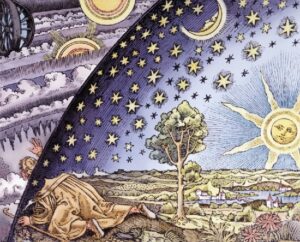
And so, given that the divine council is made in God’s image, and humans are made in God’s image, then God has “statues” of Himself in all areas of creation. This telegraphs to the reader of The Bible that God is sovereign over all of creation. [19]Of course, I am keeping in mind the three-tiered structure of biblical cosmology. The picture falls apart if we think about this in terms of modern cosmology. For in that case, you just have imagers … Continue reading If it seems objectionable to you that even the angelic host should bare God’s image, think of this; there is no interpretation of the imago dei that any theologian has ever presented that keeps divine beings out. Let’s take The Cognitive Faculties view of imago dei common among Christian philosophers. If you’ll remember, this is the view that the “image” is our rationality, free will, and moral compass. Well, do angels and demons not have these cognitive faculties? Of course they do! Likewise, are angelic beings not God’s offspring? They are! Genesis 6:1-4, Job 1:6, Job 2:1, Job 38:7, and Psalm 82:6 all call celestial or divine beings “sons of God”. [20]I know that the Genesis 6 and Psalm 82 examples are controversial, but see my other writings on this site on the divine council worldview, such as “Genesis 6: The Nephilim – Descendents Of … Continue reading And angels certainly seem to be representing God when they show up to humans to deliver messages to them. Moreover, there is no verse in The Bible that explicitly states that only humans are made in God’s image, in such a way that would exclude the heavenly host. And it becomes even less plausible when one thinks about the theological matrix of ideas surrounding sonship, the sons of God, and the eschatological destiny of believing humans to replace the fallen sons of God in the divine council. Space doesn’t permit a discussion of this for those who are unfamiliar, but the gold standard resource would be Michael Heiser’s “The Unseen Realm: Recovering The Supernatural Worldview Of The Bible”, now in an updated and expanded edition.
Summary and Conclusion
This blog post was meant to be a brief primer on the topic of The Image of God. I had to resist the urge to respond to certain objections to things I’ve said here and there, as I want to get back into the habit of writing more normal-length blog post, not academic papers that take an hour and a half to read, and 5 days to write! For those who would like to go deeper, I recommend J. Richard Middleton’s “The Liberating Image: The Imago Dei in Genesis One” and Carmen Imes’ “Being God’s Image: Why Creation Still Matters” for scholarly and popular level books, respectively.
The Image of God is not a rigid, singular definition, but a multifaceted diamond nestled within the larger diamond of the Genesis creation account. If scholars like John Walton, J. Richard Middleton, and Ben Stanhope are correct that Genesis 1 depicts the creation of the universe as a cosmic temple, the Imago Dei serves a brilliant, polemical function. In the Ancient Near East, the final act of a temple’s inauguration was the installation of the deity’s idol. By placing humanity in the cosmic sanctuary on the sixth day, the text positions us as the living, breathing “idols” of Yahweh, directly mirroring and subverting pagan temple practices.
Beyond this liturgical function, the image also carries a profound relational and familial meaning. Genesis 5:3 explicitly links the language of “image and likeness” to fatherhood, noting that Adam begot Seth in his own likeness. This reveals that our identity as children of God is not a late New Testament development, but His original, foundational blueprint for humanity. Just as children naturally and undeniably resemble their parents across generations, humanity was designed from the very beginning to reflect the character and presence of our Heavenly Father.
Finally, the Imago Dei encompasses a royal, political dimension. Just as ancient kings erected statues of themselves to mark the boundaries of their sovereign rule, humans are placed on earth as living statues representing Yahweh’s authority and cosmic kingdom. When God declares, “Let us make man in our image,” He is addressing His heavenly divine council—His spiritual images in the heavenly domain. While the grammar confirms that Yahweh alone performs the act of creation, this framing establishes that humans were created to be the earthly counterparts to the heavenly host, tasked with reflecting God’s rule and extending His sacred presence throughout the earth.
References
| ↑1 | See my previous blog post “Why I think Yahweh Addresses His Divine Council In Genesis 1:26” for a defense of why I take this reading over the popular Evangelical interpretation that this is one member of The Trinity addressing the other two. |
|---|---|
| ↑2 | Walton, John H. The Lost World of Genesis One: Ancient Cosmology and the Origins Debate (p. 9). InterVarsity Press. Kindle Edition. |
| ↑3 | Heiser, Michael S.. The Unseen Realm: Recovering the Supernatural Worldview of the Bible (p. 41). Lexham Press. First Edition. Kindle Edition. |
| ↑4 | Heiser, Michael S.. The Unseen Realm: Recovering the Supernatural Worldview of the Bible (pp. 41-42). Lexham Press. First Edition. Kindle Edition. |
| ↑5 | Craig, William Lane. In Quest of the Historical Adam: A Biblical and Scientific Exploration. Grand Rapids, MI: William B. Eerdmans Publishing Company, 2021. p 365 |
| ↑6 | For a small sampling of biblical scholars who endorse this view and the arguments behind it, see Dr. Michael S. Heiser, “The Unseen Realm: Recovering The Supernatural Worldview Of The Bible”, Expanded Edition, Lexham Press, page 49, J. Richard Middleton, “The Liberating Image: The Imago Dei In Genesis 1”, Brazos 2005, Carmen Joy Imes, “Being God’s Image: Why Creation Still Matters” , Downers Grove, IL: IVP Academic: An Imprint of InterVarsity Press, 2023. John H. Walton, “The Lost World Of Adam and Eve: Genesis 2-3 and The Human Origins Debate”, IVP Academic 2015, page 42 of the Kindle edition, location 570 of 4501 |
| ↑7 | See the book “The Manifold Beauty Of Genesis One: A Multi-layered Approach” by Gregg Davidson and Kenneth J. Turner for the many non-mutually exclusive layers of Genesis 1. |
| ↑8 | Walton, John H.. The Lost World of Genesis One: Ancient Cosmology and the Origins Debate (p. 87). InterVarsity Press. Kindle Edition. |
| ↑9 | Stanhope, Ben. (Mis)interpreting Genesis: How the Creation Museum Misunderstands the Ancient Near Eastern Context of the Bible (pp. 137-138). Scarab Press. Kindle Edition. |
| ↑10 | See also See Gordon J. Wenham, Genesis 1-15. Word Biblical Commentary Vol. 1 (Waco, Texas: Word Books, 1987), 7. |
| ↑11 | http://etcsl.orinst.ox.ac.uk/section4/tr4802.htm |
| ↑12 | The Seven Tablets of Creation, by Leonard William King, [1902], at sacred-texts.com, http://www.sacred-texts.com/ane/stc/stc15.htm |
| ↑13 | Middleton, J. Richard. The Liberating Image (p. 81). Baker Publishing Group. Kindle Edition. |
| ↑14 | David L. Turner, “Image of God,” in Evangelical Dictionary of Biblical Theology, electronic ed., Baker Reference Library (Grand Rapids: Baker Book House, 1996), 366. |
| ↑15 | Eugene E. Carpenter and Philip W. Comfort, in Holman Treasury of Key Bible Words: 200 Greek and 200 Hebrew Words Defined and Explained (Nashville, TN: Broadman & Holman Publishers, 2000), 85. |
| ↑16 | Philip P. Jenson, “Poetry in the Bible,” in New Bible Commentary: 21st Century Edition, ed. D. A. Carson et al. (Leicester, England; Downers Grove, IL: Inter-Varsity Press, 1994), 455. |
| ↑17 | David Atkinson, The Message of Genesis 1–11: The Dawn of Creation, ed. J. A. Motyer and Derek Tidball, The Bible Speaks Today (England: Inter-Varsity Press, 1990), 55. |
| ↑18 | Tremper Longman III, Genesis, ed. Tremper Longman III, The Story of God Bible Commentary (Grand Rapids, MI: Zondervan, 2016), 36. |
| ↑19 | Of course, I am keeping in mind the three-tiered structure of biblical cosmology. The picture falls apart if we think about this in terms of modern cosmology. For in that case, you just have imagers on one tiny rock in a vast cosmos, with “angels” being in a whole other dimension. We have to keep in mind that the original author and audience didn’t think of Earth and a “solar system” as we do. This doesn’t mean The Bible teaches this cosmology necessarily, but it does mean that God accommodated His theological message to the cosmology of their day. For resources on this, see See Peter Enns, “The Firmament Of Genesis 1 Is Solid, But That’s Not The Point”, January 14th 2010, BioLogos.org, –> https://biologos.org/articles/the-firmament-of-genesis-1-is-solid-but-thats-not-the-point, Ben Stanhope “The Solid Sky Dome Of Biblical Cosmology and The Ancient Near East”, June 19th 2018, — https://www.youtube.com/watch?v=c8Jz4tvlhZM, “From the Mailbag: Why would God allow scientific errors in the Bible?” By Christy Hemphill , Gregg Davidson and Ted Davis on September 15, 2016, on BioLogos.org. –> https://biologos.org/articles/from-the-mailbag-why-would-god-allow-scientific-errors-in-the-bible |
| ↑20 | I know that the Genesis 6 and Psalm 82 examples are controversial, but see my other writings on this site on the divine council worldview, such as “Genesis 6: The Nephilim – Descendents Of Cain, Neanderthals, Ancient Kings, or Angel-Human Hybrids?” and “In Defense Of The Divine Council Worldview – A Response To Marcia Montenegro” |
Discover more from Cerebral Faith
Subscribe to get the latest posts sent to your email.