
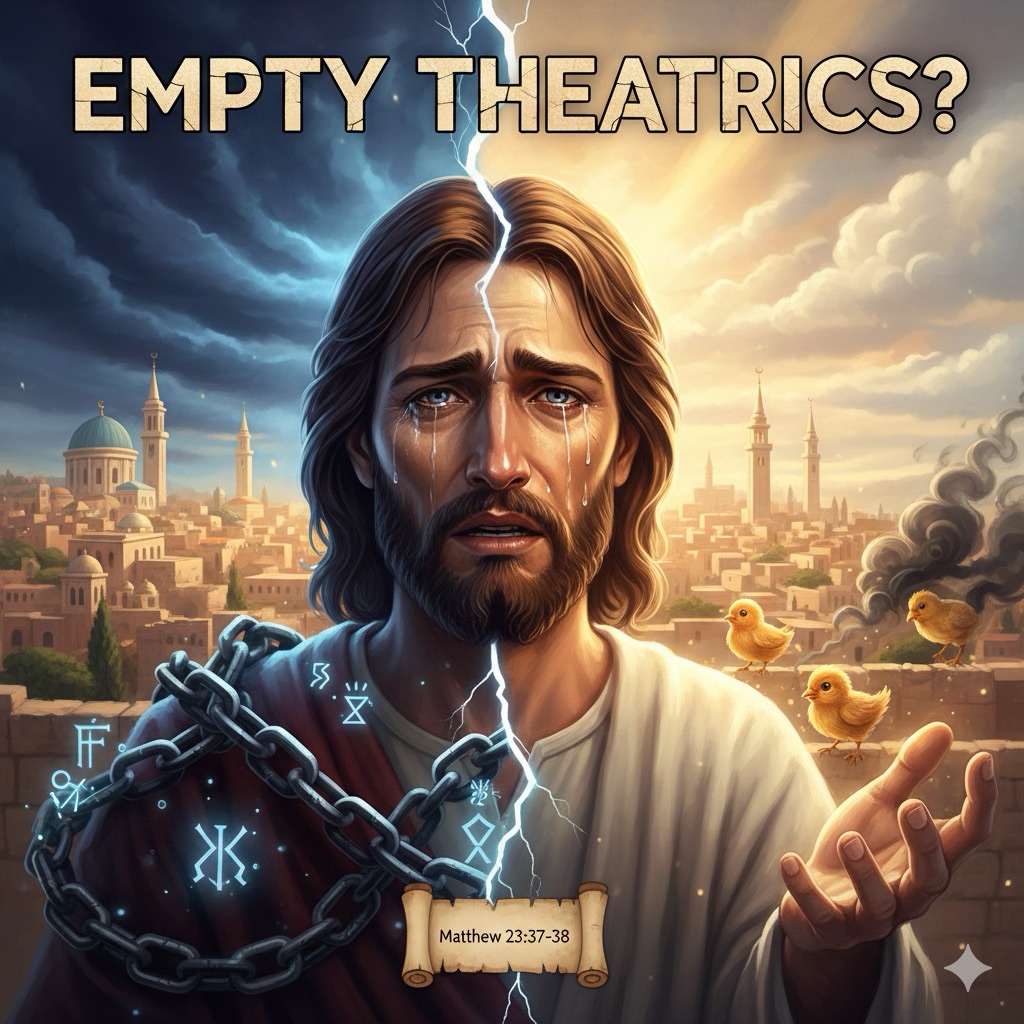
I have spent the last couple of weeks reading the late R.C Sproul’s commentary on Matthew. This was obtained freely from Ligonier Ministries because they had a deal going on in December and January where you could pick anyone of RC Sproul’s commentaries of your choosing and download it as an EPUB free of charge. I downloaded the one on Matthew and had it sent to my Kindle library. I’ve been reading it for the past two weeks. It is a pretty decent commentary, and I have thoroughly enjoyed it. But, obviously as an Arminian-Molinist I disagree with him on various points. And so often I find myself baffled at the non-answers he gives in response to objections to deformed theology. In this blog post, I will look at how he handles the Arminian interpretation of Matthew 23:37-38 and how he tries to make this compatible with Calvinism.
R.C Sproul’s Commentary On Matthew 23:37-38
On pages 631-632, he writes “As an aside, I should note that this lament has been used by many to argue against the biblical doctrine of election. The argument goes like this: Jesus wanted to gather the people together as a hen gathers her chicks, they were not willing to come to Him, and He did not force them. However, this verse teaches us nothing about election, only about the natural state of all people, which is unwillingness. Yes, we have wills that are free to do what we want to do. But our wills cannot will obedience to God. We cannot will to come to Christ. Jesus explained this truth when He said, ‘No one can come to Me unless it has been granted to him by My Father’ (John 6:65). The people of Jerusalem. refused to come to Jesus because they simply did not want to come. No one comes to Christ unless God in His mercy changes the hardness of that person’s heart so as to make him willing and even eager to come. He redeems us from our own corrupt freedom, which is really bondage, because we do what we want to do rather than what God wants us to do. Christ Himself, knowing all of that, nevertheless wept for those who were unwilling. We should, too.” [1]R.C. Sproul, Matthew: An Expositional Commentary (Sanford, FL: Reformation Trust Publishing, 2013), 675.
My Critique Of Sproul’s Comments
This totally misses the point of the passage. The point is that Jesus really wanted the people of Jerusalem to repent and accept him as their Savior and Messiah. They refused to do so, no matter how many miracles he performed, and no matter how many prophecies he fulfilled. Their hearts were hardened, and they refused to believe. The religious leaders even went so far as to say that his exorcisms were done in the power of Satan (Matthew 12:33-34). They knew that Jesus’ miracles were supernatural, but if they admitted that they came from God, then they would have to believe in him. So they said that the miracles were done by demonic powers, and Jesus points out that that is absurd because Satan would be fighting against his own kingdom and it wouldn’t stand. And he also said, basically, that that would impugn the integrity of exorcists in their own ranks. “Let’s assume for a moment that I am casting out demons by Beelzebub’s power. Are your exorcists doing it by Beelzebub’s power too?” (Matthew 12:25-27). Jesus brilliantly refuted their illogical claim. But, the point from Matthew 23:37-38 against Calvinism is that Jesus really wanted the people of Jerusalem to repent, but they refused and he was lamenting over that fact. If EDD Calvinism were true, [2]EDD is shot for “Exhaustive Divine Determinism”, which was a term coined by Dr. Tim Stratton of FreeThinking Ministries. And is used in places like his book “Human Freedom, Divine … Continue reading then this would be senseless theatrics. Jesus would be lamenting over the result of what he and the Father decreed from eternity past. God causally determined these people to sin. God chose not to zap these people with irresistible grace, so as to give them the so-called “inward call” so they could and irresistibly would repent. God chose not to give these people the grace needed to come to them. Jesus puts the blame of unbelief on the people of Jerusalem themselves.
“O Jerusalem, Jerusalem, the city that kills the prophets and stones those who are sent to it! How often would I have gathered your children together as a hen gathers her brood under her wings, and you were not willing! See, your house is left to you desolate.” – Matthew 23:37–38 (ESV)
Arminians wholeheartedly agree that people cannot come to God on their own initiative. Arminians agree when Calvinists like Sproul quote John 6:44 and John 6:65 and which say that no one can come to Jesus unless the Father who sent Jesus draws them. But we would also keep in mind John 12:32 where Jesus says “And I, when I am lifted up from the earth, will draw all people to myself.” (ESV). Not some people, not most people, all people! We also keep in mind Acts 17:30 in which Paul says “The times of ignorance God overlooked, but now he commands all people everywhere to repent.” (ESV). God calls who? Some people? Most people? No. All people! And not just all people, but all people everywhere! As if Paul’s universal language of “all people” didn’t get the point across (and for Calvinists, it obviously doesn’t), Paul makes it even clearer by saying “everywhere.” Paul’s words to his Athenian audience could be paraphrased as saying “God calls every person in every place to repentance.” If it is true that God “desires all men to be saved and to come to the knowledge of the truth. For there is one God and one Mediator between God and men, the Man Christ Jesus, who gave Himself a ransom for all..” (1 Timothy 2:4-6, NKJV) If it is true that “God so loved the world that He gave His only begotten Son, that whoever believes in Him should not perish but have everlasting life.” (John 3:16, NKJV), if it is true that God is “not willing that any should perish but that all should come to repentance.” (2 Peter 3:9b), [3]Emphasis mine in bold in all scripture quotations. then we would expect that God would send prevenient grace to all people to enable and persuade them to come to repentance, and to give him allegiance. But we know from passages like Matthew 7:13-14 and Revelation 20:11-15 that universalism is not true. Despite the fact that God wants all people to be saved, not all people will be saved. Some people will be lost. Some people will go through the wide gate that leads to destruction rather than the narrow gate that leads to eternal life. (cf. also Matthew 25:45). Therefore, the grace that God sends people must be resistible. And it is to this that Stephen alludes to when he is brought to trial in front of the Sanhedrin. In Acts 7:51, he says “You stiff-necked people, uncircumcised in heart and ears, you always resist the Holy Spirit. As your fathers did, so do you.” (ESV)
If all of this is true, then Matthew 23:37-38 makes sense. Jesus loved the people of Jerusalem. Even the people who refused to repent and believe in him. He lamented over their poor choice to come to him and live. They were not willing. He explicitly lays the blame on them. But if T.U.L.I.P were true, again, these would just be crocodile tears. Jesus would know that he reprobated these people from eternity past. Jesus would know that the reason they didn’t come to him to have eternal life is because he did not give them irresistible grace. If he had just given them irresistible grace, they both could and would come to him to have life. According to the Calvinist, God doesn’t care about whether or not we come to him freely. And so it wouldn’t matter if God zapped them with irresistible grace and drew them to repentance. If Calvinism were true, the real reason the people of Jerusalem didn’t come to Jesus to be saved wasn’t because they were not willing, but because He was not willing.
Sproul doesn’t address what the actual Arminian criticism of Calvinism from this verse really is. All he does is just reiterate the point that human beings don’t have the innate ability to come to God on their own, which is not something that the Arminian would dispute. The Arminian would agree that without the prevenient grace given by The Holy Spirit, no one would ever seek for God.
The empty theatrics of God concerning the behavior of the lost is something John Wesley picked up on in his scathing indictment of Calvinism. While Wesley’s most famous “worse than the devil” line comes from his sermon Free Grace, he applies the logic of Matthew 23:37 (Jesus’ lament) most explicitly in his treatise “Predestination Calmly Considered” (1752). In this work, he argues that if God has already decreed someone’s damnation, his public invitations to them are a “mockery.” Wesley said “”How would it sound in the ears of the world, if a king should say, ‘Not one of these my subjects shall ever come to me: I have unalterably decreed they shall not!’ and should yet loudly proclaim, ‘I would have all these my subjects to come to me; I am not willing that any of them should perish!’… Would you not say, ‘This is a mockery of all the people’? … It represents the most holy God as worse than the devil; as both more false, more cruel, and more unjust. More false; because the devil, liar as he is, hath never said, ‘He willeth all men to be saved!’ … It represents the high God as more cruel, false, and unjust than the devil!” [4]John Wesley, “Predestination Calmly Considered,” in The Works of John Wesley, vol. 10 (London: Wesleyan Conference Office, 1872), 221–225.
In the same treatise, Wesley specifically uses the “hen and chicks” imagery from Matthew 23 to prove that the “unwillingness” was human, not a result of a divine decree:
“Does he [God] say to those who are ‘reprobated,’ ‘How often would I have gathered you, and ye would not?’… If you say he would not, you represent him as a hypocrite, as a deceiver of the people, as a man void of common sincerity. … You make him say one thing and mean another; you make him to have ‘two wills,’ which is to say he has no will at all; for a man that has two wills, in this sense, has no will but to deceive.” [5]See ibid.
Since I am critiquing Sproul, I want to point out that while Sproul claims this verse teaches nothing about election but only about “unwillingness,” Wesley counters that the “unwillingness” of the people is only a moral failure if the invitation from Jesus was sincere. If the grace was never available to them, their “unwillingness” was a physical and spiritual necessity fixed by God—making Jesus’ tears, in Wesley’s view, the ultimate empty theatrics.
My Thoughts On Sproul’s Matthew Commentary Overall
There have been several times throughout reading this commentary that I have stopped and just argued with the book. I sometimes do that and I wonder if people passing by my door or not confused at the sound of me arguing with someone who isn’t there. But in this case, I finally had enough, and I decided that I would put my thoughts into writing. I want to say that I have enjoyed R.C Sproul’s commentary on Matthew. I really have! I’ve loved going through the gospel of Matthew and hearing Sproul’s thoughts on it chapter and verse. Sproul’s commentary is a blend of biblical scholarship and pastoral application. They read much like expository sermons, and I like that. There is a place for commentaries that just get into the heavy meat and potatoes of exegesis, original language studies, cultural context, apologetics issues, you know, Bible nerd stuff. And I’m not saying that Sproul’s commentary is devoid of any of this, but it isn’t really heavy on it either. But some commentaries are more heavy on exegesis while others are more heavy on application and I think Sproul’s strikes a nice balance. They are meaty sermons in written form. Indeed, The Story of God Bible Commentary series is quickly becoming one of my favorite commentary series precisely for this reason. Of the commentaries in this series, so far, I have read Tremper Longmann III’s “Genesis” and Ryan P’Odowd’s “Proverbs”. They’re very meaty exegetical commentary, but also are just as meaty in the application. And they are very engaging reads. You can read them from cover to cover and not get bored. I do read some commentaries from cover to cover, and other commentaries I use more for reference works (like Derek Kidner’s which are heavy on translation philosophy and are rather dry reads). All of this to say that, in spite of my scathing critique of Sproul, both in private soliloquy, as well as in writing here, I do like this commentary overall. I like R.C Sproul overall. Of all Calvinist teachers, he is probably my favorite. I just wish he wasn’t a Calvinist. There were parts of his commentary that I think could have been strengthened if he wasn’t hindered by his Calvinistic presuppositions. But if you get the chance, you should read his commentary.
How Could I Be So Harsh Towards Sproul and Still Endorse Him?
You might wonder how I could be so harsh towards Sproul and Calvinism in general and yet still praise the work. The truth is that I don’t think Calvinists are non-Christians. I consider them to be my brothers and sisters in Christ. I do think of all secondary in-house theological debates, this is one where the most is at stake. Although it isn’t an essential issue, I think it gets extremely close to being one. And the reason I don’t consider Calvinist to be heretics is because they don’t follow their theology to its logical conclusions. Calvinism makes God into an omnipotent demon, but Calvinists believe that God is holy. They believe he is righteous and good, in spite of their theological system. Thus, I consider them orthodox by logical inconsistency. I get into this more in my blog post “Does Thinking Calvinism Impugns God’s Goodness Preclude Fellowship With Calvinists?“See also my blog post “The Importance Of Distinguishing A View From It’s Entailments“.
Summary and Conclusion
In his commentary on Matthew 23:37, R.C. Sproul dismisses the Arminian appeal to this passage by claiming it “teaches us nothing about election,” but merely illustrates the “natural state” of human unwillingness. To Sproul, Jesus’ lament is a mourning over a corruption that only God can sovereignly heal—and has chosen not to in the case of the non-elect. However, this interpretation transforms the Savior’s tears into what John Wesley aptly decried as “empty theatrics.” In his treatise “Predestination Calmly Considered”, Wesley argues that if God has unalterably decreed that a person cannot come to Him, then a public lament over their refusal is a “mockery.” By asserting that Christ “would” gather those whom the Father has ensured “could not” be gathered, the Calvinist position, in Wesley’s view, represents God as “more false, more cruel, and more unjust than the devil.” It reduces the sincere, tear-filled invitation of the Incarnate God to a scripted performance where the outcome was never actually in doubt. In spite of this, I do think that R.C Sproul’s commentary on the gospel of Matthew is a great work and can be a valuable part of someone’s theological library. I consider myself blessed to have been able to get this commentary for free (and legally!) through Ligonier Ministries. But should you choose to read it yourself, remember to practice what Hillary Morgan Ferrer calls the “chew and spit” method. [6]Hillary Morgan Ferrer introduces this concept in Chapter 3 of her book, Mama Bear Apologetics. She uses the analogy of eating a piece of steak to describe how to approach cultural or theological … Continue reading
References
| ↑1 | R.C. Sproul, Matthew: An Expositional Commentary (Sanford, FL: Reformation Trust Publishing, 2013), 675. |
|---|---|
| ↑2 | EDD is shot for “Exhaustive Divine Determinism”, which was a term coined by Dr. Tim Stratton of FreeThinking Ministries. And is used in places like his book “Human Freedom, Divine Knowledge, and Mere Molinism: A Biblical, Historical, Theological, and Philosophical Analysis”, Wpif and Stock, October 2 2020. |
| ↑3 | Emphasis mine in bold in all scripture quotations. |
| ↑4 | John Wesley, “Predestination Calmly Considered,” in The Works of John Wesley, vol. 10 (London: Wesleyan Conference Office, 1872), 221–225. |
| ↑5 | See ibid. |
| ↑6 | Hillary Morgan Ferrer introduces this concept in Chapter 3 of her book, Mama Bear Apologetics. She uses the analogy of eating a piece of steak to describe how to approach cultural or theological messages: you keep the “meat” of the truth and spit out the “gristle” of the lies. Ferrer wrote “We don’t need to train our children to be picky when it comes to what they feed their bodies—they do this on their own. But we do have to train them to be discerning about what they feed their minds… A mature, informed, discerning worldview does not need to fear the false messages that this world churns out if it has already been trained to identify which aspects to reject.” – Hillary Morgan Ferrer, ed., Mama Bear Apologetics: Empowering Your Kids to Challenge Cultural Lies (Eugene, OR: Harvest House Publishers, 2019), 47–51. |
Discover more from Cerebral Faith
Subscribe to get the latest posts sent to your email.



I thank you for your work. I started following you when you found freedom by understanding God’s truth in the same way that I did. It was a giant burden lifted off of me, and I praise God every day for continuing to grant me freedom from slavery like he did for you.
I want to point out to you something that I’ve come to understand about God’s role in who is and isn’t saved. One of the main things you’ve argued for is the meaning of the word ALL. You seem to think that it clearly means everyone all of the time. However, if we were to look a the use of the word, it clearly doesn’t mean everyone all of the time.
-Matthew 1:17 So all the generations from Abraham to David were fourteen generations…
–If one was to review the genealogies of Christ, one would see that this is almost certainly symbolic and not literal.
-Matthew 2:3 When Herod the king heard this, he was troubled, and all Jerusalem with him;
–I would argue that not all people in Jerusalem were troubled. I am certain that there were a very significant number of people who didn’t even know about what was going on.
-Matthew 3:5 Then Jerusalem and all Judea and all the region about the Jordan were going out to him,
–I am certain that not ALL people went out to him.
-Matthew 4:23 And he went throughout all Galilee, teaching in their synagogues and proclaiming the gospel of the kingdom and healing every disease and every affliction among the people.
–There is no way he was able to visit every single spot of land in Galilee, nor was he able to visit every single person in Galilee. Maybe he went to every significant town? Who knows, but it was not literally all.
I know that this is only how Matthew uses the word all (pas), but if one were to look at blueletterbible.com one could see the context of the word usage and see that all does not always mean literally all-throughout the New Testament. This is also how the word all (kōl) was used in the Hebrew scriptures also. There were many times when the Israelites killed all of a people group, but then we find out in the next chapter that there are still people from that group who are around. The scriptures use hyperbole, and we have to be careful not to use our modern way of thinking that they thought of concepts in the same way that we do. The best way to counteract this is to look at a word’s usage in its context throughout scripture.
Now, to my main point, God claims that he softens people’s hearts with His Spirit. This is clear throughout the Old Testament and the New Testament.
-Ezekiel 36:26 And I will give you a new heart, and a new spirit I will put within you. And I will remove the heart of stone from your flesh and give you a heart of flesh.
-John 12:39-40 Therefore they could not believe. For again Isaiah said, “He has blinded their eyes and hardened their heart, lest they see with their eyes, and understand with their heart, and turn, and I would heal them.
-Romans 9:18 So then he has mercy on whomever he wills, and he hardens whomever he wills.
How can we claim that it is God alone that can change our hearts, but at the same time declare God is not the one who decides who will be given grace?
I see that God is the arbiter of good and bad. God is good. That’s all I know about who is saved and who is lost. I really think that this entire discussion is a faith issue. We just need to trust God. Therefore, I must trust Him even if I cannot understand it with my limited knowledge. I don’t think we can know any more than that without special revelation from God.
1 Corinthians 1:25 For the foolishness of God is wiser than men, and the weakness of God is stronger than men.
While it is true that universal language is not always used universally, that fact cannot be used to argue against the passages I quoted teaching that God wants all people to be saved. You might be interested in my article “Calvinists and The Fallacy Of Illegitimate Totality Transfer” in which I show that unless there are good contextual clues to indicate that universal language should be restricted, then we shouldn’t restrict it. After all, I doubt you would use that same logic to argue that Romans 3:23 doesn’t teach that all of humanity hasn’t fallen short of God’s perfect moral standard. “For all have sinned and have fallen short of the glory of God.” We rightfully take this to mean that every human being has sinned and has fallen short of God’s glory. No exceptions. Why? Because there’s no reason not to take the passage at face value. In all the examples you cited, we know these can’t be referring to truly all people either because things in the immediate context clue us in on that or else making it refer to all of humanity would result in an absurdity, such as taking Matthew 3:5 to refer to every last individual in the city going out to see John The Baptist. That’s a cartoonish picture, so we rightly restrict it to just a large number (or a majority) of people. In the case of Matthew 1:17, we know by comparing the genealogy of Matthew with Genesis and 1 Chronicles that Matthew ommited names (likely for a literary reason – making 14, 14, 14, David’s gematria, come out). But I see no contextual reason to think that when The Bible says “God wants all people to be saved” (1 Timothy 2:4) or that Jesus is “the atoning sacrifice…for the whole world.” (1 John 2:2), that this isn’t referring to all of humanity. Nothing in the immediate contexts of these verses would demand that we restrict them, and there doesn’t seem to be anything logically absurd about a Maximally Great Being loving all of his image bearing creatures.
.
As for Romans 9:18, this isn’t a good proof text for Calvinism. This verse, (and Romans 9 in general) certainly sounds Calvinistic when taken out of context of Paul’s epistle to the Romans as a whole. But when read in light of what comes before chapter 9 and what comes after chapter 9, one comes to see that what we read in Romans 9 is part of a wider argument in which Paul is not trying to restrict God’s saving intentions, but widen them, giving theololgical and Old Testament justification for why God is rejecting the Jewish people of his day while embracing gentiles. I talk about this in my article “What Is Romans 9 Really About?” I highly recommend you check it out.
.
Calvinism is full of biblical, philosophical, and theological holes. Trying to make Calvinism work with The Bible is like trying to push a square block into a round hole. I would highly recommend you spend time browsing this website for content in which I take great pains to show the falsehoods of this theological system. There are even podcast episodes and videos here on it.
.
Aside from not conforming to what the text actually says, it actually creates theological problems in other areas. R.C Sproul floundered in his commentary to try explain why, if everything is exhaustively determined by God, it is worthwhile to pray. He basically said it doesn’t change anything, but it changes us, so that makes it worthwhile. I think this was in the section in which he was expositing The Lord’s Prayer in the Sermon On The Mount. Yet as a Molinist, I have a perfectly satisfying answer. Dr. William Lane Craig talks about this in his article “Question Of The Week #287: Middle Knowledge and Prayer.” on ReasonableFaith.org. This is what I meant when I said Sproul was hindered by his theological presuppositions. He was kept from giving better answers to some things than he could have because his framework didn’t allow him those answers.
“Nothing in the immediate contexts of these verses would demand that we restrict them”
I can go along with what you’ve said that the context of the verses where “all” is used does not demand that we restrict them. However, the context of those verse also does not demand that we use that word literally.
I think I will skip discussing what you were saying about Romans 9 and the article you referenced where it is in reference to the two nations Israel (the seed of the promise) and the Gentiles (the seed of the snake). I am not sure I can really get into a discussion about that since I just don’t have the expertise.
However, there are a few points that we can go over regarding election/free will. From a purely human perspective it is absolutely free will when we choose to follow God. I was completely stuck in slavery to “the flesh” (living life in my own wisdom) blind as a bat unable to understand God and what truth really is. It is clear to me that only God could change my mind to believe in His goodness.
God is the creator of all persons, not just their bodies, but also their minds. If God has all of history known from the beginning prior to the creation of the world, what part does God not play in every single person’s salvation? If all of my experiences, personality, and life choices are known to God, what part does predestination not play in my salvation? Can it really be my choice when God dictated all of the events surrounding my life (events and choices) and who I become?
Isaiah 45:9-10 and Psalm 139:1-6, 13-14 tell me that God predestined me to saving grace and I played no part of it whatsoever. There’s just too much evidence to demonstrate God’s complete control over every single aspect of how the entirety of the universe has unfolded and will continue to progress for me to assert anything regarding free will. I believe that it is an invention of man, and not of God.
“why, if everything is exhaustively determined by God, it is worthwhile to pray. … it doesn’t change anything, but it changes us, so that makes it worthwhile.”
What a terrible answer. The Bible tells us why we are to pray.
If we refuse to pray, we are living by the flesh (Galatians 5 and Romans 8) and the reason I know that is because it is in contrast with living by the Spirit. Prayer is how we can live by not using our own wisdom, but living by the wisdom of God. The wisdom of the flesh is using our power to get for ourselves. The wisdom of the Spirit is living for God who has true wisdom. Because we have all trusted the lied of the serpent, humans are normally unable to access that wisdom when it is needed. God wants us to live by His Spirit through prayer (Ephesians 6), and that comes through meditation on God. In order to meditate on God, we must know who God is and that comes through understanding what is in His scriptures.
You said \\”I can go along with what you’ve said that the context of the verses where “all” is used does not demand that we restrict them. However, the context of those verse also does not demand that we use that word literally.”\\ – I guess I would ask why you want to restrict them. Typically, when we use universal sounding language with no contextual clues to restrict them, and certainly no logical clues, we take universal language as universal. Would you apply this same logic to Romans 3:23? If not, why not? If I said “All people have belly buttons”, you would naturally take my statement to be referring to every last person. “All people have something they care about.”, “Everyone has goals in life.”, etc. This isn’t the same as, say “Everyone was at my birthday party.” It would be absurd to comical degrees to suggest every person on the planet attended my birthday party. Here, we have a logical restriction. Or if I said “I sent an invitation to everyone at my school to attend my birthday party. Everyone came to my birthday party.” Here, we have a contextual clue that justifies our restriction of “everyone” to “everyone at my school.” Unless we have some logical or contextual clues, it would behoove us to take “all people” as “all people”. This is especially true since The Bible uses universal language in a multitude of different ways.
“For God so loved the world, that he gave his only Son, that whoever believes in him should not perish but have eternal life.” (John 3:16, ESV).
.
“[God] desires all people to be saved and to come to the knowledge of the truth. For there is one God, and there is one mediator between God and men, the man Christ Jesus, who gave himself as a ransom for all.” – 1 Timothy 2:4-6a
.
“The Lord is not slow to fulfill his promise as some count slowness, but is patient toward you, not wishing that any should perish, but that all should reach repentance.” – 2 Peter 3:9 (ESV)
.
“He is the propitiation for our sins, and not for ours only but also for the sins of the whole world.” – 1 John 2:2 (ESV)
.
“But we see him who for a little while was made lower than the angels, namely Jesus, crowned with glory and honor because of the suffering of death, so that by the grace of God he might taste death for everyone.” – Hebrews 2:9
.
And again, you have John 12:32 where Jesus said he would draw “all people” to himself, and Acts 17:30 where Paul said God calls “All people everywhere”. Look at the range of language here. “The World”, “The Whole World”, “All People”, “All People”, “Everyone”, and “All people everywhere”. Collectively, it really looks like The Bible is teaching that God’s love and salvific will is universal! Why else would there be such a variety of different ways of depicting God’s mission of salvation as universal? But the case against limited atonement is even stronger when other passages are brought into consideration. Look at 2 Peter 2:1, in which the apostle Peter writes “But false prophets also arose among the people, just as there will be false teachers among you, who will secretly bring in destructive heresies, even denying the Master who bought them, bringing upon themselves swift destruction.” Peter talks about false prophets who will infiltrate the church he’s writing to. Peter says they will teach heresy and ultimately bring swift destruction upon themselves. These people are not saved. They either were never saved to begin with, or they were saved and apostatized. But in either case, Peter tells us that Jesus died to atone for their sins by saying “even denying the sovereign Lord who bought them.” “Even denying the sovereign Lord who bought them.” The Lord bought these false teachers who will bring destruction upon themselves. I have yet to find one Calvinist deal with this passage in a non-contrived way. Dr. James White even went so far as to offer the ridiculous notion that Peter was being sarcastic! The most natural reading is that Jesus died even for the sins of the non-elect. We know this because purchasing language is used in other passages to refer to Christ’s atoning death on the cross (look up 1 Corinthians 6:19-20, 1 Corinthians 7:23, Revelation 5:9, for examples). This indicates that when The Bible says Jesus died for “all people”, “the whole world”, “everyone”, because God loves “the world”, this really does include every last human being.
.
You wrote \\”I think I will skip discussing what you were saying about Romans 9 and the article you referenced where it is in reference to the two nations Israel (the seed of the promise) and the Gentiles (the seed of the snake). I am not sure I can really get into a discussion about that since I just don’t have the expertise.”\\ – That’s fine. That is a whole discussion in and of itself and would take us very far afield here. I do want to bring things back to the point I made in the article though. How do you make God not out to be incincere if He calls people to repent, punishes people for not doing so, and even offers public laments of their refusal to come to Him if, as EDD T.U.L.I.P Calvinism teaches, these people were pre-determined by God from eternity past to never become His, that God did not elect them and therefore doesn’t give them even the slightest amount of grace to repent? How does Calvinism avoid, as John Wesley and I have concluded, that Calvinism makes God out to be an insincere charlatan, mocking the people of Jerusalem in Matthew 23:37?
.
The argument, if I may put it in the form of a syllogism, is this:
.
1: If Calvinism were true, God would be making a mockery of those whom he calls to repent, and this would be evil.
2: God can do no evil.
3: Therefore, Calvinism is not true.
.
It would seem to me that we’d both wholeheartedly embrace premise 2. But premise 1 seems just as solid. Where does the fallacy lie in my blog post?
.
You wrote \\”However, there are a few points that we can go over regarding election/free will. From a purely human perspective it is absolutely free will when we choose to follow God. I was completely stuck in slavery to “the flesh” (living life in my own wisdom) blind as a bat unable to understand God and what truth really is. It is clear to me that only God could change my mind to believe in His goodness.”\\ – You seem to be under the impression that my position is that people can come to God on their own initiative. That they can just up and decide “I’m gonna get saved today” without any work of God in their hearts. That is not the Arminian position. As I said in the blog post, the Arminian affirms a doctrine called Prevenient Grace. We affirm with Calvinists that we cannot come to God on our own initiative. If God hadn’t become a man, died on the cross, rose from the dead, sent us the gospel proclamation to here, and enable our hearts to either receive or reject Him, the only thing we COULD do would be reject him. Although I haven’t studied Provisionism to any depth yet, I doubt even our mutual friend Chris the MudWalker would deny that God has to do the bulk of the work, even if he understands the metaphyiscs differently than the Arminian. You’ll never hear me say that I saved myself. I wholeheartedly believe that if God did not wrestle me into submission, or even make any efforts at all to woo me to him, I would still be in rebellion against Him to this day. However, I maintained that if I had given more effort in stifling the Holy Spirit’s voice (and Acts 7:51 does say The Holy Spirit can be resisted), I could have chosen not to repent. Even now, I hold that it is possible for me to apostatize. But that is also a topic that can occupy a whole nother discussion.
.
\\”God is the creator of all persons, not just their bodies, but also their minds. If God has all of history known from the beginning prior to the creation of the world, what part does God not play in every single person’s salvation? If all of my experiences, personality, and life choices are known to God, what part does predestination not play in my salvation?”\\ – Let me see if I understand what you’re saying. Do you think God’s foreknowledge by the very nature of being foreknowledge, fatalistically determines our choices? Psalm 139:1-6 isn’t teaching predestination. It is, however, teaching that God has foreknowledge. I would like to comment on Isaiah 45:9-10, but my reply here is already becoming quite long. But I think making that about determinism is also a stretch. I think you’re reading your reformed presuppositions into the passage. But if you think foreknowledge entails fatalism, we should talk about that. Because I think that is predicated on a modal fallacy.
.
Finally, before my comment becomes too lengthy, let me say that you missed the point concerning prayer. Yes, The Bible tells us to pray. But the context was petitionary prayer. And the question Sproul was attempting to answer was what the point of petitionary prayer (i.e asking God “please do X”) is if God has already decided everything he’s going to do. Just saying that “prayer changes us”, which is undoubtedly true to a point, doesn’t do away with the logical problem under deterministic Calvinism. Neither does appealing to scripture’s command to pray. If prayer affects nothing in any way, then at least the category of prayer we call “petitionary prayer” IS pointless. Indeed, even the fact that you petition God is itself causally determined by God as is His answer. Exhaustive Divine Determinism reduces God to being like an insane person who has conversations with sock puppets. The sock puppets ask the puppeteer to do something, which is pointless because the puppetier has already decided the outcome. And the sock puppets request was also determined by the puppeteer. And yet, I have it on the authority of God’s word that petitionary prayer really does change things. James 4:2-3 says “You desire and do not have, so you murder. You covet and cannot obtain, so you fight and quarrel. You do not have, because you do not ask. You ask and do not receive, because you ask wrongly, to spend it on your passions.” He says “You do not have because you do not ask.” Presumably, it is reasonable to think that if James’ audience petitioned God (with the correct motives), they would have at least received positive answers to SOME of the things they asked God for. There is a feasible world in which, if they had only asked, they would have received. But in the actual world, they did not ask, and did not receive. Now, how are we to make sense of this? Exhaustive Divine Determinism (EDD) can do nothing but plaster the problem over with pious language about how prayers can change us and how God’s thoughts are higher than ours. But why settle for that when other systems like Molinism or even Open Theism can make perfect sense of this? Again, I recommend Dr. William Lane Craig’s article “Question Of The Week #287: Middle Knowledge and Prayer.” on ReasonableFaith.org.
Very interesting. I don’t agree with fatalism. I will have to think about all that you’ve presented here. I think you’ve thought this through more than I have. You’re making me think hard about the EDD in regard to situations like Abraham bartering with God about Sodom and Gomorrah, or Moses offering his own life in place of the Israelites, David pleading with God to stop the destroyer from killing any more Israelites due to his sin, or even Jesus praying for even me in the garden that I would be one with the Father.
.
What is the point of it if everything has already been determined? I’m not yet convinced of your position, because I’m having a hard time integrating God’s desire for all to trust in Jesus’ sacrifice vs. God’s foreknowledge of what will happen, which is that not all will be saved. I just know that God has to do the work in people for them to accept Jesus as the one true Lord. I can’t see where the delineation is between God’s work to enlighten us and God’s inability to save those who continue to reject Him.
.
I see in the parable of Lazarus and the rich man, Abraham claims that there are no miracles which can change the minds of those who have rejected the message of the prophets. Even though parables are not theology per se, it does support your position that each person is capable of rejecting God no matter what the evidence is demonstrated showing the grievous error that this is.
.
I know that when God created the serpent, it was not so that we would be tempted to reject God, because we know that God cannot tempt us. However, God knew this would happen, and yet He still created the creature that became the deceiver of the world. Maybe I just need to trust that God is all powerful, but that does not mean that He alone decides the fate of each person? Hmm.
.
My brain cannot contain all of this all at once. I think I am going to have to reconsider my firm grip on predestination, but I don’t know that I will be able to do that easily. I suppose I will have to consider your three step argument. It’s compelling and I will wrestle with it.
.
Thank you for your time and effort explaining this to me.
It seems to me like the crux of the issue for you is harmonizing divine foreknowledge with human free will. One resource I’d recommend on this is William Lane Craig’s “The Only Wise God: The Compatibility Of Divine Foreknowledge and Human Freedom”. I know you said that you rejected fatalism, but foreknowledge has come up a few different times now in your comments with respect to the issue of predestination. So I can’t help but wonder if this is really what’s really behind the struggle in your mind. Open Theists also see a struggle here, but they end up denying that God has foreknowledge in order to preserve human freedom. Typically reformed folk do the reverse. And I think both are predicated on the same error.
.
But I know you said I’ve given you a lot to think about, so I don’t want to info dump anymore at the moment. That’s why I just recommended Craig’s book for future reference rather than give a brief answer myself. I’ve enjoyed the back and forth. God bless you. 🙂
I’ve watched some talks from Reasonable Faith’s youtube channel on Divine Foreknowledge and Human Freedom as well as God’s Middle Knowledge. It’s pretty impressive thinking on the subject. I’m still thinking through all of this. Your resources have helped. I look forward to being challenged with these opinions. Thanks for getting me started on looking into this.
I’m glad to hear it. Some of Craig’s stuff on foreknowledge and middle knowledge can be a bit difficult to grasp, even for me. I had to read The Only Wise God slowly, really thinking through every sentence. But some of his free, online stuff (e.g his Defenders class/podcast) is easier to digest. For me, I find the “Infallible Barometer” analogy really helpful. The Barometer says what it says because the trut of what the weather will be is logically prior to the Barometer’s reading. The Barometer can’t be wrong, because that is the very definition of infallible. Yet, that doesn’t mean it determines the weather, or that the weather cannot be any different. But *if* the weather *were* different, then the Barometer would give a different reading. So as Craig says “We’re free to choose otherwise, we’re just not free to surprise God.” If I choose A, I could have chosen Non-A. But if I chose non-A, God’s foreknowledge that I chose A wouldn’t be wrong. Rather, God wouldn’t foreknown that I would have chosen A in the first place. Rather, it would have always been the case that God foreknew I would choose Non-A. This isn’t retroactive causation, but it is, as Craig has said, functionally equivalent to it. And what applies to mere foreknowledge applies to middle knowledge as well.
I’ve always had the impression that the inner workings of all of this is unknowable by human reasoning. However, it may be that this logic is faulty. It’s almost like I was conditioned not to think about this too much, and I don’t know why.
I think there something to that. I won’t deny that there *are* mysteries. We’re dealing with an infinite God after all, someone so high above us. We are bound to hit walls in our understanding at some point. But too many Christians prematurely give up the chase. I think some things ARE beyond us, but I think that a lot of things have good solid answers if one is just persistent enough. One of my favorite examples is how the persons of the Trinity relate to one another, especially in a state of timelessness before the creation of the universe. My mind cannot wrap around such a concept. Any attempt undoubtedly resorts to anthropomorphizing the persons of the Trinity! And yet we know God is a community that has been in a beginningless loving relationship.
.
Speaking of Craig, in The Only Wise God, there is a quote I absolutely love and resonate with; “I have found that the more I reflect philosophically on the attributes of God the more overwhelmed I become at his greatness and the more excited I become about Bible doctrine. Whereas easy appeals to mystery prematurely shut off reflection about God, rigorous and earnest effort to understand him is richly rewarded with deeper appreciation of who he is, more confidence in his reality and care, and a more intelligent and profound worship of his person.” ☺️