So, my pastor has been preaching on the book of Genesis over the past few weeks. We’re just beginning to get into Genesis 2. To those who have followed Cerebral Faith for a long time, it should be no surprise to learn that I consider myself a Theistic Evolutionist. I think the fossil and genetic evidence powerfully (I’m tempted to even say overwhelmingly) establishes descent with modification over the past several million years. It isn’t a view I advocate very strongly, as I’ve been quite clear that as long as you affirm that Yahweh is the Creator of all things, and that this Creator became a man, died on the cross, and rose from the dead, ascended into Heaven, etc. who cares if we disagree on the particulars. The only length I’ll go in defending it is in showing that Theistic Evolution is a viable option for a Christian with a high view of scripture.
There are many different views on Adam and Eve’s historicity within the Theistic Evolutionist camp. Some think Genesis 1-11 is completely a-historical. [1]For an influential modern defense of the completely non-historical view of the primeval narrative, see Peter Enns, The Evolution of Adam: What the Bible Does and Doesn’t Say About Human Origins … Continue reading Some view it as literal history [2]For a thorough academic defense of the traditional, historical view of the primeval history and a literal human couple, see C. John Collins, Did Adam and Eve Really Exist? Who They Were and Why It … Continue reading Some view it as mytho-history. [3]This genre designation draws heavily on the work of philosopher and theologian William Lane Craig, In Quest of the Historical Adam: A Biblical and Scientific Exploration (Grand Rapids: Eerdmans, … Continue reading For me, I don’t think a completely a-historical interpretation is feasible, not the least of which is the genealogy in Luke’s gospel tracing Jesus’ linage back to people within the primeval history (non-historical figures can’t give rise to historical figures) and what Paul says about Adam in Romans 5. In light of reading Dr. William Lane Craig’s “In Quest Of The Historical Adam: A Biblical and Scientific Exploration”, I’ve come to be convinced that Genesis 1-11 belongs in the genre of mytho-history. I am committed to a historical Adam and Eve.
All Theistic Evolutionary models that affirm a historical Adam and Eve require that Adam and Eve not be the only human beings on planet Earth. After all, individuals don’t evolve, populations do. And population genetics seems to suggest that there never could have been fewer than 10,000 hominid species. [4]See Steven Schnaffer, “What Genetics Says About Adam and Eve”, July 11th 2021, BioLogos.org, –> https://biologos.org/articles/what-genetics-say-about-adam-and-eve. And so, if one is going to hold to a Theistic Evolutionary model, one is going to have to reject the idea that Adam and Eve were the only human beings on the planet whenever they were created. [5]I say “whenever” because, depending on what genre you want to say Genesis 1-11 belongs to, how you add up the genealogies, and other considerations will depend on when you date Adam and … Continue reading
But I am convinced that The Bible is the inspired and authoritative word of God (2 Timothy 3:16-17), and so we must consult what scripture says first and foremost. If it is really true that The Bible binds us to seeing Adam and Eve as the sole peoples’ on the planet at the time of their creation, then that is the conclusion we must commit ourselves to, regardless of how that might seem incompatible with modern science. However, I adhere to the “two books” paradigm and believe that science can allow us to go back and re-examine scripture to see if we really interpreted it correctly in the first place. This is not to say that science can or should dictate our exegesis, but it can serve as an opportunity to revisit the text and question whether we read it correctly. If we do the heavy lifting and come to the conclusion that our original reading of scripture was right, then we need to revisit the scientific data and see if perhaps it is wrong. But if the scientific conclusions are sound, back to re-examining our interpretations of scripture we go. It is my commitment that God’s Word and God’s world will never conflict. If they seem to, it’s because one or both were mishandled. We need to “run the numbers” again. [6]For why I believe scripture has this authority and how I reconcile it with my commitment to evidentialism, see my essay “My Theological Epistemology Explained” here on the Cerebral Faith … Continue reading
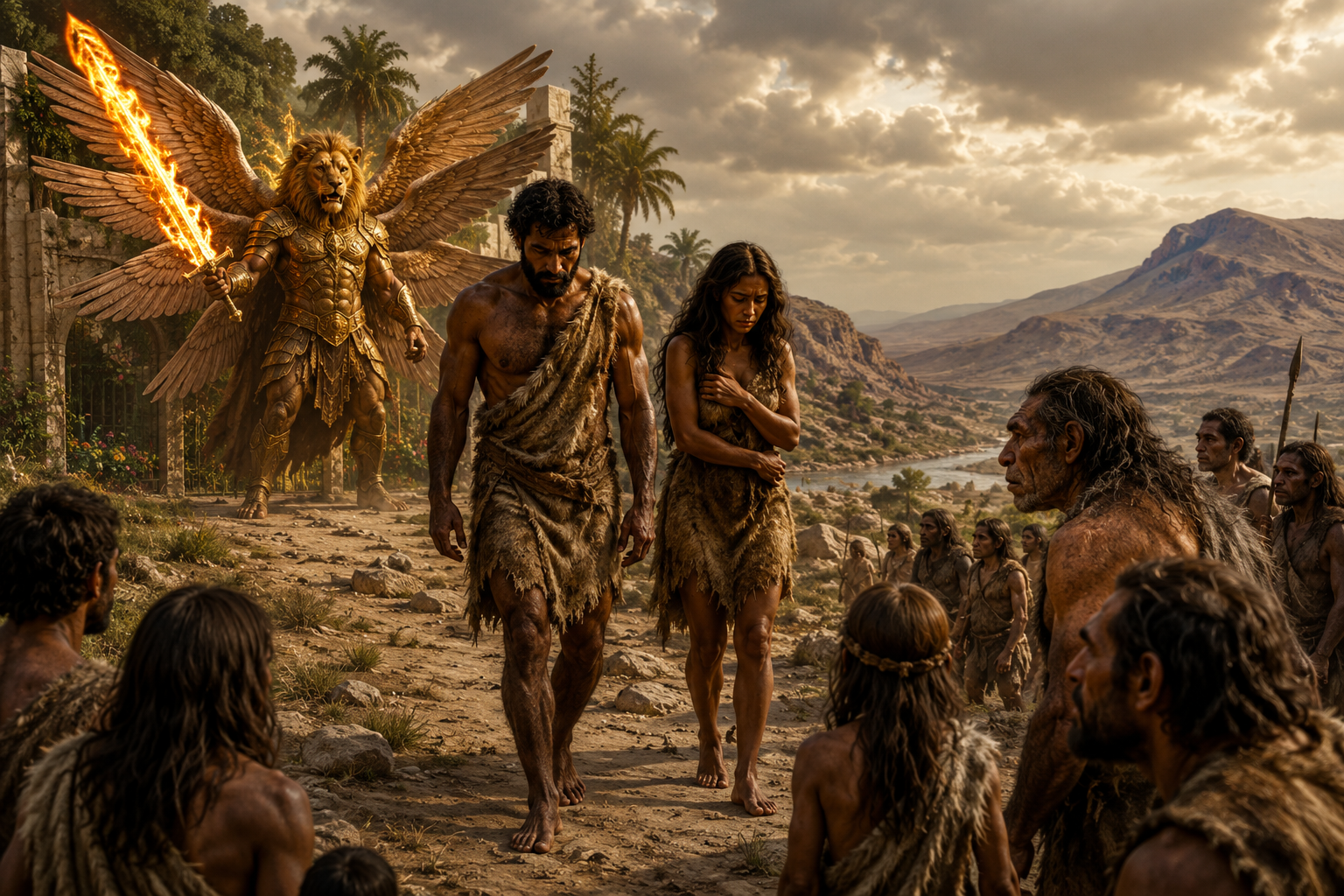
So what does The Bible say about Adam and Eve and their neighbors or lackthereof? I personally think the idea of humans outside the garden is very defensible, with only a couple of counterpoints that occasionally give me pause. I share my candidness about the pros and cons in this article not only to present the data fairly and possibly help my brothers in Christ in their journey of wrestling with science and faith, but also to show that I am first and foremost concerned with what God’s word says, and not with forcing it to conform to any pre-conceived ideas, an accusation I’ve faced from the Young Earth Creationist crowd far too many times.
Pro 1: Genesis 2 – Likely A Sequel Account To Genesis 1
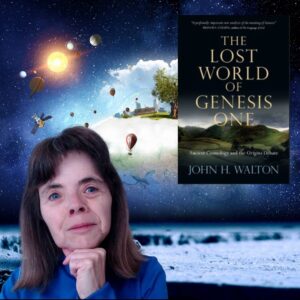
In his book “The Lost World Of Adam and Eve: Genesis 2-3 and The Human Origins Debate”, Old Testament scholar John Walton argues that Genesis 2 is actually a “sequel” to Genesis 1, in that Genesis 2 tells a story that takes place chronologically after the creation “week” of Genesis 1. John Walton writes, “If Genesis 2 is read as a recapitulation, Genesis 2:5-6 is confusing. It says that there were no plants when God created humans, yet plants come on day three and humans on day six in Genesis 1. Another sequence problem is that God created the animals first and then humans on day six. In Genesis 2, Adam is formed before the animals. The second problem exists for those who consider the days to be twenty-four-hour days. That the events of Genesis 2 could all take place in a twenty-four-hour day (among them, naming all the animals, which apparently is completed because no helper was found) stretches credulity. Given these problems, it is worthwhile to go back and reconsider the question of whether Genesis 2 is detailing day six or an event that comes later.” [7]Walton, John H.. The Lost World of Adam and Eve: Genesis 2-3 and the Human Origins Debate (The Lost World Series Book 1) (pp. 63-64). InterVarsity Press. Kindle Edition. I do take the days to be 24 hours, so I do find that second problem forceful. It might be surprising to those in the Young Earth camp to hear me say that. Based on my conversations with Young Earth Creationists, many of them seem to presuppose that the only alternative to their reading of Genesis 1 is The Day-Age view (i.e that the days of Genesis 1 are long epochs). However, in past articles, I have explained that I adhere to a multifaceted diamond of an interpretation. My primary views of Genesis 1 are the Framework Hypothesis, the Cosmic Temple Inauguration View, and the Anti-Pagan Polemical view. See my essay “Why I No Longer Think Walton’s View Of Genesis 1 Functions” to read more. I also recommend the book “The Manifold Beauty Of Genesis One: A Multi-Layered Approach” by Gregg Davidson and Kenneth Turner. Davidson and Turner defend these three non-mutually exclusive views among four others.
Richard Deem of GodAndScience.org explains the second problem of Walton’s more forcefully. He writes; “The text indicates that God planted a garden. This garden was not planted full-grown, since the text says that the trees were caused to sprout or grow (Hebrew tsamach). The amount of time allowed for the garden to grow is not stated, but would presumably take longer than 24-hours. After the garden had grown sufficiently, the man was placed into the garden to cultivate it. By this time, the trees were producing fruit so that Adam could eat. This process takes a period of time greater than 24 hours. Next, Adam was given the assignment of naming the birds, cattle and wild animals. The list includes only birds and mammals and does not mention fish or other lower life forms. Even so, it would require that Adam name at least 14,600 species (8,600 species of birds and 4,000 species of mammals). This would require Adam to name more than 10 species per minute (assuming he had the entire 24 hours). …. Following this naming of the animals, no suitable helper was found for Adam. So, God put Adam to sleep, took a piece of Adam’s side, and created Eve.” [8]Richard Deem, “The Literal Interpretation Of The Genesis One Creation Account”, GodandScience.org, accessed June of 2021, http://www.godandscience.org/youngearth/genesis1.html
Since Genesis 2’s events cannot be crammed into Genesis 1, we have two options;
1: The Day-Age Theory
2: Genesis 2 comes chronologically after Genesis 1.
Why option 1 is problematic:
Old Testament scholar John Walton explains ; “…the examples generally used of yôm referring to an extended period of time are examples in which the word is being used idiomatically: ‘in that day.’ This is a problem because words often take on specialized meaning in idiomatic expressions. So in Hebrew, the phrase ‘in that day’ is simply a way for Hebrew to say ‘when.’ The word yôm cannot be removed from that expression and still carry the meaning that it has in the expression.” – [9]John Walton, “The Lost World Of Genesis One: Ancient Cosmology and The Origins Debate”, IVP, page 91 I should remind the reader, however, that this isn’t problematic for The Framework Hypothesis/Temple Inaguration view. But it is problematic in saying Genesis 2 is just a rehashing of Genesis 1’s Day 6.
Moreover, John Walton argues that the Hebrew word toledot (typically translated as “this is the account of” or “these are the generations of”) functions structurally as a hinge that introduces a sequel or consequence, never a historical recapitulation (retelling a past event from a different perspective). [10]Walton, John H. The Lost World of Adam and Eve: Genesis 2-3 and the Human Origins Debate (The Lost World Series Book 1) pages 63-66. InterVarsity Press. Kindle Edition. Because toledot consistently indicates what follows or proceeds out of the named entity, Walton notes that Genesis 2:4 (“This is the account of the heavens and the earth…“) has an extremely low antecedent probability of being a detailed breakdown of Day 6 from Genesis 1. Instead, it introduces what happened to the newly created world (the sequel). (The table below outlines how the toledot formula operates across the structural pillars of Genesis:
| Scripture Reference | The Formula (“This is the account of…”) | What the Section Actually Contains (The Sequel / Consequence) | Does it Recapitulate the Subject’s Origins? |
| Genesis 2:4 | Heavens and the Earth | The narrative of the Garden, the testing of humanity, and the descent into the Fall. | We shall see. |
| Genesis 5:1 | The family line of Adam | The genealogical line of descendants stretching from Seth down to Noah. | No. It does not retell Adam’s creation, but moves immediately to his progeny. |
| Genesis 6:9 | Noah | The story of Noah’s sons, the corruption of the earth, and the subsequent Flood narrative. | No. It does not retell Noah’s birth or early life, but details his family’s survival. |
| Genesis 10:1 | Shem, Ham, and Japheth | The “Table of Nations” tracking how the post-Flood world was populated. | No. It does not retell the narrative of the Flood or how they survived inside the Ark. |
| Genesis 11:10 | Shem | The focused line of Semitic descendants down to Terah. | No. It skips over the broader Table of Nations to trace a specific lineage forward. |
| Genesis 11:27 | Terah | The life, travels, and trials of his son Abraham. | No. It is not a biography of Terah; Terah dies immediately so Abraham’s story can begin. |
| Genesis 25:12 | Ishmael | A brief account recording the desert tribes and chiefs descended from Ishmael. | No. It doesn’t retell Ishmael’s expulsion or childhood in the wilderness. |
| Genesis 25:19 | Isaac | The life narratives of his competitive twin sons, Jacob and Esau. | No. It doesn’t detail Isaac’s birth or the sacrifice on Mount Moriah; it focuses on his heirs. |
| Genesis 36:1 | Esau | The genealogical tracking of the Edomite clans and rulers. | No. It does not retell Esau’s loss of his birthright or his reconciliation with Jacob. |
| Genesis 37:2 | Jacob | The long narrative of Joseph being sold into Egypt and the preservation of the family. | No. It doesn’t repeat Jacob’s wrestling with God or his marriages; it follows his sons. |
The way the toledot formula is used, therefore, sets a very low antecedent probability that Genesis 2:4 is using the toledot formula differently than the rest of the book of Genesis. It doesn’t prove that Genesis 2 is a sequel to Genesis 1 decisively, but, as I said, it sets a low antecedent probability. A probability that is a-posteriori improbable when we consider just how absurd it would be to cram all of the various activity of Genesis 2 into a single day as argued above.
What’s the takeaway? If Genesis 2 is a sequel to Genesis 1, and Genesis 2 contains the creation accounts of Adam and Eve, and Genesis 1 ends with Yahweh creating human beings in his own image, then as John Walton says “…it would mean that there may be other people (in the image of God) in Genesis 2–4, not just Adam and Eve and their family.” [11]Walton, John H.. The Lost World of Adam and Eve: Genesis 2-3 and the Human Origins Debate (The Lost World Series Book 1) (p. 64). InterVarsity Press. Kindle Edition. As Genesis 1:26-27 would describe the creation of mass humanity prior to the individuals — Adam and Eve — in the chronologically proceeding account.
Moreover, it does seem to me that the focus of Genesis 2 is narrower than Genesis 1. Genesis 1 appears to be concerned with God’s creative activity and interactions with the whole world, whereas Genesis 2 seems to be very Eden-centric. If this is the case, then you do not have two contradictory creation accounts, as is sometimes alleged, but you have two different creation accounts, and this would solve the chronology problem because Genesis 2 is just about the creation of things within the garden of Eden. 
Pro 2: Genesis 4 Contains Details That Make More Sense If Other Humans Were Around
In Genesis 4, we read the account of Cain and Abel. Cain and Abel sacrifice to Yahweh (Genesis 4:3-4). Yahweh accepts Abel’s sacrifice, but doesn’t accept Cain’s (Genesis 4:4–5). This causes Cain to get angry (Genesis 4:5). Yahweh asks him why he’s angry, and says that if he does what is right, he will be accepted (Genesis 4:6-7). Yahweh then warns Cain that sin is crouching at his door, that it wants to rule over him, but that Cain must rule over it instead (Genesis 4:7). Then we read that Cain lured Abel out into the field and struck him down (Genesis 4:8). What happens next is a bit odd if you were under the impression that the only other people on the planet were Cain’s parents. “Then the LORD said to Cain, ‘Where is Abel your brother?’ He said, ‘I do not know; am I my brother’s keeper?’ And the LORD said, ‘What have you done? The voice of your brother’s blood is crying to me from the ground. And now you are cursed from the ground, which has opened its mouth to receive your brother’s blood from your hand. When you work the ground, it shall no longer yield to you its strength. You shall be a fugitive and a wanderer on the earth.’ Cain said to the LORD, ‘My punishment is greater than I can bear. Behold, you have driven me today away from the ground, and from your face I shall be hidden. I shall be a fugitive and a wanderer on the earth, and whoever finds me will kill me.‘” (Genesis 4:9-14, ESV, emphasis mine in bold).
What? Who is Cain afraid of? His only brother is dead, and if he is sent away, he’s going to be away from his parents, so if Adam and Eve wanted to kill their only remaining son to avenge the other one, he would be going in the opposite direction of them. Of course, we are told that Adam and Eve had other sons and daughters including Seth (see Genesis 5:3), but we aren’t given any indication that Adam and Eve birthed these children until later. But even if Cain had a large number of siblings by this time, still, in that culture, families tended to stay together. They didn’t move across several hundred miles – after all, they couldn’t Skype mommy and daddy whenever they wanted to or catch a flight. So it would be historically unlikely that the Adam Family would not be clustering together in some cave or village.
Then in Genesis 4:17, we are told that Cain built a “city”. A city? Granted, even if Ancient Near Eastern conceptions of cities were much smaller than our modern conceptions, this would still have to be a small town or village where multiple people would live. Are we to imagine this one solitary guy just went out into the East and built a whole village or town for just himself and his wife? And where did Cain even find his wife anyway? The traditional explanation is that Cain married his sister, but there are two problems with that, one of which I will not get into right now until the next subheader. But, again, as I said, we aren’t told exactly when Adam and Eve had these other children. They very well could have been born after Abel’s death. If Cain and Abel were the only children Adam and Eve had at the time of the murder, that would explain why the occupations of the other children aren’t mentioned, although I realize we have to be careful here on pains of committing an argument from silence. Nevertheless, two people and whatever children they might sire don’t need an entire city all to themselves!
The very story of Cain and Abel, at two different points, seem to presuppose that Adam and Eve and their children were not the only humans on Earth.
Pro 3: Leviticus 18 and The Problem Of Incest
Leviticus 18 has a long list of prohibitions not to “uncover the nakedness” of a very long list of people. The idiom “uncovering the nakedness” does not refer to literally exposing a person’s body, as if this passage prohibits family nudism, rather it is a euphemism for sexual intercourse. The passage condemns incest. [12]See Michael S. Heiser, “I Dare You Not to Bore Me with the Bible: When Appearances Aren’t Misleading,” Bible Study Magazine (Bellingham, WA: Lexham Press; Faithlife, 2019), 11:4:8–9. Bibb, … Continue reading Why is this important? After all, you might say, these laws were given at Mount Sinai, and you might argue that they weren’t in force when Adam and Eve were alive. The problem is that Yahweh says “Do not make yourselves unclean by any of these things, for by all these the nations I am driving out before you have become unclean, and the land became unclean, so that I punished its iniquity, and the land vomited out its inhabitants.” (Leviticus 18:24-25, ESV)
The logic relies heavily on the principle found later in the New Testament: “Where there is no law there is no transgression” (Romans 4:15).
The Canaanites and Egyptians did not possess the Mosaic Law. They were never given the tablets at Sinai, nor did they receive the covenantal code. Yet, God poured out definitive, severe judgment on them for practicing the things listed in Leviticus 18, explicitly calling those actions “abominations” that defiled the land.
Because God cannot justly punish people for breaking a law they didn’t have, the fact that the Canaanites were held guilty for incest proves that incest was already objectively a sin prior to Sinai. It implies that a universal moral law (see Romans 2:14-15) was already written on human hearts, rendering the nations morally accountable. How this connects to “Humans Outside the Garden” is that when this theology is applied to the problem of human origins, this argument creates a powerful gridlock for the traditional “one literal couple, no outside humans” model:
1: The Dilemma of the First Generation: If Adam and Eve were the exclusive biological parents of the entire human race, their children (Cain, Seth, and their brothers/sisters) had to commit sibling incest to propagate the species.
2: The “God Granted an Exception” Defense: The standard response to this is that God temporarily “allowed” or suspended the incest moral boundary out of biological necessity, and only codified the sin later at Sinai once the genetic pool became degraded.
3: The Leviticus 18 Counter-Argument: This is where the argument strikes. If Leviticus 18 proves that incest is an intrinsic, timeless moral wrong that defiles the very earth, and that God holds human beings accountable for it independently of the Mosaic Law, it becomes highly improbable that God’s initial, “very good” blueprint for human multiplication would explicitly rely on a fundamentally defiling, immoral act.
Therefore, theologians [13]See Martin Chemnitz and Fred Kramer, Examination of the Council of Trent (St. Louis: Concordia Publishing House, 1999), 732–733. Charles Hodge, Systematic Theology (Oak Harbor, WA: Logos Research … Continue reading who use this line of reasoning argue that it has a much higher antecedent probability that God created a wider pool of humanity outside the Garden (as progressive creation or genealogical models suggest), completely bypassing any structural necessity for incest right from the get-go.
Con 1: Adam called Eve “The Mother Of All Who Live” (Genesis 3:20).
One thing that seems to strongly suggest that Adam and Eve we’re the only people on the planet at the time of their creation is what we read in Genesis 3:20. “The man called his wife’s name Eve, because she was the mother of all living.” (Genesis 3:20, ESV). The argument here is that if Eve is the mother of all the living, and there were other human beings outside of the garden, then Eve would not be their mother. They did not come from her womb. They came from the womb of other hominids who lived outside the garden and traced their evolutionary lineage all the way back to Tiktallik. Moreover, Eve’s contemporaries would obviously not be her sons or daughters either. So, she would not be their mother.
I must confess that I feel a lot of evidential force from this one verse. There are several ways that Theistic Evolutionists like myself have tried to explain this verse (or explain it away), and I find some proposals more persuasive than others. In what follows, I’ll briefly summarize the positions of biblical scholars and theologians who explain this in ways other than how YECs and OECs do.
Approach 1: The Geneological Adam and Eve model.
This model was proposed a few years ago by S. Joshua Swamidass.
Here is a three-paragraph summary of S. Joshua Swamidass’s Genealogical Adam and Eve (GAE) model, written to be scientifically precise yet accessible for my readers, focusing heavily on how it satisfies the text of Genesis 3:20.
The brilliance of the GAE model lies in a crucial scientific distinction that is often overlooked: the difference between our genetic ancestors and our genealogical ancestors. Genetics tracks the passing down of physical DNA strands, which inevitably dilute, mutate, and vanish across generations. Genealogy, however, tracks lines of descent through a family tree, regardless of whether any physical DNA survived the journey. While population genetics proves that the entire global human race cannot be traced back to a single genetic pair within the last few hundred thousand years, standard genealogical mathematics proves that a real, historical couple living in a specially prepared Garden less than 10,000 years ago could easily become the genealogical ancestors of every person on Earth by the first century AD. [14]For the foundational mathematical and computational modeling showing how rapidly a common ancestor can become universal to an entire population, see Joseph T. Chang, “Recent Common Ancestors of … Continue reading
This model achieves scientific faithfulness by fully accepting evolutionary creation outside the Garden. Swamidass posits that God created a wider pool of humanity through evolutionary processes across millennia. When Adam and Eve were created de novo (directly by God) in the Garden, they eventually fell, were exiled, and their descendants began intermarrying with the surrounding population outside the Garden. Because family trees expand exponentially, the lineage of Adam and Eve would have rapidly swept across the globe, intermingling with every indigenous population from the Americas to Europe and Asia. By the time of the New Testament, any alternative lineages would have converged, leaving no one on Earth who was not a direct descendant of the couple in Eden. [15]see S. Joshua Swamidass, The Genealogical Adam and Eve: The Surprising Science of Universal Ancestry (Downers Grove: IVP Academic, 2019), 63–84
Because of this rapid genealogical spread, the GAE model remains completely faithful to the text of Genesis 3:20, which names Eve as “the mother of all living.” Under this framework, Genesis 3:20 does not require Eve to be the sole genetic origin of human DNA, but rather the universal genealogical mother of all living people. Every human being alive today, as well as every person alive during the times of Christ, Paul, and the writing of the New Testament, can truthfully trace their family tree directly back to Adam and Eve. This allegedly  harmonizes the scriptural demands of a historical, foundational couple with the undeniable, rigorous consensus of modern evolutionary science. [16]See Swamidass, The Genealogical Adam and Eve, 104–110.
At first, I was very impressed with this model, but I increasingly began to get concerns about it. Scientifically and biblically, this seems to work out. You do get Adam and Eve living about the time that Young Earth Creationist calculations (rather dogmatically) demand that they live, there are humans outside of the garden, and Adam and Eve are still our descendants. She really is the mother of all who live. It even preserves a de novo creation of Adam and Eve! However, this view requires that intelligent human beings were running around on the Earth for thousands and thousands and thousands of years before God ever decided to reveal himself to humanity and make the Adamic covenant. It requires centuries of humans living and dying not knowing the God who made them. This is because Paleontology shows humans were intelligent rational agents even as far back as Homo Heidelbergensus.
In his book “In Quest Of The Historical Adam: A Biblical And Scientific Exploration”, Dr. William Land Craig surveys paleontological evidence across three domains (i.e paleoneurology, archaeology, and genetics) to establish when humans achieved modern cognitive capacity. Regarding paleoneurology specifically, he examines cranial endocasts showing that by 500,000 years ago with Homo heidelbergensis, hominin brains had reached modern size and organization. [17]William Lane Craig, In Quest of the Historical Adam: A Biblical and Scientific Exploration (Grand Rapids, MI: William B. Eerdmans Publishing Company, 2021), 326–327.
Craig also discusses arterial foramina measurements (the openings through which carotid arteries pass), demonstrating that later Homo erectus and Homo heidelbergensis achieved modern human brain metabolic rates, indicating increased cognitive capacity. Additionally, he examines fossil tooth enamel growth patterns, noting that slow maturation (characteristic of modern humans) correlates positively with enhanced cognitive ability, distinguishing later hominins from earlier apelike species. [18]Ibid.
On the genetic side, Craig presents evidence that the ARHGAP11B mutation promoting neocortex expansion appears in both Neanderthals and Denisovans, suggesting inheritance from their common ancestor Homo heidelbergensis. He similarly discusses identical NOTCH2NL genes across these three species, pointing to genomic reorganization events in their last common ancestor that amplified neuronal progenitors. [19]See ibid.
Archaeologically, Craig examines stone blade production (Mode 4 toolmaking), stone point manufacture dating to at least 186,000 years ago, composite tools with hafting, and the Schöningen finds showing 400,000-year-old composite tools—all attributed to Homo heidelbergensis. [20]See William Lane Craig, In Quest of the Historical Adam: A Biblical and Scientific Exploration (Grand Rapids, MI: William B. Eerdmans Publishing Company, 2021), 326–327. While some may scoff that Dr. Craig is a philosopher and theologian, not a paleontologist, one should read his book to see all of the sources and references that he cites in chapters 10 and 11 of his book. Because Dr. Craig cites many sources from reputable scientists who are definitely experts in these fields.
But this raises the question; would God really wait so long to enact the Adamic covenant? Would He really leave himself without a witness for all that time? Generations upon generations upon generations of humans living (and dying- contra Romans 5) before finally creating one man de novo and making that covenant? Although in my previous article, I argued that rational cognitive faculties are not The image of God itself [21]Evan Minton, “A Brief Explanation Of The Image Of God”, June 24th 2026, Cerebral Faith blog, — https://cerebralfaith.net/a-brief-explanation-of-the-image-of-god/ they are, nonetheless, prerequisites to imaging. In order to do the act of imaging God, you need rationality, free will, and a moral compass. I strongly believe that, as soon as those cognitive faculties to carry out the act of imaging were present, that’s when God would kick off the human project, so to speak, and relate to His human images in whom he intended to be his sons and daughters alongside with his sons and daughters of the divine council. [22]See Evan Minton, “A Brief Explanation Of The Image Of God”, June 24th 2026, Cerebral Faith blog, — https://cerebralfaith.net/a-brief-explanation-of-the-image-of-god/ and Evan … Continue reading. For this among other reasons, I prefer Dr. William Lane Craig’s ancient Adam model.
Approach 2: John Walton’s More Idiomatic Interpretation
In “The Lost World Of Adam and Eve”, Old Testament scholar John Walton addresses Genesis 3:20, where Adam names his wife Eve, with the explanation that she is “the mother of all the living.” Rather than interpreting this as a genetic claim about human descent, Walton presents several observations that argue against that conclusion: the word “living” can encompass all creatures (yet not all animals descend from Eve), and the expression “mother of all” need not pertain to biology. [23]John H. Walton, The Lost World of Adam and Eve: Genesis 2–3 and the Human Origins Debate (Downers Grove, IL: IVP Academic: An Imprint of InterVarsity Press, 2015), 187–188.
Walton demonstrates this through parallel expressions in Genesis 4, where Jabal becomes “the father of those who live in tents and raise livestock” and Jubal “the father of all who play stringed instruments and pipes”—usages that indicate these expressions carry broader associations than biological descent alone. [24]See John H. Walton, The Lost World of Adam and Eve: Genesis 2–3 and the Human Origins Debate (Downers Grove, IL: IVP Academic: An Imprint of InterVarsity Press, 2015), 187–188. This interpretive move allows Walton to maintain that Eve’s designation as “mother of all the living” functions in a theological or functional sense rather than a strictly genealogical one, which means the verse poses no inherent problem for Theistic Evolution frameworks that require human populations outside the garden.
This explanation would not require Swamidass’ GAE, but is this really the most plausibly reading? Perhaps, but as Keaton Halley wrote; “Walton has ignored the differences in context. Jabal and Jubal started disciplines which they passed on to others and in this way played a fatherly role to those who followed in their footsteps. But how is Eve’s motherly role anything like that? Eve did not invent the discipline of ‘living’ and pass that on to non-relatives. There is no reason to think that she would be a mother to all in any sense unless she and Adam were the biological progenitors of the entire human race.” [25]Keaton Halley, “John Walton Reimagines Adam and Eve”, BOOK REVIEWS JOURNAL OF CREATION 29(2) 2015, — https://creation.com/images/pdfs/tj/j29_2/j29_2_47-51.pdf
This seems like a really powerful counter, and I hadn’t known how to respond since I first encountered it. [26]I wrote a rebuttal to Halley on this blog. Although I think a couple of his critiques are valid, a lot of what he says in response to Walton is misguided. See Evan Minton, “Response To Keaton … Continue reading
One thing Walton argues is that “mother of all living” would encompass even the animals, and yet we know that, say, my cat is not descended from Eve. However, that kind of reasoning seems about as wacky as a Calvinist arguing that if we take “the world” in John 3:16 to be universal, then God must love and sent his Son to die for rocks and trees. People with common sense can see that humans are the referent of the universal language in both cases. [27]Richard Bushey made this argument in a blog post I responded to a while back. Sadly, the article itself seems to have disappeared from his website. But my response article is called “Response … Continue reading
Approach 3: Eve Is The Mother Of All Who Live Eternally.
Recently, I have learned of an interpretation that we might call the spiritual interpretation of Eve being the mother of all who live. Many of us presuppose that Adam is speaking of Eve in a biological sense. And it is somewhat understandable to think that he might, but what if we’ve been conditioned by the creation/evolution debates?
Genesis 3 is the account of man’s fall into sin. Adam and Eve listened to Satan [28]For those who would dispute the identity of The Serpent, see Evan Minton, “The Serpent In Eden: The Case For A Seraph Named Satan”, August 31, 2025, — … Continue reading and ate the fruit that Yahweh had told them not to eat. In Genesis 3:15, Yahweh says to The Serpent “I will put enmity between you and the woman, and between your offspring and her offspring; he shall bruise your head, and you shall bruise his heel.” (Genesis 3:15, ESV) Many, including myself consider this to be the Proto-Evangelium, or the first messianic prophecy ever given. Given what Paul says in 1 Corinthians 2:8-9, this was cryptic and most certainly would not have been understood as a reference to the crucifixion, until after the crucifixion and resurrection of Jesus occurred, just as is the case with Isaiah 53 and Psalm 22. Nevertheless, Adam and Eve undoubtedly would’ve interpreted this as not just God saying that descendent would one day, in someway, they don’t quite understand, kill the serpent. But that the killing or crushing of the serpent would somehow also be the undoing of what he had brought upon them; The introduction of death (Genesis 2:17, 3:19, 3:23). One day, the seed of the woman would crush the head of the serpent and undo the curse of death. Adam probably didn’t understand how God would crush the serpent and rescue them from death, but apparently he had faith that God would. If this is the case, then this would explain why he names his wife Chavah (Eve’s name in Hebrew which sounds like the Hebrew word for “life”). She isn’t simply the mother of everyone who would physically live. She is the mother of all who live unto eternal resurrection life (Daniel 12:2-3, John 11:26-27, 1 Thessalonians 4:13-18). Whether or not we all can trace our ancestry back to Adam and Eve, it is undoubtedly the case that Jesus Christ traces his ancestry back to Adam and Eve, (see Luke 3:23-38).
Luke’s genealogy traces Jesus’s lineage backward through the patriarchs, extending from Joseph through David, Abraham, Noah, and ultimately to Adam, concluding with the phrase “the son of God.” (Luke 3:23–38) This is the only gospel genealogy that explicitly connects Jesus to Adam; Matthew’s genealogy, by contrast, begins with Abraham rather than extending further back.
This genealogical connection becomes theologically important in discussions of the historical Adam, since it demonstrates that the New Testament authors understood Jesus’s redemptive work in relation to a specific historical figure whose actions affected all subsequent humanity. The genealogy’s existence presupposes that Adam was a real historical person whose place in human ancestry mattered for understanding Christ’s role as the “second Adam” who reverses the effects of the first Adam’s transgression. (See Romans 5).
We have eternal life through our Allegience to King Jesus, the one whose maternal ancestor was Adam’s wife. Because of this, because Jesus is “the seed of the woman” who “crushes the head of the serpent”, she can be said to be the mother of all who live in this redemptive sense. This is especially coherent if you already affirm conditional immortality as I do on the basis of scripture passages such as John 3:16b, Matthew 10:28, 2 Peter 2:6-7, Jude 7, and Revelation 21:8 just to name a few. See my book “Yahweh’s Inferno: Why Scripture’s Teachings On Hell Doesn’t Impugn The Goodness Of God” for a more thorough defense of Conditional Immortality.
Because on this view, the wicked will not live forever in torment, but, as Jesus said, will die the death of body and soul and hell. Only those who believe in Jesus will have eternal life, while the unbelievers will perish. Eve, therefore, is the mother of all faithful Yahwhists in a spiritual sense, not all humans in a biological sense.
I think this does carry a degree of plausibility to it. Genesis 3:20 does come only a few verses after Genesis 3:15. Adam and Eve are experiencing the worst day of their lives. They were given a death sentence, but with the promise very subtly that that death sentence would be revoked. Adam’s naming of Eve, therefore, would be an expression of Adam’s hope in Yahweh’s promise. The only weakness I can see here that Genesis 3:20 has no chronological indicators. While some have proposed that Adam did not name his wife until after they were kicked out, I do find it a little strange that Eve was running around nameless for whatever short period of time they were in Eden. However, this is admittedly an argument from personal incredulity. [29]For an example of one scholar who advocates for this redemptive interpretation, see Michael D. Russell, A Timeline of Origins: Toward Better Integration of the Bible and Science (Eugene, OR: Wipf and … Continue reading
Con 2: Evaluating the “One Man” of Acts 17:26
When discussing the possibility of human populations existing outside the Garden, Acts 17:26 is frequently raised as a definitive proof text for a traditional, isolated creation. In his address to the Athenian philosophers on Mars Hill, the Apostle Paul declares that God “made from one man every nation of mankind to live on all the face of the earth.” On its face, this passage seems to demand that every human being who has ever walked the planet must trace their biological lineage exclusively back to Adam.
However, prominent Theistic Evolutionists who maintain the existence of a historical Adam have offered robust, textually engaged responses to this verse. To weigh how these frameworks interact with the broader biblical narrative, we must survey the three primary interpretive approaches alongside their respective strengths and weaknesses.
Approach 1: The National Covenant Model (John Walton)
Old Testament scholar John Walton offers a fresh exegetical reading by arguing that the “one man” Paul refers to in Acts 17:26 is actually Noah, not Adam. Walton highlights that Paul’s immediate focus is not on biological origins, but on national origins and geography, as the text states God established “allotted periods and the boundaries of their dwelling place.” This explicitly echoes the language of the Table of Nations in Genesis 10, which details how the seventy known nations of the Ancient Near East spread out across the earth specifically through the line of Noah’s three sons after the Flood.
- Strengths: This view stays highly sensitive to the immediate Old Testament context that Paul is drawing from. Genesis 10 explicitly deals with the structural, geopolitical boundaries of the nations, making Noah a highly logical textual referent when discussing how God organized global geography. It successfully defuses Acts 17:26 as a biological objection without needing to alter deep timelines.
- Weaknesses: Shifting the referent away from Adam feels profoundly counterintuitive to most readers, as the broader New Testament witness (such as Romans 5 and 1 Corinthians 15) consistently uses Adam as the corporate and foundational head of humanity. Furthermore, critics argue that even if Paul is thinking of Genesis 10, Noah himself ultimately traces back to Adam anyway, which means the biological question is merely pushed back a few generations rather than truly answered.
Approach 2: The Universal Genealogical Model (S. Joshua Swamidass)
In his Genealogical Adam and Eve (GAE) framework, scientist S. Joshua Swamidass fully accepts the face-value reading of the text: God did make every nation from one man [30]S. Joshua Swamidass, The Genealogical Adam and Eve: The Surprising Science of Universal Ancestry (Downers Grove: IVP Academic, 2019), 63–84. However, Swamidass introduces a critical distinction between genetic ancestry (the passing down of DNA) and genealogical ancestry (lines of descent in a family tree) [31]S. Joshua Swamidass, The Genealogical Adam and Eve, 104–110. Using standard population mathematics, Swamidass demonstrates that if a real, historical Adam and Eve were created de novo in a Garden roughly 6,000 to 10,000 years ago, their descendants would have rapidly intermingled with the larger population existing outside the Garden [32]Joseph T. Chang, “Recent Common Ancestors of All Present-Day Individuals,” Advances in Applied Probability 31, no. 4 (1999): 1002–1026. Because family trees expand exponentially, by the time Paul stood on Mars Hill in the first century AD, every single human being on the planet would have been a direct genealogical descendant of Adam [33]Douglas L. T. Rohde, Steve Olson, and Joseph T. Chang, “Modelling the Recent Common Ancestor of All Living Humans,” Nature 431 (2004): 562–566. Thus, Paul’s statement is entirely literal; every nation alive at that moment was physically generated from “one man.”
- Strengths: The GAE model achieves an elegant harmony between science and scripture. It allows us to completely accept mainstream evolutionary science regarding human populations without having to compromise on a recent, de novo creation of Adam and Eve or their universal headship over all living humans.
- Weaknesses: As I said earlier in this blog post, my biggest issue with Swamidass’ model is that it requires vast stretches of time where thousands of generations of fully cognitive humans lived, suffered, and died prior to Yahweh ever revealing himself to humanity or establishing the Adamic covenant. It seems far more consistent with the character of Yahweh that he would want to reveal himself to human beings as soon as the fundamental imaging factors (i.e rationality, free will, and a moral compass) evolved within the human race. Leaving Homo sapiens in the spiritual dark for tens of thousands of years regarding who He is and what He wants from them sits uncomfortably with a robust theology of revelation. Because modern cognitive faculties date back at least 750,000 years ago (if not much further), this critique suggests that a more ancient historical Adam model is vastly preferable over Swamidass’ recent timeline.
Approach 3: The Ancient Progenitor Model (William Lane Craig)
Philosopher and theologian William Lane Craig agrees with traditional commentators that Paul is asserting Adam to be the literal, biological progenitor of the entire human race. However, Craig reconciles this with evolutionary science by pushing Adam’s timeline deep into the ancient past, locating him between 750,000 and 1,000,000 years ago [34]William Lane Craig, In Quest of the Historical Adam: A Biblical and Scientific Exploration (Grand Rapids: Eerdmans, 2021), 245–336. Surveying paleoanthropological data, Craig notes that ancient hominids like Neanderthals and Denisovans exhibited unmistakable human cognitive, symbolic, and linguistic behaviors. Therefore, Craig identifies Adam and Eve as members of Homo heidelbergensis (Heidelberg Man), making them the last common biological ancestors shared by Homo sapiens, Neanderthals, and Denisovans.
- Strengths: This model maintains strict biological monogenism, satisfying the most rigid traditional readings of Acts 17:26. It also avoids the theological awkwardness of a “recent Adam” by ensuring that God enters into a relationship with humanity right at the dawn of true human consciousness and capability, leaving no cognitive humans “in the dark” for millennia.
- Weaknesses: By placing Adam a million years in the past, the historical connection between the literary dress of Genesis 1–11 and the actual events becomes incredibly thin. Critics argue that isolating a couple that far back stretches the biblical genre of “mytho-history” to its absolute breaking point, separating the narrative from any recognizable historical or cultural context of the ancient Near East.
Final Thoughts
I have written this blog post with the intention of furthering the dialogue among Christians on the issue of science and faith. I personally think that modern science, including so-called macro evolution can be harmonized with a faithful reading of the biblical text that follows the grammatical historical hermeneutic. This does not mean that I have all of my questions answered. In fact, another reason for me writing this blog post was to show that I still wrestle with things from time to time. That said, from my late teens to my early twenties, I’ve always felt the force of the fossil and genetic evidence, but because I believe the Bible was true on other grounds (like The Maximal Data Argument for Jesus’ Resurrection) and because I didn’t think The Bible permitted an evolutionary view of origins, I adopted as many anti-evolutionary theories that creationists would want to propose to explain away the evidence. There was always a part of me that knew I was having to work at maintaining my skepticism of Darwin. But my commitment to God’s word was absolute. Once I became convinced that I could be a biblically faithful Christian and adopt evolution, it wasn’t very long until I stopped resisting and just followed the evidence where it lead. I say this because I have been accused by YECs of not taking scripture seriously. Even the serious accusation of calling God a liar! It’s very hurtful because they have no idea just how much and how long I have agonized over this issue, reading everyone I can, just trying to make sense of it all. I would not allow the scientific data for evolution to speak until I was persuaded that the Bible would allow that data seat at the table. It was the biblical and theological investigation that came first. It still comes first. I agree, wholeheartedly with the maxim of the youth pastor at my church; “If it goes against The Bible, it’s wrong.”
While the idea of humans outside the garden does have its pros and cons, and while I sometimes find myself second guessing some TE explanations such as I’ve outlined in this chapter, I’m confident enough that science and The Bible (properly interpreted in its ANE context) can be harmonized.
Finally, this blog post, even though it turned out to be much longer than I initially wanted it to be [35]Although surely you guys are used to that by now. was never written to be the final word on this topic. I recommend that Christians and non-Christians both look into some of the resources that I have cited. My thoughts may yet continue to “evolve” on this issue, pun intended.
References
| ↑1 | For an influential modern defense of the completely non-historical view of the primeval narrative, see Peter Enns, The Evolution of Adam: What the Bible Does and Doesn’t Say About Human Origins (Grand Rapids: Brazos Press, 2012). Enns argues that Adam is a literary proto-Israel figure designed to explain Israel’s national story and exile, rather than a biological ancestor of humanity. |
|---|---|
| ↑2 | For a thorough academic defense of the traditional, historical view of the primeval history and a literal human couple, see C. John Collins, Did Adam and Eve Really Exist? Who They Were and Why It Matters (Wheaton: Crossway, 2011). Collins employs a structural and linguistic analysis to argue that the narrative demands a real historical couple at the headwaters of humanity to make sense of the wider biblical worldview. |
| ↑3 | This genre designation draws heavily on the work of philosopher and theologian William Lane Craig, In Quest of the Historical Adam: A Biblical and Scientific Exploration (Grand Rapids: Eerdmans, 2021). Drawing on ancient Near Eastern literature, Craig classifies Genesis 1–11 as “mytho-history,” arguing that while the literary dress is highly figurative and non-literal, it is still anchored in a baseline of real historical events and individuals (whom he identifies as Homo heidelbergensis). |
| ↑4 | See Steven Schnaffer, “What Genetics Says About Adam and Eve”, July 11th 2021, BioLogos.org, –> https://biologos.org/articles/what-genetics-say-about-adam-and-eve |
| ↑5 | I say “whenever” because, depending on what genre you want to say Genesis 1-11 belongs to, how you add up the genealogies, and other considerations will depend on when you date Adam and Eve historically. Even on Theistic Evolution models, you have the recent date of S. Joshua Swamidass S. Joshua Swamidass proposes a “Genealogical Hypothesis” to bridge evolutionary science and traditional theology. In “The Genealogical Adam and Eve: The Surprising Science of Universal Ancestry” (Downers Grove: IVP Academic, 2019), he distinguishes between genetic ancestry (the small fraction of biological data passed down through DNA) and genealogical ancestry (the vast web of actual family lineages). Swamidass demonstrates that while genetic lines dilute rapidly to the point of disappearing, universal genealogical ancestors emerge incredibly quickly. He proposes that Adam and Eve could have been created miraculously in a Garden roughly 10,000 years ago, surrounded by a broader population of humans who had evolved outside the Garden over millennia. As Adam and Eve’s descendants left the Garden and intermarried with this evolved population, their lineage would rapidly spread, ensuring that every human being on Earth by the time of Christ, and down to the present day, is a direct genealogical descendant of the Genesis couple. Of all TE models, Swamidass’ is the one I can imagine appealing the most to a religious fundamentalist, because apart from Genesis 1 and the creation days, you can read Genesis 2 onward pretty much in the literal way that a young earth creationist would. Representing an Old Earth, Progressive Creationist view, astronomer Hugh Ross and biochemist Fazale Rana of Reasons to Believe argue that Adam and Eve were a literal, historical couple created de novo (with no common descent from hominids) who served as the sole progenitors of all humanity. Based on genetic data (such as Mitochondrial Eve and Y-Chromosomal Adam), fossil evidence of unique globular human skulls, and the sudden appearance of advanced human behavior (such as symbolic art and jewelry), they place the creation of Adam and Eve between 100,000 and 150,000 years ago. See Fazale Rana with Hugh Ross, “Who Was Adam? A Computer Scientist and a Biochemist Look at the Biological and Genetic Evidence for the First Human Couple” (Covina: RTB Press, 2015). William Lane Craig’s decision to locate the historical Adam and Eve between 750,000 and 1,000,000 years ago rests on a dual biblical and scientific thesis. First, drawing from the New Testament, Craig maintains that Adam must be the unique, biological progenitor of all true human beings. Second, surveying paleoanthropological and archaeological data (such as paleoneurology, structured hearths, and composite tool making), Craig argues that Neanderthals and Denisovans exhibit unmistakable cognitive, symbolic, and linguistic behaviors that require classifying them as fully human. Therefore, Adam and Eve must be pushed back far enough to serve as the last common ancestor shared by Homo sapiens, Neanderthals, and Denisovans—a lineage Craig identifies as Homo heidelbergensis (Heidelberg Man). See William Lane Craig, “In Quest of the Historical Adam: A Biblical and Scientific Exploration” (Grand Rapids: Eerdmans, 2021). |
| ↑6 | For why I believe scripture has this authority and how I reconcile it with my commitment to evidentialism, see my essay “My Theological Epistemology Explained” here on the Cerebral Faith blog. |
| ↑7 | Walton, John H.. The Lost World of Adam and Eve: Genesis 2-3 and the Human Origins Debate (The Lost World Series Book 1) (pp. 63-64). InterVarsity Press. Kindle Edition. |
| ↑8 | Richard Deem, “The Literal Interpretation Of The Genesis One Creation Account”, GodandScience.org, accessed June of 2021, http://www.godandscience.org/youngearth/genesis1.html |
| ↑9 | John Walton, “The Lost World Of Genesis One: Ancient Cosmology and The Origins Debate”, IVP, page 91 |
| ↑10 | Walton, John H. The Lost World of Adam and Eve: Genesis 2-3 and the Human Origins Debate (The Lost World Series Book 1) pages 63-66. InterVarsity Press. Kindle Edition. |
| ↑11 | Walton, John H.. The Lost World of Adam and Eve: Genesis 2-3 and the Human Origins Debate (The Lost World Series Book 1) (p. 64). InterVarsity Press. Kindle Edition. |
| ↑12 | See Michael S. Heiser, “I Dare You Not to Bore Me with the Bible: When Appearances Aren’t Misleading,” Bible Study Magazine (Bellingham, WA: Lexham Press; Faithlife, 2019), 11:4:8–9. Bibb, Bryan D. 2016. “Uncover Nakedness.” In The Lexham Bible Dictionary, edited by John D. Barry, David Bomar, Derek R. Brown, Rachel Klippenstein, Douglas Mangum, Carrie Sinclair Wolcott, Lazarus Wentz, Elliot Ritzema, and Wendy Widder. Bellingham, WA: Lexham Press. |
| ↑13 | See Martin Chemnitz and Fred Kramer, Examination of the Council of Trent (St. Louis: Concordia Publishing House, 1999), 732–733. Charles Hodge, Systematic Theology (Oak Harbor, WA: Logos Research Systems, Inc., 1997), 3:411. |
| ↑14 | For the foundational mathematical and computational modeling showing how rapidly a common ancestor can become universal to an entire population, see Joseph T. Chang, “Recent Common Ancestors of All Present-Day Individuals,” Advances in Applied Probability 31, no. 4 (1999): 1002–1026. This principle was further demonstrated globally by Douglas L. T. Rohde, Steve Olson, and Joseph T. Chang, “Modelling the Recent Common Ancestor of All Living Humans,” Nature 431 (2004): 562–566, which concluded that the most recent common genealogical ancestor of all living humans likely lived within the last few thousand years. |
| ↑15 | see S. Joshua Swamidass, The Genealogical Adam and Eve: The Surprising Science of Universal Ancestry (Downers Grove: IVP Academic, 2019), 63–84 |
| ↑16 | See Swamidass, The Genealogical Adam and Eve, 104–110. |
| ↑17 | William Lane Craig, In Quest of the Historical Adam: A Biblical and Scientific Exploration (Grand Rapids, MI: William B. Eerdmans Publishing Company, 2021), 326–327. |
| ↑18 | Ibid. |
| ↑19 | See ibid. |
| ↑20 | See William Lane Craig, In Quest of the Historical Adam: A Biblical and Scientific Exploration (Grand Rapids, MI: William B. Eerdmans Publishing Company, 2021), 326–327. |
| ↑21 | Evan Minton, “A Brief Explanation Of The Image Of God”, June 24th 2026, Cerebral Faith blog, — https://cerebralfaith.net/a-brief-explanation-of-the-image-of-god/ |
| ↑22 | See Evan Minton, “A Brief Explanation Of The Image Of God”, June 24th 2026, Cerebral Faith blog, — https://cerebralfaith.net/a-brief-explanation-of-the-image-of-god/ and Evan Minton, “Why I Think Yahweh Addresses His Divine Council In Genesis 1:26”, June 21st 2026, Cerebral Faith blog, — https://cerebralfaith.net/why-i-think-yahweh-addresses-his-divine-council-in-genesis-126/ |
| ↑23 | John H. Walton, The Lost World of Adam and Eve: Genesis 2–3 and the Human Origins Debate (Downers Grove, IL: IVP Academic: An Imprint of InterVarsity Press, 2015), 187–188. |
| ↑24 | See John H. Walton, The Lost World of Adam and Eve: Genesis 2–3 and the Human Origins Debate (Downers Grove, IL: IVP Academic: An Imprint of InterVarsity Press, 2015), 187–188. |
| ↑25 | Keaton Halley, “John Walton Reimagines Adam and Eve”, BOOK REVIEWS JOURNAL OF CREATION 29(2) 2015, — https://creation.com/images/pdfs/tj/j29_2/j29_2_47-51.pdf |
| ↑26 | I wrote a rebuttal to Halley on this blog. Although I think a couple of his critiques are valid, a lot of what he says in response to Walton is misguided. See Evan Minton, “Response To Keaton Halley’s Critique Of The Lost World Of Adam and Eve (Part 2)”, August 12th 2019, Cerebral Faith blog, — https://cerebralfaith.net/response-to-keaton-halleys-critique-of_12/ |
| ↑27 | Richard Bushey made this argument in a blog post I responded to a while back. Sadly, the article itself seems to have disappeared from his website. But my response article is called “Response to Bushey’s Critique Of My Prevenient Grace Article”, Cerebral Faith, March 27th, 2016, — https://cerebralfaith.net/response-to-busheys-critique-of-my/. Unfortunately, I can’t find the source of Bushey’s original article, and I didn’t directly quote him when responding to him in my response, article back in the day, so unfortunately, this footnote is going to be a real life example of “Source: Trust me, bro”. |
| ↑28 | For those who would dispute the identity of The Serpent, see Evan Minton, “The Serpent In Eden: The Case For A Seraph Named Satan”, August 31, 2025, — https://cerebralfaith.net/the-serpent-in-eden-the-case-for-a-seraph-named-satan/ |
| ↑29 | For an example of one scholar who advocates for this redemptive interpretation, see Michael D. Russell, A Timeline of Origins: Toward Better Integration of the Bible and Science (Eugene, OR: Wipf and Stock, 2024). |
| ↑30 | S. Joshua Swamidass, The Genealogical Adam and Eve: The Surprising Science of Universal Ancestry (Downers Grove: IVP Academic, 2019), 63–84 |
| ↑31 | S. Joshua Swamidass, The Genealogical Adam and Eve, 104–110 |
| ↑32 | Joseph T. Chang, “Recent Common Ancestors of All Present-Day Individuals,” Advances in Applied Probability 31, no. 4 (1999): 1002–1026 |
| ↑33 | Douglas L. T. Rohde, Steve Olson, and Joseph T. Chang, “Modelling the Recent Common Ancestor of All Living Humans,” Nature 431 (2004): 562–566 |
| ↑34 | William Lane Craig, In Quest of the Historical Adam: A Biblical and Scientific Exploration (Grand Rapids: Eerdmans, 2021), 245–336 |
| ↑35 | Although surely you guys are used to that by now. |
Discover more from Cerebral Faith
Subscribe to get the latest posts sent to your email.